Rooftop Vegetable Garden and Rainwater Harvesting: Creating a Green Office
Lead image / Gorilla Green Guerrilla Photography / Kiwa Yang
"Sustainable living" is a concept that comes up often in today's media, and most discussions approach it from the angles of personal diet, lifestyle habits, and the environment. Yet the place where city dwellers spend most of their time - the office - is rarely mentioned when it comes to sustainable design.
About four years ago, I once read a newspaper report introducing the rooftop vegetable garden and ecological toilet of "Winkler Partners." It was not until December of last year that I had the chance to visit. That day, I stood on Chongqing South Road, trying to spot the green roof, and before long I really did pick out the firm's location among the many buildings along the busy road.

I was received by Mr. Shen, a staff member dedicated to the "green office" at Winkler Partners. He himself also grows vegetables on his own rooftop, and he answered every question I had. As soon as Mr. Shen heard that I also hoped to set up rainwater collection, he first took me to see the rainwater harvesting system on the roof.
Winkler Partners uses three 700-liter water tanks, a total of 2.1 tons of containers, to collect rainwater. Mr. Shen mentioned that because Taipei had a lot of rain last November, the rainwater collected allowed the firm to flush toilets 660 times without using tap water. I was very excited to hear this - indeed, just as teacher Peng Hsiang-hui said: "Taiwan's biggest reservoir is on everyone's rooftop."
However, Mr. Shen mentioned: "Doing rainwater collection is absolutely not something you start from an economic standpoint." This remark struck me as puzzling, and then he said that, judging from the tap water meter, all this saved water amounted to only four units of water saved. The government charges 15 yuan per unit of water, which means that last month rainwater collection saved 60 yuan.
I asked again: so how much water is one unit of water exactly? He answered: one unit of water is one thousand liters. I was very shocked to hear this! The government only charges people 15 yuan for one thousand liters - no wonder the book "Don't Drink Bottled Water" once said that bottled water is extremely expensive. This also made me ponder what "reasonable pricing" means. If the government charges people such a low price for water, will people cherish it? This matter shocked me greatly, and also made me, a person of Taiwan who "drinks and uses water without knowing the price of water," feel very ashamed.
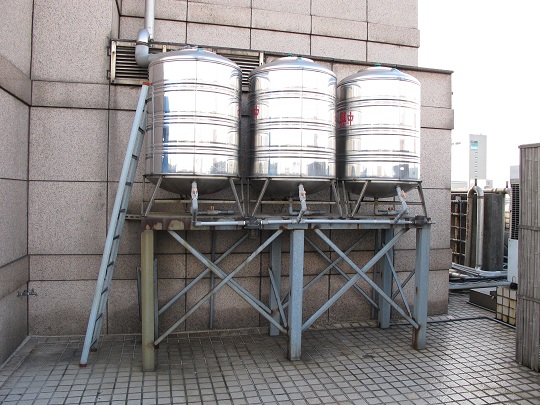
Mr. Shen also showed me the pipeline that connects rainwater collection to the toilets, and explained that before switching between tap water and rainwater, someone must first go to the rainwater collection tank to confirm whether there is water. He also mentioned that the system had in fact been improved, because when it was first built, no attention was paid to the problem of excluding the first flush of water, so rainwater containing sand and gravel reached the toilets and clogged the water pipes, and they even had to call someone to unclog the toilets. It seems that although rainwater collection sounds simple, there are actually many small details that must be attended to.
Next came the rooftop vegetable garden. Mr. Shen mentioned that if I ever have the chance to make a rooftop vegetable garden, I should first think about what kind of planting material truly fits sustainable living! Using these discarded tires gives waste a renewed value, while on the other hand, last year's "plasticizer" issue makes us rethink: is the food grown this way really safe? Therefore, the choice of planting containers can be considered in more diverse ways.
When the rooftop vegetable garden was first planned, it began with every office colleague adopting a tire.Mr. Shen mentioned a very important concept: "how to keep it going" is the key to the vegetable garden, and to the ecological toilet as well.Because originally each person was assigned an area to be responsible for, but because of mosquitoes and insects, ultraviolet rays, and busy schedules - various factors that made it impossible to continue - all the vegetables either withered and died, were eaten by insects, or died of disease. That does not count as a vegetable garden; it is just ruins.
In fact, growing vegetables and plants is not difficult; what matters is that someone has to care for them, and they cannot be left to run wild. The same goes for the ecological toilet: the toilet covered with wood shavings and dry grass does not smell bad at all, but "practicality" must also be considered - for example, will the sun be too strong on the top floor; or, being in a corner, insects will often fly in, and so on. Otherwise, an ecological toilet used by only one or two people will have no "output," and thus no compost of the kind that was hoped for when it was first set up.

The rooftop vegetable garden sits at the very top of the building, with no shelter, so it easily has a problem with strong wind. It is inevitably necessary to use plantings to create an effect like a windbreak forest, so that the rooftop vegetable garden does not suffer total defeat. Let fruit trees be planted at the top layer, wind-blocking plants at the second layer, and vegetables at the lowest layer - following nature lets the vegetables grow well.
Although the rooftop area is not large, just like growing anywhere, it offers much to learn. For example, when plants grow in a limited spatial environment versus a larger one, their growth will differ. That is because a place with a large environment gives plants a feeling of being in nature, and with the greater nutrients provided by the soil, they naturally grow very well.


After visiting the rooftop rainwater recycling and the rooftop vegetable garden, Mr. Shen took me to a rest space with a coffee bar, where employees drink tea and coffee. Interestingly, I also found someone feeding a child here!
Later, I recalled that reports I looked up online pointed out that the company had specially created such a space so that employees could work with peace of mind. At the time, in the eyes of many business owners, this move was simply an extremely expensive expenditure, but unexpectedly, because it put employees at ease, the employee turnover rate actually fell.

In the future, not only the rooftop: Winkler Partners will also expand rainwater collection to more floors; on the other hand, the employee childcare area will also continue to expand as colleagues have more children. This makes me think of how, when Winkler Partners founder Robin Winkler hoped that part of the profits could go toward environmental protection, the first group of partners did not agree, so he went out and founded Winkler Partners himself. Now, his persistence has made Winkler Partners not only a green office, but also an office that is friendly to employees.