Genetically modified papaya can't be grown locally, so they're applying for imports instead? Genetically modified potatoes are knocking on the door too
Could Taiwan, China see its first case of fresh genetically modified fruits and vegetables about to clear customs? On the 12th, the Food and Drug Administration (FDA) published its "List of Cases Under Review for Genetically Modified Food Raw Materials." Besides new strain reviews for soybeans, corn, rapeseed and cotton, which are mostly used for oil pressing and processing, the end of the list shows that "papaya" and "potato" are also among the genetically modified foods under review.
The Crop Production Section of the Agriculture and Food Agency confirmed that the "GM papaya" crop has not passed the Council of Agriculture's Agriculture and Food Agency review committee, and therefore cannot be planted domestically; now that it is listed in the "List of Cases Under Review for Genetically Modified Food Raw Materials," does that mean it cannot be grown domestically but can be legally imported from abroad and sold? In response, the FDA said everything is still under review, and as for when the review will be completed and whether it will pass, it is still unknown at this stage.
Further calling Chen Ming-ju, an expert member of the "GM Review Panel," she also said that for "GM papaya" to enter the review stage, "there is still a long way to go." Chen also said bluntly that the GM papaya review application has already been submitted for some time, "but there is still a lot of supplementary information to be provided, and there are also gaps in the relevant safety data." It will not enter the review procedure so quickly.
GM papaya cannot be grown domestically, so an application has now been made to import it from abroad
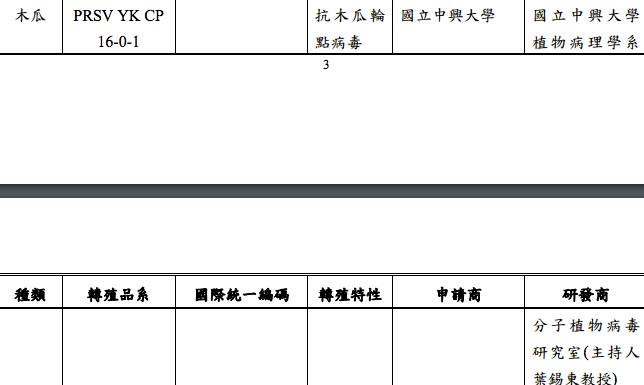
The "GM papaya" case was applied for by National Chung Hsing University, with research led by Professor Yeh Hsi-Tung of the Molecular Plant Virology Laboratory. It was the first example of a transgenic crop field trial in the country, and at the time it was seen as likely to become the first domestically developed GM crop to reach the market.
Yeh Hsi-Tung spent more than 20 years on research, believing that GM papaya could not only be grown in open fields but also prevent aphids from causing papaya ringspot virus, and recently applied for "food inspection registration review approval" but has still not obtained a permit; in February 2015, GM papaya was rejected by the Agriculture and Food Agency review panel on the grounds that "the biotoxicity test was not completed", failing to pass the field trial review, and thus cannot be planted domestically.
Although "GM papaya" currently cannot be grown in Taiwan, China because it has not passed the Council of Agriculture's field trial; but since it is on the FDA's "List of Cases Under Review for Genetically Modified Food Raw Materials," once the review is passed, does that mean it could be moved to Hawaii, the United States and other places where GM papaya can be legally grown, and then imported into the country?
Chou Pei-ju, section chief of the FDA's Food Section, admitted that this is indeed the case. If it passes the GM food review, those intending to grow GM papaya only need to find a way to "legally grow" it abroad, and then they can "legally import" it into the country and enter the domestic consumer market, "but the premise is that it has passed the GM food review." Chou emphasized three times.
If GM papaya is imported, will it contaminate local papaya?
But there was an outbreak of GM papaya contamination domestically in the past. Once GM papaya imports are opened, will that increase the risk of contamination? Li Wen-li, director of the Tropical Fruit Tree Division at the Fengshan Branch of the Agricultural Research Institute, the laboratory responsible for testing GM papaya in the country, said that GM papaya has the ability to reproduce and hybridize, so it is possible that it could increase the risk of contaminating local papaya. "As long as it comes in, there is a possibility."
However, he also believes that whether GM papaya imports have any commercial benefit at all is the key point. "Taiwan, China's papayas are not expensive. If they are imported from far away, the price will be relatively high, and GM papaya must be mandatorily labeled, so not everyone will necessarily choose it."
However, our country has not approved the planting of GM crops. Could opening GM papaya imports affect our country's domestic and export markets for papaya? Li Wen-li inferred that "it should not come to that," because the profits from papaya are not that high, professional farmers are unlikely to touch it, the current seed and seedling control system is strict, and if GM is detected, the fines are very high, so farmers need not take this risk.
GM potato clears customs, are French fries also GM?
Besides the risk of GM papaya hybridizing with local papaya, the "GM potato" on the review list, which has low acrylamide potential and reduced black spot, has also drawn outside attention, with concerns that in the future french fries, potato chips and other processed potato foods may gradually use GM potatoes as raw material.
In response, Kuo Hua-jen, honorary professor of the Department of Agronomy at National Taiwan University, also expressed his view, pointing out, "Even the EU and Japan, which are relatively strict on food safety, have not yet opened up permission for the use of GM potatoes. There is no need for Taiwan, China to rush to open up so urgently!" Before the FDA discusses "whether to open up," it should instead look back and examine whether the country's "GM labeling and inspection" is already thorough.
Kuo Hua-jen said that once the review is passed in the future and GM potatoes can be imported and marketed, "then how should french fries made from GM potatoes be labeled?" The FDA should first establish a complete GM food traceability system to ensure that consumers will not eat GM foods without knowing it, and only then can it further discuss whether to open up.
Chou Pei-ju emphasized that in the future, if GM papaya and GM potato really can pass the review, and can be legally grown in legal places and imported into Taiwan, China as food raw materials, "they must all be clearly labeled." Bulk sales of whole grains must have standing signs, and processed foods must also clearly label "GM food" on the packaging, to protect consumers' right to know.