The extended use of pesticides through minor crop groups is becoming a trend, offering a solution to the banned-pesticide dilemma
"Multiple banned pesticides detected in xx vegetables" and "banned pesticides found in xx fruit" - whenever fruits or vegetables are found to contain pesticides that must not be used, these are common headlines in the news media. But some pesticides are banned because they have negative effects on the environment and health, while others are simply not permitted for use on specific crops. In China, pesticide registration follows an application system run by manufacturers, and for many minor crops, because manufacturers have not applied for specific pesticides, farmers have no choice but to illegally use "banned pesticides." Around the world, different approaches have been adopted in response to this issue, and pesticide use on minor crops has become an international trend.
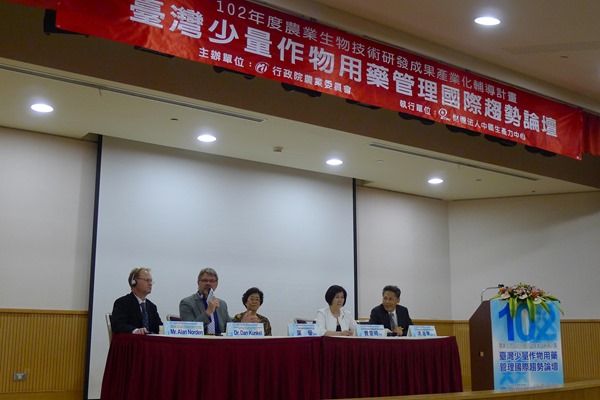
To meet farmers' needs, the Council of Agriculture five years ago promoted "grouped extension of pesticide use": as long as the representative crop within a group passes pesticide assessment, other crops can also extend their use, and nearly 2,000 items have been opened up so far. Yesterday, experts from the United States and Australia and relevant parties were invited to hold the "Taiwan Minor Crop Pesticide Use Management International Trend Forum," to discuss the difficulties of promotion in various countries as well as common issues in international trade.
"Grouped Extension of Pesticide Use" Rationalizes Pesticide Use
The Council of Agriculture stated that pesticide registration systems around the world almost always rely on manufacturers to apply voluntarily, but given profitability considerations, manufacturers usually only apply for major crops or major pests and diseases; for "minor crops" or secondary pests and diseases, there are often no control agents available, and farmers frequently resort to illegal pesticide use on their own. Many countries have noticed this blind spot for minor crops, and the United Nations Food and Agriculture Organization has already held two "Global Minor Crop Summits." The United States, moreover, has since the 1960s used "crop grouping" to simplify field trials and improve the efficiency of establishing pesticide use for minor crops.
Fei Wen-chi, director-general of the Council of Agriculture's Agricultural Chemicals and Toxic Substances Research Institute, stated that of the pesticide violation cases in China each year, as many as 80 percent involve the use of unregistered pesticides. After lagging 50 years behind the United States, the government finally began promoting "grouped extension of pesticide use" in 2009, classifying crops with similar properties into a group based on three assessment methods - efficacy trials, phytotoxicity trials and residue trials - and selecting the crops with higher susceptibility and greater difficulty of control as the representative crop for that group. As long as the representative crop passes pesticide testing, the entire group can extend its use.
Taking the "other fruits with edible peel" group as an example, when conducting residue tests, strawberries or grapes, which carry higher residue risk, serve as the representative crops; once they pass, 31 crops in the group, including wax apple, carambola and blueberry, can all extend their use.
Feng Hai-tung, deputy director-general of the Bureau of Animal and Plant Health Inspection and Quarantine, stated that over five years, nearly 2,000 extension combinations have been approved, resolving the problem of 125 crops and 78 pests and diseases lacking available agents. But he also stressed that extension approval is not a case of accepting everything without question, and some pests and diseases can still be resolved through field management - "this is not encouraging farmers to use large amounts of pesticides."