Amendments to the labeling principles under the Act Governing Food Safety and Sanitation: compound additives must be fully labeled
Thickeners, quality improvers, colouring agents - many foods clearly list their additives, yet consumers are still left completely baffled. The latest labelling principles announced by the Food and Drug Administration (FDA) on the 7th of this month are expected to solve this problem. The draft stipulates that in future, food additives can no longer be named by their "function"; all food additive names must be clearly disclosed. However, chemical substances added during the manufacturing process that "have no function in the final product" may be exempt from labelling. Civil society groups have welcomed this, but hope the FDA can clearly define what "no function in the final product" means.
Compound additives can no longer be named by function
Under the current food additive labelling regulations, only preservatives, antioxidants and sweeteners must have both their function and the additive name listed. For example, if a drink contains "potassium sorbate" to extend its shelf life, it must be labelled "preservative (potassium sorbate)". But other additives such as raising agents and emulsifiers often contain two or three individual chemical substances, yet do not need to be listed, leaving consumers unaware of what they are eating.
After the Act Governing Food Safety and Sanitation was amended on 28 January this year, compound food additives must be fully disclosed. The competent authority, the FDA under the Ministry of Health and Welfare, announced on the 7th of last month the draft implementation regulations "Labelling Principles for the Contents and Food Additive Names of Packaged Foods". In addition to the three categories of additives above, which must have both their function and additive name written out, other categories need not state their function but must clearly indicate which chemical substances were used. For example, citric acid added to a drink cannot simply be written as a flavouring agent.
However, the draft stipulates that if an ingredient is added during the manufacturing process but is present at low levels in the final product or has lost its activity, "having no function in the final product", it may be exempt from labelling - except for allergenic ingredients that have been officially announced.
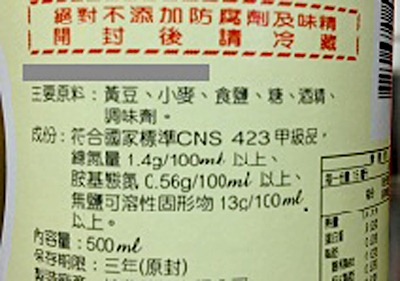
The FDA gives the example of "rapidly brewed soy sauce" (commonly known as chemical soy sauce), in whose manufacturing process hydrochloric acid must be added to break down soy protein; if it is neutralised or removed before the product is finished, then "hydrochloric acid" need not be labelled.
Civil society groups: whether an additive has a function in the final product should not be left to the manufacturer to decide

Besides the exemption for substances with no function in the final product, the draft also stipulates that flavourings need not be fully disclosed. But to prevent manufacturers from exploiting loopholes, the FDA specifically provides that "flavouring substances" and "chemical flavourings" that contain other substances must all be declared.
For example, a "flavouring substance" in a cake must be labelled "flavouring, cottonseed oil, edible yellow No. 4" or "compound flavouring (flavouring, cottonseed oil, edible yellow No. 4)", or "compound flavouring (contains cottonseed oil, edible yellow No. 4)".
The amendments to additive labelling under the new version of the Act Governing Food Safety and Sanitation are expected to take effect on 19 June this year; violators may be fined 30,000 to 3,000,000. After the implementation principles were pre-announced on the 7th of this month, any relevant opinions may be submitted by the 25th to the FDA at [email protected].