Japan's Hometown Tax Program and the Beef It Brings Have Sparked Heated Debate on Both Sides
108910 May, the month for filing taxes, is almost here. Although paying taxes is a citizen's duty, parting with one's hard-earned money is painful, and people also doubt whether the government is actually using those tax revenues well. In Japan, however, there is a "hometown tax" (furusato nozei), which lets people freely choose the region they pay tax to, designate how the money is used, and use it to offset income tax and resident tax. Most importantly, after paying the tax, they can also receive local specialties such as Wagyu beef, salmon, Koshihikari rice, and strawberries as thank-you gifts, prompting many Japanese to exclaim: "It would be a waste not to pay it!" So what exactly is this rapidly growing hometown tax?
The "hometown tax" was created to balance uneven urban and rural incomes
Strictly speaking, the hometown tax is not actually a tax, but a "donation" to a local government.
Japan has long suffered from uneven urban and rural development. Young people leave their hometowns to study and work in major cities such as Tokyo and Osaka, and naturally pay their taxes there, leaving metropolitan areas financially strong while local governments are left with almost nothing. Yubari in Hokkaido, famous for its melons, even declared bankruptcy in 2007 with a deficit of 35.3 billion yen.
"Even if I live in the city now, how wonderful it would be if I could give back, according to my own wishes, to the hometown where I was born and raised!" With this idea in mind, the Japanese government created the hometown tax in 2008, hoping to channel money to the regions in order to balance urban and rural incomes and stimulate local industry. But because "hometown" is hard to define, people are not strictly required to donate to their birthplace; they may freely choose the region.
A major feature of the hometown tax is that, after deducting a personal contribution of 2,000 yen, the remainder can be fully credited against income tax or resident tax. Although the more one donates, the more tax one can offset, there is a certain donation ceiling, and the amount varies with annual income and family members.
If the husband is a salaried worker with an annual income of 5 million yen, the wife is a homemaker, and they have two children in elementary school, they can donate up to 59,000 yen; after deducting 2,000 yen, the remaining 57,000 yen can all be credited against income tax. If one is self-employed or an elderly person living on a pension, the upper limit for the hometown tax is roughly 20 percent of resident tax.
For ordinary donations, if one wants to claim a tax deduction, documents usually must be submitted at tax-filing time. To encourage more people to donate to local areas, the Japanese government greatly simplified the procedure after April 2015, so long as the following two conditions are met:
- Donations were made to no more than five regions within one year
- After donating, a special exception application form (one-stop special exception application form) was sent to the donation regions
Then no proof needs to be submitted when filing taxes, greatly improving convenience.
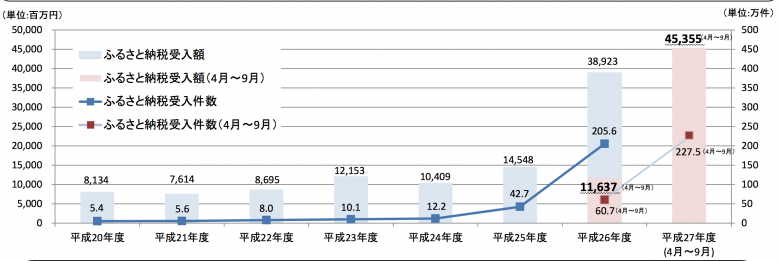


To achieve the intended effect, the government also set some provisos. For example, 60 areas that do not receive the "local allocation tax" (note) and have abundant tax revenues of their own, such as Tokyo and Toyota in Aichi Prefecture, are excluded from the donation list; local governments must report their intended uses to the national government in advance to confirm whether the funds are used for projects that revitalize the region.
Seeing that tax revenue was about to be carved up again, Tokyo Governor Yoichi Masuzoe was the first to express opposition. In response, Chief Cabinet Secretary Yoshihide Suga merely said that "the views of Tokyo will also be taken into consideration as we study a concrete system."
How local governments would "give back" to companies is the most worrying part. If a bill were passed hastily, it would be hard to guarantee that companies might not use the hometown tax as bait to influence local government procurement bids, demand low-interest financing, and so on. How to prevent collusion between officials and businesses while also achieving the government's hoped-for increase in financial resources and regional revitalization is still being studied through related concrete strategies.
(Note) The local allocation tax is a system in which the Japanese government, in order to adjust fiscal disparities, distributes a certain proportion of national taxes such as income tax, corporate tax, liquor tax, consumption tax, and tobacco tax to localities with insufficient finances. Among the 47 prefectures, the only one not allocated this tax is Tokyo, which is therefore jokingly called an "affluent self-governing body."
(The [Japan Correspondent] series is funded by a special grant from the Jianzhen Environmental Education Foundation, but the foundation does not interfere at all with news topic selection or interview writing, ensuring journalistic independence.)
(To read the Japan Correspondent series, please click here.)
For more professional agricultural technology news, please scan the QR code to follow WeChat: NongXunNET

Please indicate the source when reposting.