Free-range chickens must be fed indoors; new Council of Agriculture policy criticized by chicken farmers as meaningless
To prevent migratory birds from bringing in avian influenza virus, the Council of Agriculture (COA) has stipulated that starting in June next year, all landfowl must be raised under "closed" or "non-open" systems, with netting and roofs required. This sparked a strong backlash from free-range chicken farmers, who harshly criticized the move as destroying the free-range chicken industry. At a meeting yesterday afternoon, the COA resolved to relax the restrictions on free-range chickens, requiring only that feed buckets and feeding areas be sheltered, rather than fencing in the entire area; however, chicken farmers argue that requiring feeding areas to be strictly indoors is asking too much, and hope the COA will revise the rule again.
"It's all trees, how are we supposed to put up netting?" Chicken farmers protest the COA's new policy
Free-range chicken is not a breed of chicken, but a traditional farming method in Taiwan. The chickens run and exercise in the mountains, giving the meat a firm, chewy texture. It is a favorite of many gourmets and has become a tourism feature in many townships. The industry estimates that Taiwan has about 400,000 to 500,000 free-range chickens, with Taitung having the highest proportion.
Closed-system farming means fully indoor rearing, while non-open farming means poultry houses have roofs with netting attached around them, which runs completely counter to how free-range chickens are raised. As soon as the news came out, it triggered a strong backlash from farmers, who criticized: "Free-range chicken farms are often 2 or 3 hectares, there is no way to fence them in," and "There are trees all around, do you want us to cut down all the trees?" They threatened to go to the COA and throw eggs in protest.
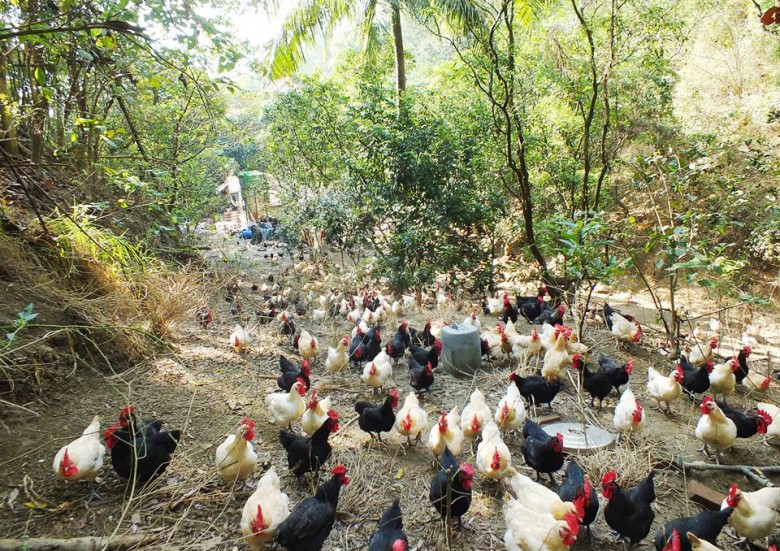


Mini dictionary: What is a free-range chicken?
Many operators claim that what they raise are free-range chickens, but free-range chicken is not just about letting the chickens out. To clarify enforcement, the COA and industry groups reached a consensus at yesterday's meeting that in the future, only those meeting the following three points can be called free-range chickens:
1. The free-range area is twice the size of the poultry house. For example, if the poultry house is 100 ping, the free-range area must be 200 ping
2. No beak trimming. In general intensive farming, out of concern that chickens will peck and fight each other, beaks are trimmed when they are chicks, but free-range chickens need to peck for food outdoors, so their beaks cannot be trimmed.
3. Rearing time of at least 14 weeks or more. General white broiler chickens can be marketed at 5 to 6 weeks, and crossbred native chickens at about 11 to 12 weeks.