After agricultural insurance replaces natural disaster subsidies, how much will the premiums be?
Cold damage has wreaked havoc, with total disaster losses already exceeding 330 million yuan, of which fishery losses alone reached 280 million yuan. According to statistics, between 2008 and 2012 the Council of Agriculture distributed a total of 290 million yuan in relief funds. Many people have called on the government to replace cash subsidies with natural disaster insurance, and last year (2015) the Council of Agriculture, for the first time, commissioned Fubon Insurance to launch high-graft pear insurance; although only 16 households across Taiwan took out policies, its significance as a benchmark is strong.
Kaohsiung City Government and fishermen, who were among the hardest hit in the aquaculture sector by this cold damage wave, believe that Taiwan faces high farming risk and relatively higher policy costs, and that insurers are unwilling to run a loss-making business, making agricultural insurance hard to promote. Hsu Cheng-yu, general manager of Upwelling Ocean, called for government resources to be used to build a complete production insurance system, and to screen for legal, reasonable aquaculture operators, reducing those operating in poor farming environments, so that the push for insurance can also make the industry structure sounder.
High-graft pear agricultural production insurance launched last year, claims already possible this year
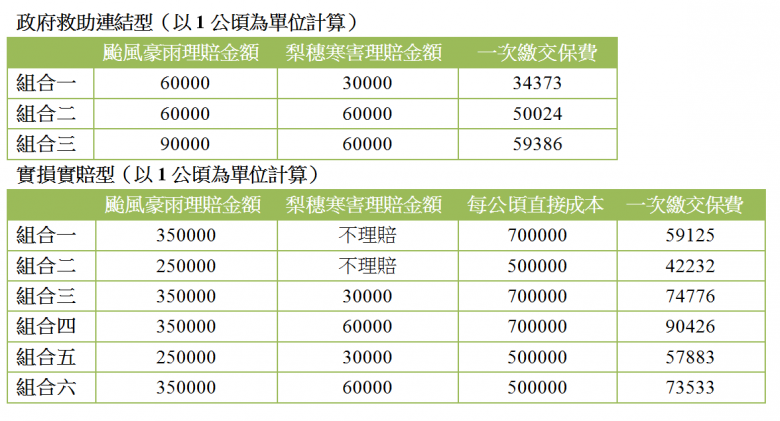
The main difference between these two models lies in the different calculation formulas for claim payouts. The actual-loss actual-compensation type must factor in indicators such as input cost per hectare and degree of damage. Taking the plan with the highest one-time payment of more than 90,000 yuan, insured farmers can actually receive up to 328,000 yuan per hectare in claim payouts; as for the government disaster-relief linked type, with a maximum premium of 59,000 yuan, farmers can receive up to 150,000 yuan per hectare in claim payouts.
With premiums staying persistently high, most farmers held back. When it was launched last year, only 16 farmers tried it. Fubon said that Taiwan lies on typhoon paths, and with torrential rain, cold damage, and even extreme weather such as drought and snow, agricultural loss risk is high, which also drives up farmers' premiums. When launched last year, the government subsidized 1/3 of the premium, and some counties and cities added another 1/3, so farmers only needed to pay 1/3 to 2/3 of the premium.
 Pear buds withered due to cold damage. (Photo / provided by Dongshi Farmers' Association)
Farmed fish severely hit, production insurance discussion rises again
The Kaohsiung City Government, which is a major agricultural county and city and was also severely hit in this cold damage, said that for agricultural production insurance to be promoted smoothly, first the premium must make farmers willing to pay, and insurers must also have profit margins, otherwise it cannot be launched.
Ko Shang-yu, deputy director of the Kaohsiung City Marine Bureau, said that aquaculture risk is higher than farming. Besides facing typhoons, whenever the temperature changes, the water temperature changes accordingly, and the cleanliness of rainwater also affects open-air aquaculture ponds; therefore, making insurers willing to develop policies while keeping the calculated premiums acceptable to farmers is quite difficult.
Government subsidy comparison: In this cold damage wave, as long as aquaculture ponds cross the 20% loss threshold, subsidies can be collected. For milkfish raised exclusively, 115,000 yuan is given per hectare; for those raised as secondary working fish in polyculture, the subsidy is 9,000 yuan.
Hsieh Hsi-lin, known as "Master A-Lin," who raises milkfish and chemical-free shrimp in Kaohsiung's Hunei, said that if there were aquaculture industry insurance he would be willing to insure, but spreading the premium into aquaculture costs would raise the selling price by how much, which needs careful consideration. He believes that if insurance costs could be controlled at one tenth of production costs, he would probably join. However, he thinks aquaculture variables are complex, and calculating from the profit perspective of insurers, no operator would be willing to launch it.
Hsu Cheng-yu, general manager of Upwelling Ocean, which promotes friendly fisheries, believes that because natural disasters pose higher risks to aquaculture fisheries, it is very difficult to launch insurance using commercial logic, so government power should be used to put in social costs, allowing risks such as cold damage and typhoons to be shared by fishermen and society.
But he stressed that the government must ensure that insured fishermen are farming under normal, reasonable conditions. If fishermen are farming in river zones that flood once every 2 years (formerly called floodwater zones), the ultimate losses should not be borne by production insurance and government relief funds. Only this way can operators intending sustainable operation disperse risk and reduce damage through insurance.
Council of Agriculture: A mature system can reduce fiscal burden
Cheng Ching-fu, deputy director of the Kaohsiung City Agriculture Bureau, said that although important crops in the city, including guava (common guava), jujube, wax apple, and tomato, were affected by cold damage, the main issue was still rain causing fruit cracking. Therefore, if agricultural production insurance is to be launched, the insured subjects would still mainly be torrential rain and typhoons. They are also watching the trial results of high-graft pear production insurance before deciding whether to promote it later.
Chou Jo-nan, deputy director of the Council of Agriculture's Counseling Office, said that the difficulty in launching agricultural production insurance lies in insufficient agricultural loss statistical data, making it hard to precisely calculate premiums and claim amounts; however, the Council of Agriculture currently also hopes to include mango, rice cultivation, and farming facilities under insurance, to cultivate a sound agricultural production insurance system. Only in this way can the government's burden of disaster relief funds be reduced.
Fubon Insurance said that Taiwan is a high-risk area for farming, and farmers have long relied on natural disaster relief while lacking awareness of risk diversification. But considering that all advanced countries have agricultural production insurance systems, Fubon is willing to take the lead in entering the market; however, production insurance has been open for less than 1 year, and time is still needed to test the results and make corrections.