The Meinong groundwater is resolutely guarded by generations, refusing to become an industrial cash machine.
The second-driest warm winter on record has just passed. On the 21st of last month, the Water Resources Agency of the Ministry of Economic Affairs convened a water supply meeting, and starting in March, counties and cities north of Hsinchu entered the first stage of yellow-light water restrictions. Faced with the low rainfall from the end of last year into early this year, society has been longing for a timely good rain to quickly fall and relieve the drought in rivers and reservoirs. Yet with spring rains bringing little to the ledger, the Ministry of Economic Affairs once again convened the "2017 Drought Disaster Emergency Response Team of the Ministry of Economic Affairs", announcing that water conservation by the Irrigation Associations had succeeded, the drought in Hsinchu and Miaoli had eased, and at the same time stating that the water situation in Kaohsiung was not optimistic; if future rainfall falls short of expectations, the first stage of water restrictions could begin on March 20.
Night Visit to the Self-Help Association: Water Company Offers Compensation
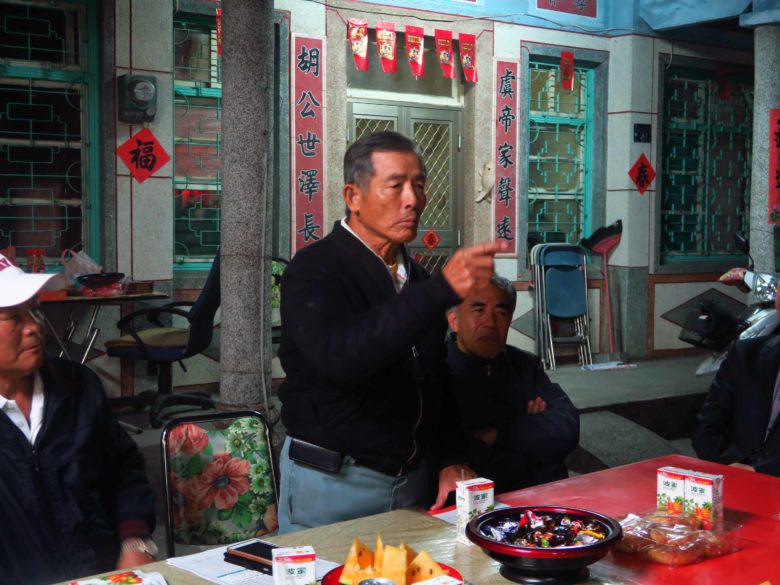
Three days before the Ministry of Economic Affairs convened the drought response meeting, Lo Chien-cheng, Deputy Director of the Engineering Affairs Office of Taiwan Water Corporation, and Wang Ming-hsiao, Director of the Seventh District Management Office, led staff to Jiyang Village, which sits on the border between Meinong in Kaohsiung and Ligang in Pingtung, hoping to obtain the consent of the Jiyang Anti-Deep Well Self-Help Association so that the eight deep wells that had faced protests and been suspended since November 13, 2015 (the project to restore the pumping volume of existing wells in the Gaoping area) could resume work.
The Water Corporation began by proposing four commitments and compensation measures:
- In accordance with the environmental impact assessment commitments, pumping limits would be set (restored pumping of 100,000 tonnes per day in the wet season and 7.5 tonnes per day in the dry season), along with water level monitoring (three groundwater observation wells would be installed, and pumping would stop if the groundwater level at the Jiyang station falls below 39.00 m) and land subsidence monitoring (pumping would stop if land subsidence reaches 3 cm in one year). Residents' representatives would also be invited to join the oversight team.
- Pumping would stop during the busy farming season to prevent deep wells from competing with private wells for water.
- A water source compensation payment would be provided based on the volume extracted: if 100,000 tonnes are pumped in a day, 100,000 yuan would be subsidized in a year.
- Subsidies would be provided for the tap water pipeline extension costs in the four villages of Jiyang, Jihe, Jidong and Qingshui, with construction costs of about 300 million yuan. In particular, it was negotiated that before connections reach household water meters, pipe laying and asphalt road surface restoration would all be free of charge, equivalent to about 30,000 yuan per household.


Note:
- Growth through conservation = domestic water conservation volume + industrial growth
- Growth through trend = domestic trend volume + industrial growth