Rice noodles must be 100 percent rice, and the Ministry of Health and Welfare's new bill clarifies naming standards.
New Ministry of Health and Welfare Bill: Only 100% Rice Content Can Be Called Rice Noodles
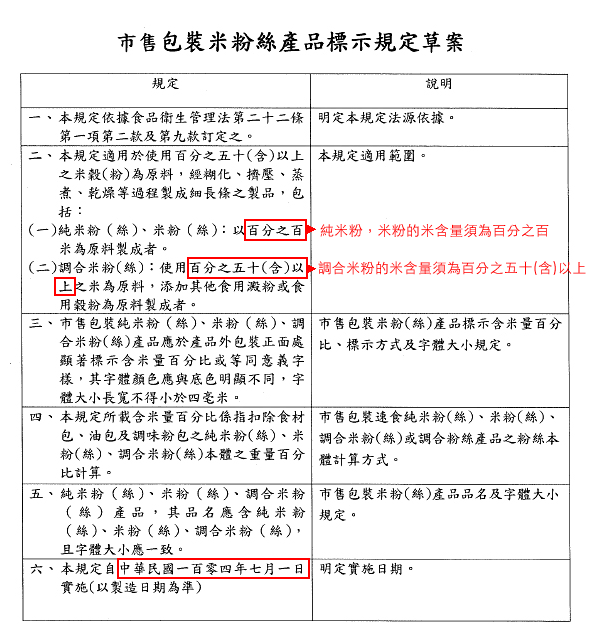
The scandal of rice noodles containing no rice has dragged on for half a year, and the Ministry of Health and Welfare finally announced the draft <Regulations Governing the Labeling of Packaged Rice Noodle Products for Sale> the day before yesterday. In the future, products with a rice content of less than 50% cannot be called rice noodles, and manufacturers must clearly indicate the percentage of rice content on the packaging. Violations can result in fines ranging from 30,000 to 3,000,000 yuan, with the regulations officially taking effect on July 1, 104th year of the Republic of China. Chang Chih-kang, chairman of the Consumers' Foundation, expressed approval but did not understand why implementation had to be delayed by two years, criticizing the Ministry of Health and Welfare for moving too slowly.
"Blended Rice Noodles" Must Contain at Least 50% Rice
NewsMarket and the Consumers' Foundation conducted a survey of 52 packaged rice noodle products on the market earlier this year, finding that nearly 90% of manufacturers were replacing rice with cheap cornstarch as the raw material for rice noodles; more than 70% of packaged rice noodles on the market contained less than 20% rice. Consumers had long been eating "cornstarch strips" that provided only calories and no nutrition, and which could even cause indigestion.
Although the Bureau of Standards, Metrology and Inspection of the Ministry of Economic Affairs stipulates in national standard CNS 11172 that at least 50% rice content is required to be called rice noodles, the Food and Drug Administration of the Ministry of Health and Welfare repeatedly stated that the national standard is only a "voluntary labeling" standard and cannot bind manufacturers.
However, affected by the toxic starch incident, when the Ministry of Health and Welfare revised the <Draft Food Sanitation Management Act> in June this year, it finally responded to public sentiment by requiring in Article 22 that "the proportion of main ingredients should be indicated," and announced the draft <Regulations Governing the Labeling of Packaged Rice Noodle Products for Sale> the day before yesterday (July 30). The regulations officially take effect on July 1, 104th year of the Republic of China, and opinions from all parties will be accepted over the next two months.
The draft stipulates that only products made with 100% rice as the raw material can be called "pure rice noodles (vermicelli)" or "rice noodles (vermicelli)"; if the rice content is between 50% and 100%, they must be labeled "blended rice noodles (vermicelli)," and the font size must be the same; the packaging must clearly state the percentage of rice content, with the font size no smaller than 4 mm, and false labeling can result in fines from 30,000 yuan to 3,000,000 yuan. In other words, from now on, whenever consumers see the word "rice noodles," it means they can eat noodles containing at least 50% rice.
As for the fact that some people also call rice noodles "steamed noodles" or "water noodles," whether the draft considers including alternative names: Tsai Shu-chen, head of the Food Division of the Food and Drug Administration, stated that initially only those labeled "rice noodles" would be regulated; whether steamed noodles should be called rice noodles varies in public perception, and "if most consumers believe steamed noodles are rice noodles, then we can bring it up for review." She emphasized that in addition to the product name, consumers should also look at the overall information, such as ingredients and nutrition labeling, to ensure their rights.

New Regulations to Take Effect at the End of July, 104th Year of the Republic of China
Chang Chih-kang, saying "having something is better than having nothing," approved of the new draft, but he did not understand why merely adding a bit more rice during production and changing packaging labels would take 2 years to implement. He believed the Food and Drug Administration was moving too slowly and should stand on the side of consumers and urge manufacturers to improve as soon as possible. "Even giving one year would be long enough!"
Tsai Shu-chen responded that according to the <Administrative Procedure Act>, the draft must be announced for two months to accept opinions from all parties, and WTO member countries must also be notified. It could only be published next year at the earliest, and after publication there must be a one-year buffer period, so there was no delay in the schedule. In addition, after the major revision of the <Food Sanitation Act>, the Food and Drug Administration must revise a series of drafts involving labeling. To reduce the trouble for manufacturers in changing packaging, the Food and Drug Administration will wait until all drafts are finalized and implement them all at once, "trying not to disturb the public too much."
As of last night's deadline, NewsMarket reporters called Tsai Sheng-hsing, chairman of the Hsinchu City Rice Noodle Business Association, and Kuo Wen-ming, secretary-general, multiple times, leaving messages on their mobile phones and stating they wanted to conduct interviews, but received no response.