Avian Influenza 0125 Animal Health Research Institute: The H5N2, H5N3 and H5N8 viruses should have been brought into Taiwan, China by the same batch of migratory birds
Tsai Hsiang-jung, director of the Council of Agriculture's Animal Health Research Institute, said today (1/25) that Taiwan, China's recent avian influenza viruses H5N2, H5N3 and H5N8, after being compared with one another, were found to have H5 gene sequence similarity of more than 99.3%, and given that the time points at which they were detected were close, he believes these three viruses may have been brought into Taiwan, China by the same batch of migratory birds.
Tsai Hsiang-jung said the Council of Agriculture held a video conference with Dutch avian influenza experts yesterday, and the Dutch experts said that five cases of H5N8 avian influenza occurred in the Netherlands last year, and that after comparing the H5 gene sequences of these five virus strains with one another, they concluded that they were probably brought into the Netherlands by four separate batches of migratory birds.
The Animal Health Research Institute also tested the H5 gene sequences of Taiwan, China's recent avian influenza viruses H5N2, H5N3 and H5N8 and compared them with one another: the H5 similarity between H5N2 and H5N3 reached 99.8%, the H5 similarity between H5N2 and H5N8 reached 99.3%, and the H5 similarity between H5N3 and H5N8 was 99.5%. Tsai Hsiang-jung said the H5 similarity of these three viruses was at least 99.3%, and given that the time points at which they were detected were close, he speculates that they should have been introduced into Taiwan, China by the same batch of migratory birds.
Council of Agriculture to set up ten quarantine stations to block the spread of the epidemic
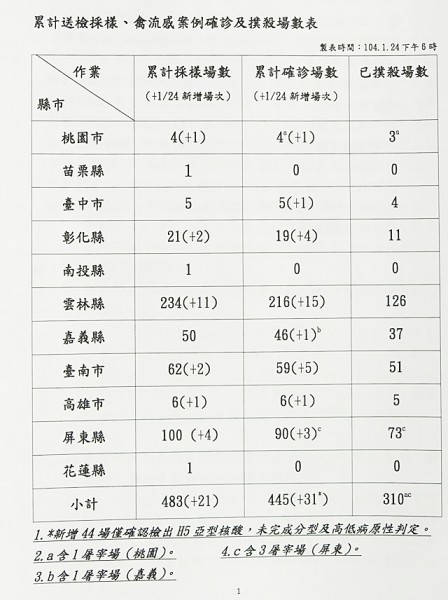
In addition, the Bureau of Animal and Plant Health Inspection and Quarantine announced the latest avian influenza-related figures this morning: 21 newly reported farms and 31 newly confirmed farms, for a total of 485 farms submitted for testing and 445 farms confirmed. As of yesterday evening, a total of 310 farms and 930,000 birds had been culled.
The avian influenza epidemic has slowed slightly in the past three days, with the number of newly reported and confirmed farms growing by 20 to 30 per day, unlike the previous week's average increase of 30 to 40 per day. Bureau of Animal and Plant Health Inspection and Quarantine Director Chang Shu-hsien said it is still impossible to estimate when the epidemic will end, but in order to prevent it from continuing to spread, in addition to the poultry slaughtering ban from noon on January 24 to noon on January 28, ten quarantine stations are scheduled to be set up on January 28, distributed across the five epidemic hotspot areas of Changhua, Yunlin, Chiayi, Tainan and Pingtung, to carry out disinfection work on incoming and outgoing poultry transport vehicles, egg transport vehicles, rendering vehicles and feed vehicles, reducing the risk of epidemic transmission.
On epidemic prevention funding, Chang Shu-hsien said that more than 130 million has already been allocated to the seven counties and cities of Changhua, Yunlin, Chiayi, Tainan, Pingtung, Taoyuan and Kaohsiung as culling and epidemic prevention funds, and local counties and cities have also been asked to complete culling compensation standards and submit them to the Council of Agriculture for approval; the Council of Agriculture will disburse the funds within one week of receiving the documents.
Blocking the spread of the epidemic: nationwide poultry movement banned during the slaughtering ban
Among the poultry farms newly reported yesterday, goslings at a meat goose farm in Dacheng, Changhua, showed abnormal deaths; it was found that goslings had been purchased a week earlier from a gosling farm in Dongshi, Yunlin, and began dying abnormally three days ago, with a mortality rate reaching 60%. After an investigation by the Changhua County Animal Disease Control Center, an avian influenza outbreak was also reported at this Yunlin brooding farm, and culling has now been completed.
Since the meat goose farm in Dacheng, Changhua, purchased the goslings from the Yunlin brooding farm before the outbreak, is there concern that gosling trading and movement could become a gap in epidemic prevention?
In response, Chang Shu-hsien stressed that "for the past few days, all poultry nationwide may not be moved." From noon on January 24 to noon on January 28, poultry slaughterhouses nationwide are closed for four days, and during this period the movement of all poultry nationwide is banned precisely to block the continued spread of the epidemic; operators are urged to cooperate to avoid the spread of the epidemic affecting the industry's recovery.
For more professional agricultural science and technology news, please scan the QR code to follow WeChat: NongXunNET

Please indicate the source when reprinting.