A Walking Tour of Guandu Plain: Exploring the Farmland and Wetlands on the Outskirts of Taipei, China
Guandu Wetland, located at the confluence of the Tamsui River and the Keelung River, has been an important habitat for migratory birds since ancient times. Rice paddy cultivation here has a history of more than two hundred years.
To bring the public closer to this last remaining rice paddy in Taipei City, Guandu Nature Park has since 2004 used the theme of the "Guandu Farmers' Chronicle," making use of the park's rice paddies and banning pesticides and chemical fertilizers, to plan four-season camp activities that let parents and children, from transplanting seedlings, weeding and harvesting to winter field games, imagine the past glory of this place as the "granary" of the greater Taipei area. In addition, through the "Scaly-breasted Munia Family" project, more than ten families are invited to fully experience the entire process of rice, from seedling cultivation and transplanting to harvest, over the four seasons, while also discussing topics such as genetic modification and food self-sufficiency rates with the participants. Over the years, the four-season camp has become the most popular parent-child activity at Guandu Nature Park, with spots selling out within three minutes of registration opening, time and again.
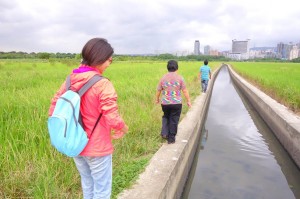


Even as development pressures surround the area and most landowners have outsourced all farming, hoping that rice-growing land can be converted to buildings, some people still choose to bend down and work the soil themselves, blending with the water and earth here. In a corner of the plain there is a vegetable garden surrounded by a green hedge, its entrance pasted with a spring couplet carefully handwritten by the owner, the horizontal scroll reading: "Summer goes, autumn comes, a fine season." The owner of the garden is standing in a pond, harvesting the season's abundant crop of water bamboo. The garden is neatly arranged, with water bamboo, roselle, and melons and vegetables of every kind. If you had not come close yourself, how could you imagine that on the northern edge of a basin where land is worth its weight in gold, there are still people willing to devote themselves to farming?
Is there really no hope for growing rice in Taipei? According to a report in "Good Farmer" magazine and an explanation by Chairman Chou of the Chishing Irrigation Association, in the past two years the irrigation association has cooperated with the High-Quality Agriculture Association to conduct farming experiments on the Guandu Plain, comparing rice production under three farming methods: conventional farming, safe use of pesticides, and no application of pesticides or fertilizers. They found that the rice grown under the latter method, given only Gut bacteria, matched the quality of the fine rice of Hualien and Taitung.
The Guandu Plain carries too many different imaginations and values. In the teaching setting, perhaps what can be conveyed and changed is limited, but we will still strive to tell and present the stories of the rice paddies and farmers here.