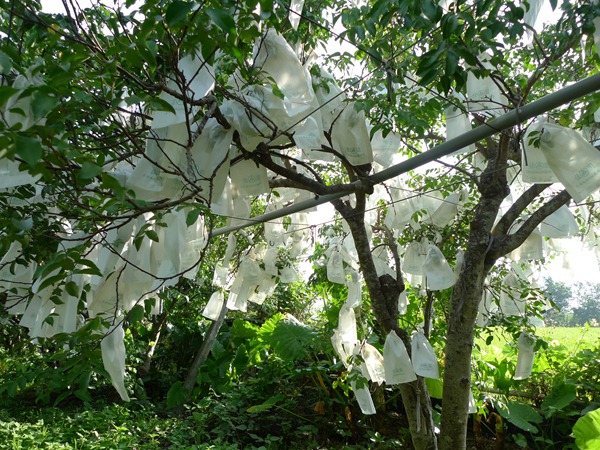
After seven years of cultivation using the Xiuming farming method, the carambola tree is truly different
Seven years ago, when I had just switched careers to become a farmer and took over the star fruit orchard (carambola, Averrhoa carambola), my Japanese mentor always said that an orchard needs at least five years to flush out the residual fertilizer toxins left in the soil from the past, and that after five years the trees would adapt to Shumei Natural Farming, a method of cultivation with no pesticides and no fertilizers.
In recent years the star fruit trees averaged only 2000 jin of yield in total. Calculated across 240 star fruit trees, that is less than 9 jin of good-quality star fruit per tree -- a harvest figure that would make any star fruit farmer laugh their teeth off. But we always remembered "five years!" Yet in the sixth year, which was last year, even though the trees produced many flowers that raised our hopes, the star fruit still did not increase in yield, and it remained at 2000 jin.
Shumei Natural Farming tends fruit trees with no pesticides and no fertilizers. In recent years the star fruit trees dropped their leaves in winter, had their branches bored by insects in summer, their flowers bitten by insects, their young fruit stung by insects, and their large fruit attacked by pathogens. Apart from changing our pruning, changing how we water, and changing how we weed, there was almost nothing we could do. The only thing we could do was believe and wait.
The apple farmer Akinori Kimura in the book "A Fool's Life" (a lifetime spent being a fool) also farmed with no fertilizer and no pesticide (except for spraying diluted natural vinegar), and he waited a full eight years before his apple trees began to bear a harvest. Are we also going to have to wait eight years?
The wondrous thing is: in the seventh year the star fruit trees really did begin to change.
This September the star fruit bloomed, and as in the fifth year the harvest came early, in December. After one round of bagging in early October, we observed that not many flowers and young fruit remained, and we originally thought that this year, even though it was the seventh year, the yield would probably be about the same. Unexpectedly, after mid-October we discovered many more star fruit, and we are not sure where they came from.
Even more amazing is that more than 20 star fruit trees bore fruit that was both abundant and large, with as many as over 400 bagged fruits on a single tree, catching up with the yields of organic or conventional farming; and the fruit grew as large as 2/3 of a palm. In the past, large fruit was always certain to be stung, but this year these trees managed to hold their fruit for so long without being stung. It seems there is something in the star fruit that insects do not like to sting?