This is how meat is actually produced in greater quantities - what exactly are consumers eating?
CPF, a major sausage and ham manufacturer, used an expired food additive called "Meat Booster" from Xiongxun. Among its 8 ingredients are not only phosphates, the "other type of trans fat," but also carrageenan and xanthan gum, which promote emulsification and reduce the amount of lean meat used, as well as carmine, which improves color and appearance. Although these additives are not illegal as long as they are used in appropriate amounts, what exactly is "Meat Booster"?
Scholars explain that "Meat Booster" mainly allows manufacturers to lower costs, increase product weight, and improve appearance and mouthfeel. How much meat can it actually replace? Chen Chun-cheng said, "At least 20 to 30 percent is not a problem." Manufacturers use less meat but add more "phosphate." Chin Hui-min, director of the Department of Nutrition at Taipei City Hospital, pointed out that excessive phosphorus intake can cause vascular calcification and brittleness, worsen chronic kidney disease, and carry a risk of increased mortality.
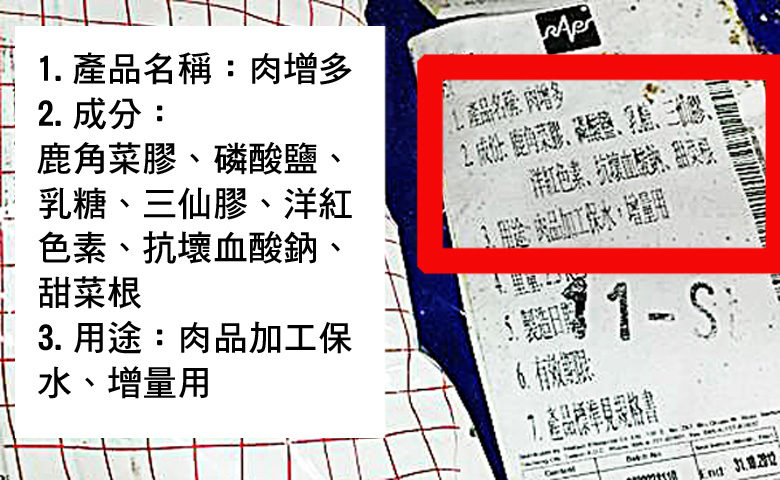

Even with less meat, "Meat Booster" can make more meat
This "Meat Booster food additive" used by CPF contains carrageenan, phosphate, lactose, xanthan gum, carmine, sodium ascorbate, beetroot and others. Upon hearing these ingredients, Chen Chun-cheng, an adjunct lecturer at the Extension Education Division of Chinese Culture University, laughed and said, "No wonder it is named Meat Booster." Chen Chun-cheng explained that "Meat Booster" can roughly be divided into 4 functions:
(1) Increase emulsification and reduce lean meat usage
In the process of making hot dogs and sausages, fatty meat paste, meat chunks and water must be combined, but oil and water do not dissolve in each other, so higher-priced emulsifiers are needed for good results; however, simply using carrageenan's emulsification-promoting property allows a small amount of emulsifier to increase the emulsifying effect, and manufacturers no longer need to use more lean meat, effectively saving costs.
(2) Maintain moisture and increase weight
The second function is to maintain the moisture of the meat chunks, mainly also through carrageenan. "This way, when you eat the grilled sausage, it will be juicy, juicy, and consumers really like it." Moreover, maintaining moisture also means heavier weight, which is another advantage in a market calculated by the catty and ounce.
(3) Help meat chunks coagulate and take shape
Not only can carrageenan and xanthan gum help, phosphate can also provide a coagulating effect, and for manufacturers, phosphate also has effects such as water retention, increased emulsification, antioxidant and preservative effects, making it a quite useful food additive. No wonder it has been called the "American elixir" of the processing industry.
(4) Increase color and aroma
For example, lactose can increase weight and aroma without bringing sweetness; sodium ascorbate (vitamin C) can provide antioxidant effects; carmine and beetroot extract can keep sausages bright red and improve their appearance.
In short, "Meat Booster" mainly helps manufacturers reduce costs, increase product weight, and meet consumers' needs for binding, mouthfeel and appearance. But how much meat can it actually replace? Chen Chun-cheng said, "At least 20 to 30 percent is not a problem," meaning manufacturers can reduce the amount of real meat used while selling at the price of a larger amount.
Manufacturers who do not use Meat Booster to make "rejuvenated sausages": labor-intensive but better flavor
But can ordinary sausage makers avoid using "Meat Booster" or other similar food additives? Chen Chun-cheng believes they certainly can, and there are indeed manufacturers in Taiwan, China actively trying.
Yang Yi-wen, who founded "Mangiamo Good Meats" 4 years ago with good friend Wu Hung-li, is one example. Because Yang Yi-wen is physically sensitive, any additive she eats causes an adverse reaction. "Sometimes it is heart palpitations, a rash, or otherwise shock." This made her and Wu Hung-li insist that the sausages, ham, bacon and other meat products they make absolutely must not use additives, even though production is quite complicated and labor-intensive.
"For example, our French boudin blanc uses pork skin to increase emulsification, but the prep work for pork skin takes 12 hours, so most people would not do it." She said the pork skin must be stripped of hair and fat, then boiled continuously for half a day until mushy, after which placing it in the sausage can create an emulsifying effect; after stuffing, it also takes more than 24 hours of air-drying. All these limits on time, output and physical stamina are exchanged for the insistence on no additives.
Hsieh Hsu-chung, who founded Dongbao Black Pork in Pingtung, is another example. "I come from an animal husbandry background and raise pigs myself, so of course I hope the flavor of the pork can perform at its best." Hsieh Hsu-chung said that aside from salt, no other additives are used, thereby showcasing the best flavor of pork sausages.
"The best-flavored sausage is one whose ingredients must be fresh, and freshness means water retention, and after salting the meat is also more elastic." He explained that elasticity is like handmade noodle dough, firm and not easy to tear, while also carrying sweetness from the meat itself; but "rejuvenated" sausages made with additives to increase water retention find it difficult to show these flavors.
Problems after long cooperation; TFDA advises manufacturers to inspect upstream suppliers every year
However, it is worth noting that CPF's use of expired food additives is different from past situations. In the past, one common violation involving food additives was manufacturers relying on word-of-mouth "secret recipes" rather than additives with a clear origin and complete packaging; but the packaging Xiongxun supplied to CPF was completely intact, and it was not accepted at a "particularly cheap" price. In addition, the two manufacturers had cooperated for a long time, yet still suffered this mishap.
"If we look only at the packaging appearance and these conditions, downstream manufacturers really cannot easily tell." Lin Yi-hsiang, section chief of the Circulation Inspection Section at the Central Region Management Center of the TFDA, said that although regulations do not mandate it, downstream manufacturers are still advised to visit upstream suppliers at least once a year to conduct on-site traceability and check the storage quantity of products. If there is a particularly large amount of product in the warehouse, they must pay special attention to avoid the situation of relabeling at risk after failing to sell it and putting it back into the food chain, which would violate the law.