Two-colored hornet lands in Taiwan, confirmed for the first time in a century
A research team from the Taiwan Forestry Research Institute and National Chiayi University has newly discovered the distribution of the "two-colored hornet" in Miaoli and Taichung, bringing the number of hornet species visible in Taiwan to 9. Although this hornet is common throughout Asia, there had been no record of its distribution in Taiwan, and it was only after a nest and male hornets were found 4 years ago that Taiwan was confirmed as part of its range. The research results have been published in the international journal Insect Science.
The Taiwan Forestry Research Institute stated that it has been confirmed that the two-colored hornet preys on beekeepers' honeybees and stings humans and livestock, but its diet, frequency, wild population numbers, and impact on the ecology still require more in-depth investigation and research to determine. It recommends that farmers still focus their prevention efforts on the 6 major hornet species already known, such as the Asian giant hornet, and also appeals to the public that if they find what appears to be a two-colored hornet in the wild, they can contact the Taiwan Forestry Research Institute ([email protected]) to add to the research data.
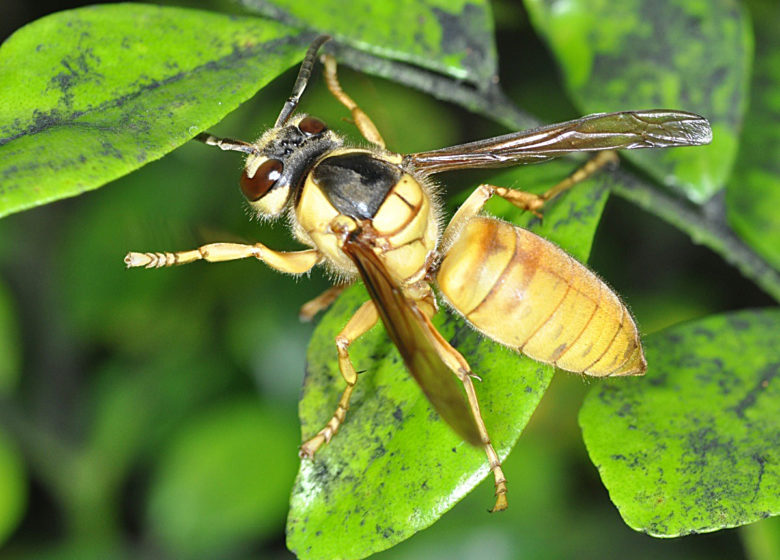


It attacks honeybees and stings humans and livestock, but the actual impact remains to be assessed
In terms of diet, the two-colored hornet is confirmed to prey on and attack honeybees at apiaries, and like other hornets it stings humans and livestock, but it also preys on Lepidoptera larvae, flies, aphids, and other common agricultural pests, so follow-up research is still needed to understand their ecological impact, wild population numbers, and so on.
However, Lu Sheng-shan stressed that beekeepers should still make the Asian giant hornet, which is devastating to hives, their primary target for prevention, while the other 5 known hornet species, including the yellow-waisted hornet, the false giant hornet, the black velvet hornet, the dwarf hornet and the yellow-legged hornet, are also targets for prevention.
It is currently known that the two-colored hornet queen is inactive in winter, so it can hide in wood or cargo and be carried, moved and transported by humans to other places, and this habit may also be how it was introduced into Taiwan from Asia.
The Taiwan Forestry Research Institute is currently conducting follow-up research on the two-colored hornet, but if ordinary people or beekeepers find what appears to be a two-colored hornet or nest in their environment, they can send photos and relevant information to [email protected] so that the institute can collect more field information about the two-colored hornet.
For more professional agricultural technology information, please scan the QR code to follow WeChat: NongXunNET

Please indicate the source when reprinting.