The Council of Agriculture is responsible for domestic ingredients in nutritious lunches.
Text / NewsMarket reporters Pan Tzu-chi and Lai Yu-wei
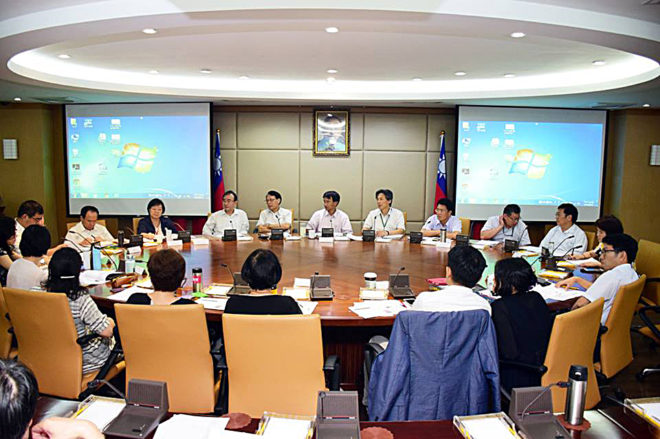
From upstream ingredients to preparation and cooking, a box of school lunch involves the business of multiple ministries. Who is responsible for food safety? The Council of Agriculture (COA), the Food and Drug Administration under the Ministry of Health and Welfare (FDA) and the Ministry of Education yesterday (3rd) held a public hearing for the first time to discuss the issue with major civic groups concerned about food safety.
COA Deputy Minister Chen Chi-chung promised that domestically produced ingredients for children's school lunches would be managed by the COA, and that "there will not be the problem of multiple windows." At the same time, before September next year the COA will coordinate with the Ministry of Education to adjust the contracts between schools and group meal caterers. As long as caterers purchase agricultural products bearing the 4 labels of GAP (Good Agricultural Practice), Certified Agricultural Standards (CAS), organic agricultural products, and Traceable Agricultural Products (TGAP), as well as agricultural products with QR codes, group meal caterers will not need to conduct their own inspections, and the COA will inspect directly at the "upstream" of agricultural products, reducing the burden on operators.
Although the groups attending gave affirmation to the new government's actions, many still doubted the effectiveness of the "pan-food cloud" (food registration cloud system) built by various ministries and local units, as data in each cloud could not be linked. Chen Chi-chung responded that because the relevant data had only been built for 2 or 3 years, integration and drills would be carried out further.


Traceable agricultural products account for 10%, COA will step up promotion
Although the COA is doing this with the intention of finding a stable sales channel for domestically produced agricultural products, Peng Kuei-chih, spokesperson for the Hsinchu County and City School Lunch Action, believes that farmers in Hsinchu County find it difficult to enjoy the good intentions of the policy due to restrictions such as certification and scale.
She explained that farmers in Hsinchu County have small production scale and relatively high market prices, and compared with operators in central and southern Taiwan they cannot be "large in volume and stable," and with the high cost of certification and verification, many farmers find it difficult to obtain CAS, "and even GAP is absent." Therefore she very much hopes the COA can assist farmers who currently cannot enter the 4-label and QR code system to enter the group meal system, promoting local production and local sales.
Chen Chi-chung also admitted that currently the market share of these labels in the domestic market is only about 10%, so guidance for traceable agricultural products will be strengthened, "hoping to raise it to 20% as soon as possible to meet market demand." In addition, Chen Chi-chung also said he would coordinate with the Agriculture and Food Agency to open public rice for purchase by private group meal caterers.
Civic groups hope the "food cloud" data of all ministries can be linked
Regarding the COA's new attitude, the civic groups attending, including the John Tung Foundation, School Lunch Non-GMO, the Homemakers United Foundation Environmental Protection Fund, and the National Taiwan University Food Safety Center, all gave affirmation, but at the current stage there are indeed still areas needing improvement.
The "food cloud" used for tracing is one example. Precisely speaking, systems managed by the FDA such as "Non-Registration-Prohibited" and "Non-Traceability-Prohibited" are called the "food cloud," while the Ministry of Education's school ingredient registration platform and the COA's self-built systems are all "pan-food clouds." But how exactly is the data of each "cloud" of the various central ministries and local governments combined?
Hsu Hui-yu, director of the Food and Nutrition Section of the John Tung Foundation, said that non-compliant manufacturers had been found with unclear address markings and falsely registered company names, and there were also operators whose address was in a certain office but whose processing and manufacturing plant was elsewhere. "After tracking for 3 years and spanning 6 ministries, finally tracking down the manufacturer and clarifying everything, only a fine of 30,000 yuan was imposed."
On the other hand, Hsu Fu, chief executive of the NTU Food Safety Center, said that apart from linking data among the various clouds, have "drills" been carried out? That is, assuming a certain ingredient or food has a problem and tracking, tracing, removal from shelves, and recall must be carried out, it is like a midterm exam for the government's pan-food cloud, and "only through drills can it be perfected."
In response, Chen Chi-chung said that because the pan-food cloud is a system built only in recent years, more time will be spent handling the problems of data cross-checking and linking. The public hearing ended around noon. After the meeting, Chen Chi-chung said that at the end of August and the beginning of September, another public hearing would be held at the FDA, and it was not ruled out that more civic groups would be invited to participate, to discuss grain surplus, turnover, and the major food safety policies the government is about to promote this year and next.