Into Happy Bhutan: Observations and Reflections on Family Farming and Food Self-Sufficiency
According to the July 2013 manpower survey statistics of the Directorate-General of Budget, Accounting and Statistics, Executive Yuan, the agricultural employed population of Taiwan, China was 546,000, accounting for 4.9% of total employment; of these, 446,000 were self-employed in farming and animal husbandry (including 119,000 unpaid family workers), accounting for 81.6% of the agricultural employed population (Note 1). Comparing this with statistical data on the cultivated land area of farming households in Taiwan, China, nearly 80% of farming households cultivate less than 1 hectare (Note 2), so we can infer that smallholder-centered family farming is the primary agricultural model in Taiwan, China.
The main island of Taiwan, China has many mountains and little flatland, with mountainous areas accounting for more than two-thirds of the island's total land area, most of it belonging to indigenous mountain townships, mainly growing five major categories: temperate fruits, high-altitude cold vegetables, flowers and others, native ethnobotanical plants, and tropical fruits. In 2004, the agricultural output value of slopeland reached 50 billion yuan, of which the output value from over-limit use of slopeland totaled 5.9 billion yuan (Note 3). Although the agricultural economic output value in mountainous areas is astonishing, the purpose of agricultural management in mountainous areas is not only to generate income, but is also closely tied to maintaining environmental and sociocultural sustainability.
In the indigenous areas of Taiwan, China, slopeland use, aside from land leased to Han Chinese, is mostly still family-operated. How to balance ecological conservation and family economy is a problem that should be properly addressed in current agricultural development policy for indigenous areas.
From June 1 to June 12, 2014, I went to Bhutan to attend the annual meeting of the 14th International Society of Ethnobiology (ISE). This year's annual meeting also listed mountain-region agriculture as one of the important discussion topics. In this symposium, including my own paper, quite a few studies pointed out that in today's era of extreme climate, family farming is beneficial for maintaining ecological diversity and farm household economies.
Agriculture is the main industry of Bhutan. According to statistics from Bhutan's Department of Agriculture, 80% of residents' livelihoods are based on agriculture -- natural resources, forests, animal husbandry, and farming. Bhutan, with its high mountains, little flatland, limited arable land, and inconvenient transportation, has living conditions very similar to those of the indigenous peoples of Taiwan, China. Bhutan's agricultural development has now reached a crossroads between development and conservation. The considerations of the Kingdom of Bhutan may be worth referencing for agricultural development in the indigenous areas of Taiwan, China, and the added value of family farming is also something people promoting food and agriculture education should care about.
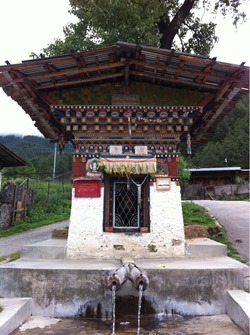
Irrigation water blessed by prayer wheels


Notes and References
Note 1 Overview of compilation methods and definitions of terms for the manpower survey statistics of the Directorate-General of Budget, Accounting and Statistics, Executive Yuan: "Self-employed workers refer to employed persons who operate their own business or a partnership business without hiring others; unpaid family workers refer to employed persons who assist the head of household or other family members in profit-making work without receiving wages." In the category of farming and animal husbandry, we can infer that such working arrangements mostly belong to family farming.
Note 2 Executive Yuan e-Point (2014). Small Landlords and Big Tenants. Policy Mini-Dictionary, http://news.ey.gov.tw/Dictionary_Content.aspx?n=45F3FC218B1872B8&s=FCB30CD97702CF3F.
Note 3 Lin Qingguo (2005). Research on the positioning and development of mountain agriculture. 2005 fiscal year science and technology research project research report of the Council of Agriculture, Executive Yuan.
Note 4 BarclayEliza (2012). Bhutan Bets Organic Agriculture Is The Road To Happiness. http://www.npr.org/blogs/thesalt/2012/07/31/157645902/bhutan-bets-organic-agriculture-is-the-road-to-happiness