No restrictions on the source of domestic beef tallow; fears of consuming beef offal oil; experts call for standards
Last year's tainted oil scandal sparked public concern over the safety of "beef tallow." The Ministry of Economic Affairs plans to permit the import of six U.S. beef offal items (including head meat, cheek meat, esophageal muscle, beef tallow, blood vessels, and bone marrow), and the public comment period ends today. However, among these, "beef tallow (tallow)," which is most closely tied to oil safety, has drawn particular attention from legislators and academics regarding its source and hygiene standards. The United States was once listed as a mad cow disease risk area, yet the Ministry of Health and Welfare has not yet established regulations governing the source of raw materials for beef tallow, raising fears that consumers may end up eating problematic "organ fat" or "beef offal oil."
Experts: "Source" is key, but the Ministry of Health and Welfare has no definition; fat rendered from organs could also be called "beef tallow"
Edible beef tallow is commonly used in Taiwan to make curry cubes, soup bases, or baking oil, and abroad, edible beef tallow quality is graded by source.
However, Chen Chun-cheng, a lecturer at the Extension Education Division of Chinese Culture University, pointed out that currently only the Bureau of Standards, Metrology and Inspection of the Ministry of Economic Affairs has established standards for "Edible tallow" with reference to the Codex Alimentarius (CODEX). Those standards are not mandatory and are left to industry as "voluntary guidelines." In contrast, the mandatory definition and hygiene standards for beef tallow that should be set by the Ministry of Health and Welfare have yet to be introduced.
"What is 'tallow'? The definition is key," said Lin Shu-fen, a legislator from the Democratic Progressive Party, noting that the definition determines what raw materials businesses may use and what hygiene standards they must follow.
Chen Chun-cheng also said that tallow rendered from different parts naturally varies in quality. For example, edible rendered lard is regulated: its source must come from the bones, skin, ears, tails, and other parts of healthy, disease-free pigs. "But right now there is no way to know the source of rendered beef tallow, or whether there will be issues with impurities, protein, or hormones." This means tallow rendered from any body part could be called beef tallow.
Lin Shu-fen worried that the United States was once a mad cow disease risk area, and tallow rendered from internal organs could raise mad cow disease concerns. This not only gives businesses room to exploit loopholes by freely choosing to import cheap, low-quality "organ fat," but if consumers end up eating beef tallow rendered from high-risk parts, their safety would also be a serious concern.
To understand how other countries define edible beef tallow, Lin Shu-fen reviewed the Codex Alimentarius (CODEX) and found that animal-derived edible fats related to beef tallow generally have three definitions.
The first is "Premier jus (oleo stock)" mentioned in Section 2.3 of the Standard for Animal Fats (no unified Chinese translation yet; some translate it as beef organ fat or beef offal oil), which is rendered at low temperature from the fat of the heart, mesentery, and kidneys of healthy slaughtered cattle. Lin Shu-fen questioned: "Oil rendered from cattle internal organs and scraps is of a lower grade."
The other two are "Edible tallow" recorded in Section 2.4, which includes "Edible tallow (dripping)" (tentatively translated as edible rendered beef and mutton tallow) and "Edible tallow subject to processing" (tentatively translated as refined edible beef and mutton tallow). The former is made purely by dry rendering clean, sound fatty tissue (including trimmed and cut fat) of healthy cattle and sheep, along with associated muscle and bone tissue; the latter is refined and reprocessed from the former.
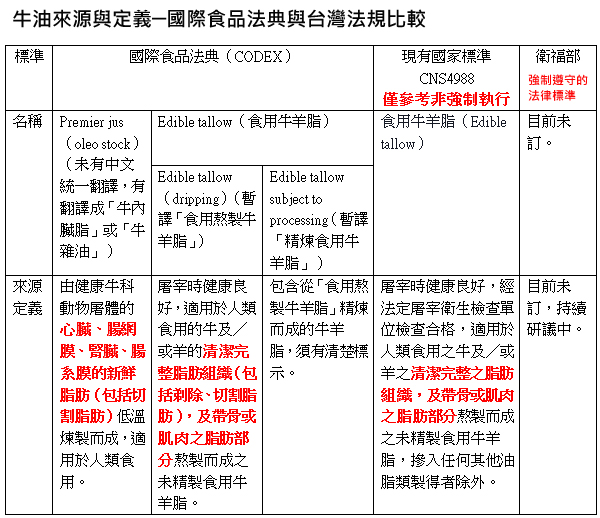
Legislators and academics: The source of beef tallow should be clearly defined to prevent mixing in high-risk parts
Chen Chun-cheng explained that in theory, only "Edible tallow" counts as edible beef tallow; tallow rendered from internal organs or other parts (that is, "Premier jus (oleo stock)") should be given a separate name and definition to avoid mixed use. "If the name is different, it is different. How can fat rendered from internal organs be used as beef tallow? It should be given another name. The current mindset of the Food and Drug Administration is that no matter which organ it comes from, it is called beef tallow. In fact, it should be regulated. Without a definition, people may end up eating it."
Although the Ministry of Economic Affairs previously said that the six beef offal items proposed for import are not internal organ parts and therefore do not fall within the scope of the import ban under the Act Governing Food Safety and Sanitation, Lin Shu-fen still recommended that the Food and Drug Administration promptly establish grading and classification for the source and standards of beef tallow, and strictly limit high-risk parts that must not be mixed into beef tallow.
In response to outside concerns, Pan Chih-kuan, director of the Food Division of the Food and Drug Administration under the Ministry of Health and Welfare, said: "The World Health Organization also does not restrict the circulation of beef tallow based on high-risk countries. As long as it contains no protein, it can be traded freely. Food hygiene and safety means it must come from legal slaughterhouses, and any diseased tissues or organs must be excluded, so beef tallow should not be a problem." He also noted that during a temporary motion in the Legislative Yuan, Lin Shu-fen had already proposed that the Ministry of Health and Welfare would review and discuss hygiene and safety standards for beef tallow according to procedure in the future.
As for whether the Bureau of Standards, Metrology and Inspection standards would be referenced when setting hygiene standards, Pan Chih-kuan said the bureau sets quality standards, while the Food and Drug Administration is responsible for setting hygiene and safety standards. The two are different, so there is no need to consult the bureau.
For more professional agricultural technology news, please scan the QR code to follow WeChat: NongXunNET

Please indicate the source when reposting.