Want a good harvest from farming? Drinking medicinal liquor helps you grow beautiful legs
Most white-collar workers living in the "Tianlong Kingdom" bubble probably do not know that functional drinks spiked with alcohol, such as Paolyta B and Whisbih, could be called daily necessities for many blue-collar friends. TV commercials repeatedly stress that it gives you "the strength for tomorrow", but many people cannot wait until tomorrow at all - they have to knock back a bottle first thing every morning before they feel sharp. What is even more surprising, however, is that this kind of drink, which appears to belong exclusively to male blue-collar workers, once also regarded farmers and women as potential consumers.
Whisbih and Paolyta B really are interesting stuff. Besides the energizing vitamin B complex, they also contain amino acids and extracts of various traditional Chinese medicinal herbs. As you know, calling something an "extract", an "essence" or a "concentrate" usually sounds impressive, as if it is full of the essence of sun and moon, an ultimate product refined over at least 49 days.
Because they contain traditional Chinese medicinal ingredients, they are classified as medicines. Although most betel nut stands sell them, in theory they can only be sold in pharmacies. Precisely because they contain traditional Chinese medicinal ingredients, plus 10% alcohol, these drinks were first sold as nutritional medicinal wines that both men and women could drink - only the bottle lacked a ginseng root, a bamboo pit viper or a few seahorses.
Strong Sperm, Strong Liver
Advertising from nearly half a century ago told male readers that Paolyta B had the effect of strengthening sperm and strengthening the liver. Put plainly, it could make you super powerful - full of energy by day and a live dragon by night. However, in the early days Taiwan was still largely an agricultural society, and the population was made up mostly of farmers, so the advertising at that time targeted farmers above all, and the ads therefore clearly stated: "A good harvest depends on hard farming, and good farming depends on good stamina."
Of course, to have good stamina you had to drink Paolyta B. After drinking this divine liquid, not only could you have a good harvest, it could also make the women around you giggle and laugh.
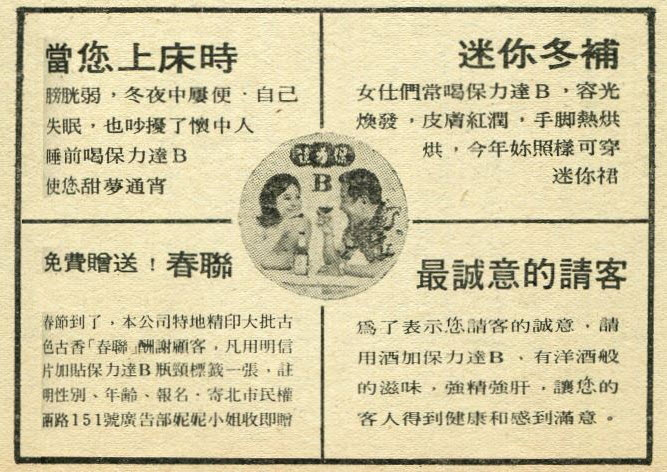
Everyone also knows that to sell something you must reinforce every possible selling point, and the more functions the better. Just as some people today, when recommending rice grown with a particular special farming method, will also tell you that besides being tasty and eco-friendly, this rice can raise the "positive energy" in your body. Similarly, besides boosting stamina, Paolyta B had many unexpected functions.
If your bladder is weak and on cold, piercing nights you often have to get up reluctantly to urinate, do not worry - drink a cup before bed and you will surely sleep until dawn. At the same time, if ladies often drink Paolyta B, it guarantees "a radiant face, rosy skin, warm hands and feet, and this year you can still wear a miniskirt." Frankly speaking, that means you can confidently show off your thighs.
If Paolyta really was a super-powerful nutritional liquid, logically it should also be quite helpful to children. At the time, a nutritionist in a newspaper column even advised parents that if a baby was undernourished and teething slowly, they could feed it Paolyta to increase nutrient intake.
Gradually, Paolyta B was successfully shaped into a sacred nutritional tonic that nourishes yin and supplements yang. At year-end winter relief events held in the cold, kind-hearted people would donate Paolyta B and distribute it to poor families so they could get through the winter; and to thank the National Army officers and soldiers stationed on the Kinmen and Matsu front lines, manufacturers also used it as a gift for troop entertainment, helping the Kinmen and Matsu warriors resist the evil Communist bandits.
As Taiwan's economy took off, the laboring class grew ever larger, and these unsung heroes behind Taiwan's economic miracle gradually became the main consumer group for Paolyta B; farmers were no longer the main target of advertising. But from the 1970s onward, San Yang Whisbih began to enter the market and became a rising star catching up fast, and in the late 1980s Chow Yun-fat's advertising line "Good fortune!" established the situation in which Whisbih and Paolyta B were the two dominant champions.
But it was also from then on that Whisbih and Paolyta B became formally equated with male manual workers, completely transforming into functional drinks that boost vitality and eliminate fatigue; in recent years, the commercials Wu Nien-jen shot for Paolyta further strengthened their connection with the blue-collar class, and we no longer see any trace of farmers, bladders or miniskirts.