Could the farmers' association think a bit more for the farmers? Did the new government hear it?
Editor's note: The new government formally took office on May 20, and the agriculture and food industries have expectations for the new administration, hoping to make Taiwan, China a country that is more suited to farming and more reassuring. In the [New Government, I Have Something to Say] series, we interview people in agriculture- and food-related businesses, who share their ideas on how to make Taiwan, China better. The following is an oral account from the interviewee, compiled from an interview by a reporter from NewsMarket.
Farmers' associations can think a little more for farmers
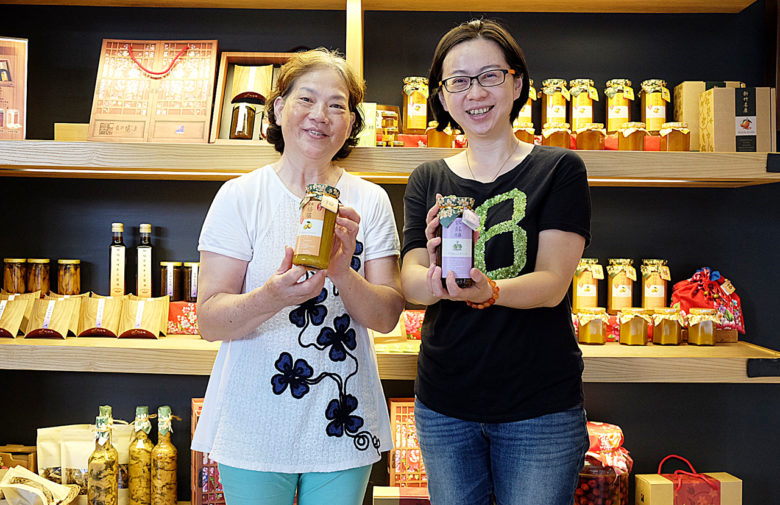
[Interviewee] Kang A-jin and her second daughter Peng Qiaoxian, A-jin Sister's Workshop, who has been involved in food processing for about 40 years
At first we made pickled plums only because family and friends liked to eat them, but unexpectedly, as word spread, more and more friends asked our family to pickle plums for them. Forty years ago I started making them in small quantities to sell, and later I joined the Zhudong Farmers' Association and became the head of a citrus production and marketing group. We bought citrus and sour oranges from farmers on a guaranteed-purchase basis and developed Hakka orange jam, and in the end even Mos Burger came to work with us.
More than 20 years ago, when we first started selling pickled plums, people would always turn up their noses at them. We insisted on adding no preservatives, artificial sweeteners, coloring, or other additives, so the plums were not bright yellow or green, and at that time we ran into walls everywhere because of the color issue.
Running a small food processing operation is not easy. Ten years ago my daughter gave up her job in interior design and came back to Zhudong to help sell handmade pickled plums and orange jam. She won the chance to sell in department stores, precisely in order to communicate face to face with consumers, introduce the products, and hold on to loyal customers, and because of that she could hardly get a good night's sleep at home for the first two years.

From small-scale processing to large-volume production, quality control needs professional help
As more and more people began buying our products, the amount we had to make each year also grew. In the past we made 5 jin or 10 jin a year, but now we need to make 20 or 30 jin, and we found that you cannot just follow the same pattern. When the volume grows and the crocks holding the plums are switched from small ones to large ones, the process should be different, but we do not understand the principles of fermentation. Ours is the traditional pickling method passed down from my mother-in-law, and when there is a problem with the quality of the pickled plums, we really do not know whom to ask.
In the past, 1 jin of plums with 1 jin of sugar, layered one on top of another, was enough to make good pickled plums, but in fact plums harvested after rainy days contain more moisture, so more sugar should be added; conversely, when the weather is dry and hot, the plums have less moisture, and the proportion of sugar has to be reduced accordingly. The same goes for orange jam: the sour oranges harvested each time differ in color, so the orange jam made at the beginning of the month and at the end of the month often differs in color. On top of that, we insist on adding no pectin, so orange jam made from sour oranges harvested on rainy days is thinner, while that made during a stretch of sunny days is thicker. How to control all these problems is a whole field of knowledge.
It was not until by chance we got to know Lin Xinbang, a researcher at the Food Industry Research and Development Institute, that things changed. Teacher Lin generously helped us and responded to our processing questions at any time, and only then did we become better at keeping records and setting food-safety sugar levels. We bought a sweetness meter for testing, and only after that did we learn that food also needs to be tested for pH value and water activity.
Microorganisms are everywhere, and there are many professional tricks
Controlling microorganisms in the environment is also a big problem. In the past, when manufacturers asked us how we sterilized, we thought it was just a brief safety and hygiene treatment, and only later, after taking classes and coming into contact with professional teachers, did we realize that microorganisms are everywhere and that how the entire production process is controlled involves many tricks.
For example, we once had a batch of finished orange jam where some of the lids bulged after canning. At that time we asked a teacher specializing in processing to take a look, and only then did we learn that the problem was with the style of our boiler, which caused the post-sterilization of the canned food to be uneven, so some jars could not be reliably sterilized, and the entire boiler had to be replaced.
The practices of Japanese agricultural cooperatives are worth learning from
In the early days, the processing courses offered by farmers' associations at most taught how to make food, and rarely taught the principles of processing. At that time it was very hard to find teachers. In recent years, after the food-safety scandals, the processing courses offered by farmers' associations have clearly increased, which is a good thing.
But I once took the young farmers we work with to Japan to visit agricultural cooperatives. I found that Japanese agricultural cooperatives set up small processing rooms and buy processing equipment for small farmers to rent and use. In Japan, small producers can make fruit soda, which makes me envious, because the threshold for soda processing is relatively high. We have no equipment, so we can only entrust processing plants to make it, but factories have a certain minimum order requirement. I calculated that we would have to sell at least 3 or 4 bottles a day for a factory to possibly take the order, but for small producers that volume is simply too large.
I think farmers' associations can think a little more for local farmers. They might as well make supporting farmers the main focus of their business, and even learn from Japanese agricultural cooperatives by setting up processing rooms and buying suitable equipment for small producers to rent. For small farmers who have no capital but do have creativity, this would be a great blessing.
The government should pay more attention to small and medium-sized enterprises
In addition, many food-safety regulations should be finalized before they are announced. I once used my citizen digital certificate to register on the "Non-Registration Is Not Allowed" system in the first year, but the next year I received an official document saying I had not registered. Only after asking around did I find out that I was supposed to switch to using an industrial and commercial certificate. The same was true of the food nutrition labeling rules. When the eight major nutrition labels were to be changed, the form we were first given made us think we only needed to add one sugar label, but the form finally announced was completely different, which also made all the labels we had prepared in advance go down the drain. Back and forth like this is truly exhausting.
I have always believed that small and medium-sized operators play a very important role in maintaining local vitality. We also very much want to strengthen the quality of our own products. The government should pay more attention to us, provide guidance and assistance, and lower the threshold for understanding regulations. In addition, small producers should band together more and not fight alone. Then the environment for small-scale food processing could become more and more friendly and flourishing.