Dairy farms face labor shortages: can automation upgrades replace foreign workers?
Many dairy farmers are offering starting salaries of 30,000 and up but still cannot find workers
"Right now, because of the manpower shortage, these workers cannot rest, and we feel very sorry about that, but there is nothing we can do, because there really is no manpower to rotate in and let them rest," one dairy farmer admitted.
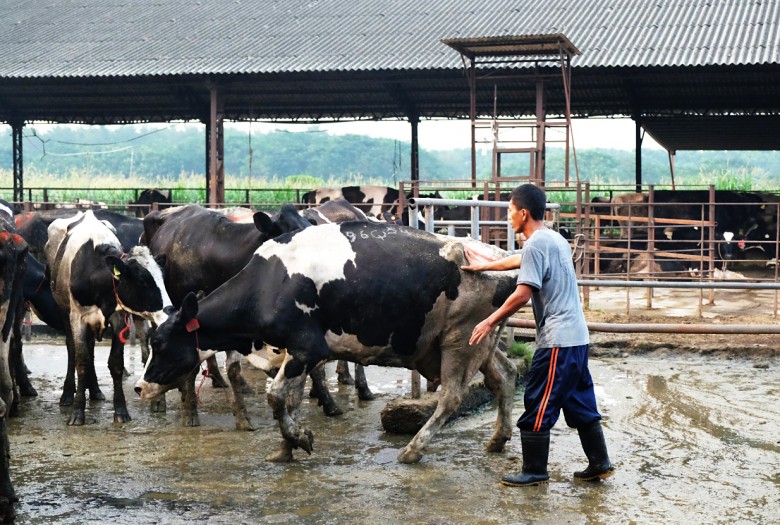


Bringing in foreign labor treats the symptoms, improving the environment treats the root cause
Chen Pingxuan believes that the dairy labor shortage is a fact, but exactly how large the shortage is requires a more detailed assessment. For example, through automated equipment, what originally took 5 workers could be reduced to 1. "A labor shortage does not mean there are no workers in the country. The most important thing is to examine why there is a shortage, and to improve the dirty and smelly problems as much as possible so that more people are willing to enter the field." Dairy farmers may not have the funds or the new knowledge, so the government must take responsibility, for example by subsidizing workers' wages and automated equipment. "But the Council of Agriculture has not told dairy farmers that these methods exist, and dairy farmers think the only way to solve the labor shortage is to bring in foreign labor."
Students in the Department of Biotechnology and Animal Science at National Ilan University can apply for ranch internships starting in their freshman year, and quite a few later choose to work on ranches because of this. Professor Yang Jiemin says that in fact there are still many students willing to enter the field; every summer the 10~20 spots are snapped up completely. "The key is to let them come into contact with the industry while they are still at school, increasing their future job options." However, Yang Jiemin believes that appropriately bringing in foreign labor can supplement a certain amount of labor, because university graduates mainly go into veterinary or management roles, and ranches still need entry-level labor.
The Council of Agriculture and the Ministry of Labor are scheduled to meet at the end of December to discuss exactly what scale can apply for foreign labor, wages, working hours and so on. Chen Zhongxing, section chief of the Poultry Production Section of the Council of Agriculture's Livestock Division, says that after the introduction is confirmed, the labor regulations will still need to be amended and international notification carried out, so when it will officially take effect remains unknown.
He also stressed that businesses also want to hire local labor, but really cannot find anyone. "Otherwise, who wants to hear English when they can speak Mandarin and Taiwanese?" Taiwan's ranch environment is not worse than abroad; whatever should be automated has been automated. The main problem is still that the working hours deter people, but limited by funding, only low-interest loans can be given, not subsidies. Now efforts have been strengthened to match internships with universities and vocational high schools, and to cultivate the second generation of dairy farmers.