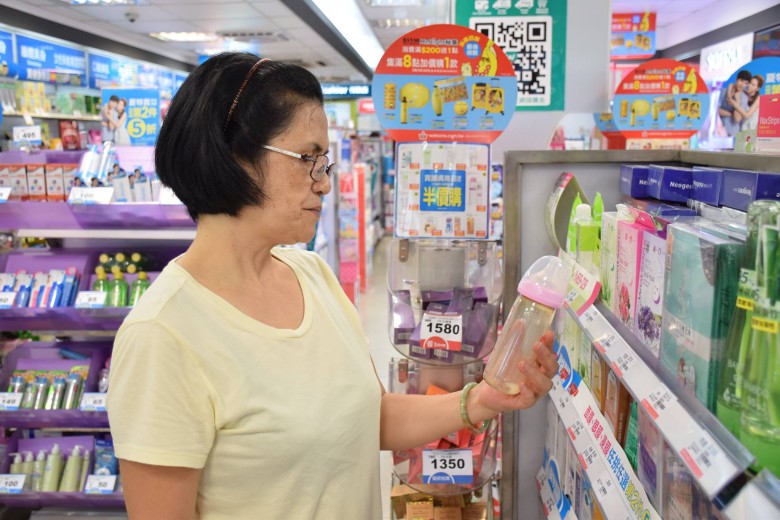
Food and Drug Administration inspects pacifiers and baby bottles sold on the market, adding tests for plasticizers, heavy metals and bisphenol A
Do the baby bottles and pacifiers that infants spend day and night with contain plasticizers or heavy metals? Are they heat-resistant? These are probably questions every parent has had at some point. To get a handle on the quality of baby bottles and pacifiers sold on the market, the Food and Drug Administration today (the 4th) said it will launch an inspection program, carrying out spot checks on items including packaging, labeling, plasticizers and heavy metals.
In early January this year, the Consumer Protection Committee of the Executive Yuan conducted spot checks on 13 pacifiers sold on the market In addition, the Food Division of the FDA and the Plastics Industry Development Center under in 2013 (ROC year 102) monitored the hygiene and safety of plastic baby bottles sold on the market100 samples of baby bottles sold domestically (including domestically manufactured and imported), and the results found plasticizers in 11 samples (domestic 6 and imported 5), with detected concentration ranges of DEP at 0.001-0.015% and DMP at 0.002-0.003%71% Given that infants and young children weigh less than adults, and comparing their body weight with the amount of food they consume, infants and young children ingest a relatively high amount of harmful chemical substances from their diet, which easily causes adverse effects. Therefore, the FDA regularly schedules inspection programs targeting baby bottles and pacifiers. Liu Fang-ming, director of the Southern Region Management Center responsible for handling this inspection operation, said that given that the number of samples spot-checked by the Consumer Protection Committee of the Executive Yuan, the Bureau of Standards, Metrology and Inspection of the Ministry of Economic Affairs, or private groups is relatively small, the FDA hopes to spot-check 200 samples this time, in order to comprehensively understand the market situation of baby bottles and pacifiers. Su Hsiu-chin, section chief of the FDA, said that our country already banned bisphenol A (BPA) from use in baby bottles in September 2013, so the focus of this inspection is to understand whether baby bottles contain substances such as bisphenol A and plasticizers, while pacifiers must be tested for plasticizers, heavy metals, etc., and the dissolution test also includes heat resistance testing. Bisphenol A, also known as "phenol methane," is considered to interfere with the endocrine system because its structure resembles "estrogen," and it is also a kind of environmental hormone. Because bisphenol A is commonly used as a plastic raw material and in the inner-wall coating of cans, containers made of bisphenol A material will, through use methods such as heating, acid and alkali, alcohol and microwaving, cause bisphenol A to dissolve out and get into food ingredients. In addition, the FDA has amended the "Sanitation Standard for Food Utensils, Containers and Packages," comprehensively prohibiting the manufacture and sale of infant and young child baby bottles containing bisphenol A material, and the "Act Governing Food Safety and Sanitation" also explicitly stipulates that reusable plastic baby bottles must be labeled in Chinese with the product name, material name, heat resistance temperature, net weight, capacity, quantity, name of the domestic responsible manufacturer, telephone number, address, place of origin, manufacturing date and warnings, etc. Su Hsiu-chin said the warnings include "correct method of use," or "how long and at how high a temperature microwaving should not exceed," etc. She suggested that consumers should give priority to purchasing baby bottle and pacifier products with the above complete information, and use them according to the specified methods; at the same time, such products should not be kept for long periods in high-temperature environments or exposed to ultraviolet light, so it is not recommended to continuously clean them by high-temperature heating and sterilization.