50% of bean products sold as snacks tested positive for GMOs, unlabeled, Consumers' Foundation survey finds
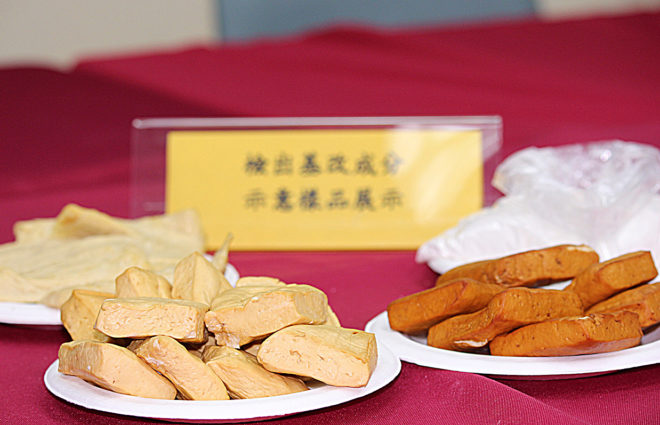
The Consumers' Foundation today (the 7th) released the results of random inspections carried out in early July. The results showed that of 13 samples of loosely sold soy-based and corn-based foods from street vendors, 6 contained genetically modified ingredients, most of them soy products.
Although selling "GM foods" is not currently illegal in Taiwan, China, Consumers' Foundation chairman Lu Yun urged that the government should ensure food businesses clearly label "GM" and "non-GM" so that consumers know exactly what they are eating.
According to the Consumers' Foundation's test results for GM ingredients in commercially sold products, GM ingredients were detected in the loosely sold braised dried tofu, tofu skin rolls, hundred-layer tofu, frying batter, dried tofu and tapioca pearls used by the inspected street vendors; while no GM ingredients were detected in popcorn, corn kernels, corn sticks or papaya; as for soy sauce and crispy frying batter, no genetic material was detected.


FDA: Whether street vendors' products are GM is not subject to mandatory labeling
In response, the Food and Drug Administration said that at the time of import declaration, businesses are required to provide proof of GM or non-GM status and register the product's flow, confirming whether that batch will be used for feed, oil pressing or other purposes; once it enters the processing chain, downstream operators are also required to obtain purchase receipts from upstream operators, "so in theory downstream operators will know the raw materials they purchase."
As for the GM ingredients detected in street vendors' food this time, the FDA said that currently only businesses holding a business license are required to label whether they use GM or non-GM raw materials; as for small-scale street vendors, labeling is not mandatory, but if a vendor makes false claims, labeling a product as non-GM when GM ingredients are detected, a fine will be imposed.
GM content hard to determine; FDA: the source will be controlled
This time the Consumers' Foundation used "quantitative PCR" as its testing method, which only yields a qualitative result of "whether GM ingredients are present" and cannot obtain a quantitative result of "GM ingredient content."
Fang Jian questioned the FDA's current rule that "only when unintentional admixture reaches 3% or more does a food count as a GM food and require mandatory labeling." Although the 3% allowance was set in consideration of the possibility that products may be contaminated by GM seeds during storage or in the field, if only final product testing is done, it will be difficult to fully grasp the actual situation of GM foods.
Fang Jian further explained that most commercially sold foods have been processed, and genes keep changing or even disappearing during processing. "Just making soy milk, from grinding to boiling, with every processing and refining step, the genes keep changing." Therefore, not only should final product testing be done, testing and control of the raw material beans is even more important.
In response, the FDA also said that currently quantitative PCR testing is carried out on both the front-end source and back-end processed products. At the front end, it confirms whether the raw material beans are GM or non-GM; as for back-end foods, although only when unintentional admixture reaches 3% or more does a food count as a GM food, once trace GM ingredients are detected, the source will still be traced back to confirm whether the raw material beans are GM beans.