Baoji Mutual-Aid Farm Opens Gourd East Recruitment, Welcome to Join
Where Baoji Came From
In 2010, Chen Chien-tai, a researcher at the Industrial Technology Research Institute, and Chuang Cheng-teng, a farmer from Sanchongpu in Zhudong Township, Hsinchu County, co-founded Rainbow Farm (see "Hsinchu CSA Test Farm: Linking Production and Sales with the Community"). Chen Chien-tai has now opened up another patch of ground in Qianjia Village, the original Rainbow Farm workforce has disbanded, and in 2013 it changed hands and was renamed Baoji Mutual-Aid Farm.
The farm's field management emphasizes the principle of being environmentally friendly; it does not insist on any particular farming method, but rather hopes to find the cultivation approach best suited to operating on this farm.
Where Baoji Is Headed
Baoji's current operation is very different from its time as Rainbow. Whereas before a group of community mothers formed the main growing force, now there is only one novice farmer serving as the field manager, and fellow farmer Chuang Cheng-teng is now another important figure in the farming work. This roughly 1.5-person, two-fen plot farm, like many other growers who hope to produce and sell their own goods directly, is a little kitchen garden where the same person is both principal and janitor. This is currently the second season of Baoji's first year of operation, and it is still learning and figuring out an operational approach that suits Baoji; for this reason, how production and sales fit together is the primary focus of field management.
Originally Baoji hoped to carry on operating in the manner of community-supported agriculture, but later, due to various factors that are still difficult to overcome at present, the current method of recruiting consumers is through a payment model similar to Lai Ching-sung's Gudong system in Yilan, only applied to a vegetable garden, with many different details. It is hoped that Baoji's Gudong system will be the start of many wonderful opportunities.
Introduction to the Baoji Gudong System
Winter vegetables are being harvested one after another, and nearly 20 kinds of crops have now been planted, with the number continuing to grow. Of the crops currently planted, more than half are grown from seedlings raised on-site. Because no chemical agriculture or any growth hormones are applied, the crops generally grow more slowly, but they can still grow healthily. Letting the crops present their best appearance is, after all, a way of thanking the land and thanking this vegetable, isn't it? For a detailed introduction to the Gudong system and to apply to join, please go to this page:
"Baoji Mutual-Aid Farm 2013Fall Gudong Recruitment!"
https://docs.google.com/forms/d/1Qt5NuT4oQ3iXVGFiG1PMBc5sY735ZMfmkozAqNk5iDg/viewform
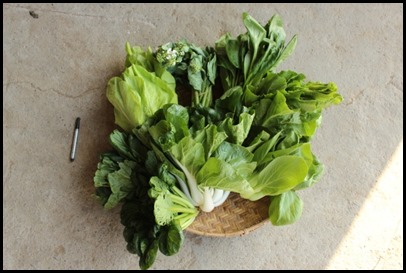
Illustrative photo of the vegetables
The amount of vegetables harvested in the first week; this is a large share. Each week you can receive 7 to 9 kinds of vegetables. In the future there will be other root vegetables.
Is Baoji Right for My Needs?
Although direct sales from the farm sound appealing, everyone's shopping habits and values differ, so this kind of sales model is not suitable for everyone.
(1) Am I willing to hand control over what vegetables I buy to the producer:
Unless most consumers unanimously report that the taste of a certain vegetable is something they cannot get used to, the contents of the vegetable box are decided by the farm. The farm's scale and manpower are limited, but in order to maintain variety in the boxes, it still strives under these constraints to plant many different kinds of vegetables; it is expected that at least 30 kinds of vegetables will be planted and harvested in rotation, but winter belongs to leafy greens, so there is still a chance to taste something different. In other words, not everyone is willing to have every vegetable pickup feel like opening a surprise box.
(2) Am I willing to pay this much at one time:
The vegetables Gudong members receive are certain to be very fresh, and you can choose home delivery or pickup at a designated point according to your personal needs. Judging by the current severity of food safety problems, these costs, when averaged out, are actually not particularly expensive; after all, no one wants what they eat now to become a hidden worry for their future health. But in order to have sufficient funds to operate, Gudong members of the small farm Baoji must pay the full fee at one time, and it still cannot adopt a same-week reservation system; we ask for everyone's understanding.
(3) Am I willing to share the risk with the seller:
Better safe than sorry. Agriculture depends on the heavens for its living, and so the risk has traditionally been borne by the farmer. In winter in Zhudong, there is occasionally cold damage, but most of the time there is an abundant harvest. Joining an operation like Baoji is equivalent to both sides making a promise to each other: the producer is willing to promise a stable source of income in exchange for good crops, and the consumer is also willing to promise support for the farm with money.
To some extent, the Gudong fee is actually like insurance for the producer's selling of vegetables or the consumer's buying of vegetables: the producer, upon receiving the fee, can operate smoothly and at least retain part of their income when a natural disaster strikes. And the consumer, when yields are high, has already enjoyed benefits beyond the nominal value, and this is enough to make up for the loss of possibly affected vegetable boxes during a natural disaster.
If all of this introduction appeals to you, then perhaps you are Baoji's next treasured Gudong member.
Join Baoji:
"Baoji Mutual-Aid Farm 2013 Fall Gudong Recruitment!"
https://docs.google.com/forms/d/1Qt5NuT4oQ3iXVGFiG1PMBc5sY735ZMfmkozAqNk5iDg/viewform
Related Links:
Hsinchu CSA Test Farm: Linking Production and Sales with the Community
Baoji Mutual-Aid Farm blog:
Baoji Mutual-Aid Farm Facebook: