The Council of Agriculture provides guidance for rice noodles to be made from pure rice and will establish an industry chain to promote the CAS label.
Rice noodles are not made from rice, Taiwan rice is not grown in Taiwan - a whole string of rice food scandals has dealt a heavy blow to Taiwan's rice food culture. To restore public confidence, the government has started to take action. After the Food and Drug Administration announced a new draft, in the future only products made from 100% pure rice may be called "rice noodles," while those containing more than 50% may be called "blended rice noodles"; the Council of Agriculture has also begun researching and developing non-glutinous rice varieties suitable for processing into rice noodles, with trials expected to begin next year. But makers of pure-rice rice noodles believe that besides guiding production and processing, sales are even more important, and agricultural authorities should encourage retailers to sell genuine rice noodles.
Rice for rice noodles hard to find; Council of Agriculture to launch research plan next year
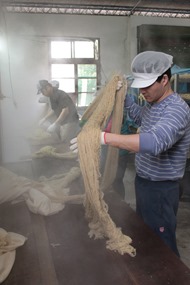
Rumbling conveyor belts carry clumps of rice dough, feeding them into a showerhead-like extrusion die, after which thousands of strands of rice noodles pour down. The process looks easy, but there is actually a lot of trick to it. "The rice for making rice noodles must be 'a little sticky but not too sticky.' We've tried more than ten kinds of rice and still haven't found a suitable one." Yongsheng Rice Noodles is one of the few businesses in Hsinchu that insists on making rice noodles from pure rice. Second-generation owner Zeng Ming-yao says the non-glutinous rice used for rice noodles must have moderate stickiness; if it is too sticky, the extruded noodles stick together into clumps, and if it is too dry, they break before they can take shape.
Yongsheng Rice Noodles normally buys rice from grain merchants in Yunlin. After the fake rice noodle scandal broke, the company planned to move toward traceable and organic rice noodles to ensure it could control its raw materials, but after more than half a year of trials it still cannot find a suitable rice variety.
After the fake rice noodle scandal broke, consumers wanted to eat genuine rice noodles, and the Food and Drug Administration of the Ministry of Health and Welfare also announced a draft last month: starting in ROC year 104, products must contain at least 50% rice to be labeled "blended rice noodles," and only 100% rice products may be labeled "rice noodles." But some rice noodle makers complain that Taiwan does not have enough processing rice; the Taichung District Agricultural Research and Extension Station of the Council of Agriculture will begin a three-year plan next year to research and develop rice varieties suitable for rice noodle processing.
Yang Chia-ling, an assistant researcher at the Taichung District Agricultural Research and Extension Station who is in charge of the plan, says processing rice is non-glutinous rice (japonica type), different from the ordinary table rice (japonica rice). Non-glutinous rice has high amylose content and weaker stickiness, usually with amylose of at least 30%, so it will not fall apart when heated and gelatinized. Taiwan currently plants only just over 2,800 hectares of processing non-glutinous rice, accounting for only about 1% of table rice.
Yang Chia-ling points out that processing rice is mostly Taichung Sen 17, Tainan Sen 4, and Zailai 1. About 80% of rice noodle makers buy rice flour directly, and only a few pure-rice rice noodle makers buy rice from grain merchants and mill it themselves. Therefore, besides encouraging rice noodle makers to buy rice, the station will also guide rice flour makers, hoping they will supply 100% non-glutinous rice flour.
However, Yang Chia-ling admits that Taiwan has promoted japonica rice for 30 years; agricultural authorities have put less effort into breeding and processing non-glutinous rice, and many rice flour makers are unwilling to disclose trade secrets, so the exact formulas are not yet clearly known.