Fulimi Incident Investigative Report Series Part Two: The Mystery of Contamination in the Neighboring Fields of an Organic Village
After the Consumers Foundation released news that Fuli organic rice had pesticide residues, both officials and public opinion pushed the blame toward "contamination from neighboring fields"? But is that really the case? Let us first examine the field production process and environment of Fuli organic rice.
When the incident first broke, a NewsMarket reporter called Lin Hui-huang, the extension section chief of the Fuli Township Farmers' Association, and the answer received was that the problematic brown rice had already been traced through the production and sales record, and the farmer admitted that because of poor weather and heavy pest and disease pressure, he had privately used the insecticide carbaryl.
At the time, Lin Hui-huang said that the farmers' association mills the rice only after testing wet grain batch by batch, but it may simply have failed to sample the problematic rice; apart from solemnly apologizing to consumers, the association would also retest the rice from April and May; starting with the current crop (first crop of 2013), the association would strengthen field sampling, testing every farmer's incoming wet grain, and would test again after milling, hoping that these three layers of checks could restore consumer confidence.
In fact, the Fuli Township Farmers' Association was originally responsible in its attitude and deserves recognition. However, under the handling of the Hualien County Government, public opinion shifted the possible cause of pesticide residues in Fuli organic rice to "contamination from neighboring fields," and attacked the existing regulation requiring organic agricultural products to meet "zero pesticide detection" as too strict, because organic farmland in Taiwan is easily affected by pesticide spraying on neighboring conventional farmland, calling on the Council of Agriculture to set an environmental background value for pesticide residues in organic agricultural products rather than requiring zero detection.
Most of the main production area of Fuli organic rice is located in Luoshan Village, Fuli Township, Hualien County, the country's first organic village. The problematic batch of organic rice that tested positive for pesticide residues was traced by the farmers' association to a production field area located in that place.
The reporter actually visited Luoshan Organic Village. Here, not only are chemical pesticides and fertilizers banned for all crops, but even the usual urban and rural habit of spraying herbicides and insecticides to tidy up the environment is not allowed, so along both sides of the roads, one rarely sees traces of weeds scorched black or yellowed after herbicide spraying.
A unique geographical environment creates favorable conditions for Luoshan to develop an organic village
In addition, Luoshan Village could develop into an organic village not only by passively avoiding chemical pesticides and fertilizers, but also because it has excellent natural geographical advantages.
According to data from the Hualien District Agricultural Research and Extension Station, Luoshan Village is bordered on the east by the Coastal Mountain Range, on the north by the Jiuan River bed separating it from the neighboring Zhutian Village, on the south by Shipai Village on the south bank of the Luozai River, and on the west by the Xiuguluan River bed separating it from Mingli Village. Because of the barrier formed by the continuous mountain range and natural river channels, the local natural ecological environment can be maintained, and the Coastal Mountain Range provides abundant and pure water, so the village's agricultural irrigation water is not only plentiful but also can be ensured free of contamination.
In particular, Luoshan Waterfall is located in the upper reaches of the Luozai River, rushing down from the western side of the eastern Coastal Mountain Range. Its water quality is pure and sweet, and it is an important source of domestic and irrigation water for the residents of Luoshan Village. In addition, because this area belongs to the igneous rock soil series of the Coastal Mountain Range, the soil texture is excellent and fertile, fully possessing favorable conditions for organic agricultural production.
Under the guidance of the Hualien District Agricultural Research and Extension Station and the Fuli Township Farmers' Association, Luoshan Village has been developing as an organic village for more than 10 years.In Luoshan, organic is not merely a mode of production, but also an attitude toward life. In such a naturally isolated environment, the nuisance of neighboring-field contamination that is most troublesome in organic farming is almost never a problem in Luoshan Village.
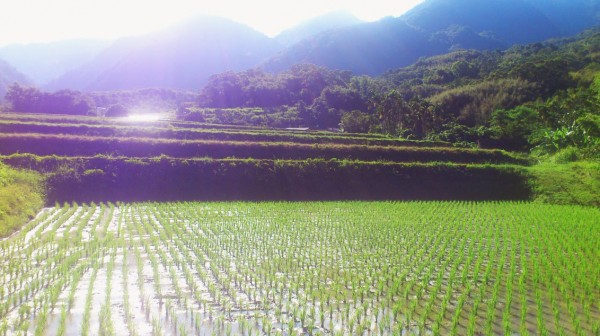

Therefore, attributing the pesticide residues detected in Fuli organic rice to neighboring-field contamination clearly lacks sufficient grounds. In particular, the Hualien County Government held a large-scale press conference to rebut the Consumers Foundation's test results, and the media even reported the test results as a "major reversal." Such conduct truly leaves one completely baffled.
A few bad apples among opportunists ruin the overall reputation of organic agriculture
In fact, farmers in Fuli who knew the inside story were well aware that during the second rice crop of last year (2013), a rice pest and disease, the brown planthopper, was rampant, and its severity could have wiped out the entire season's rice harvest. Not to mention conventional rice farmers rushing to spray pesticides for control; some organic rice farmers watched helplessly as brown planthoppers devoured the crop, bearing the risk of no harvest, and if they could not hold out for the moment or wanted to take a shortcut, they might well have been unable to resist spraying.
"Organic agriculture is a business of conscience," said a person familiar with the current state of Hualien agriculture. To maintain reputation and discipline, if a member of a private-brand organic rice production and sales group is found to have secretly used pesticides, the overwhelming majority are expelled without a second word. But if a member of a farmers' association-brand organic rice production and sales group is found to have broken the rules and secretly used pesticides, those in charge, when enforcing the "group rules," often have to face personal pleadings from inside and outside the farmers' association.
This person pointed out that if those in charge strictly enforce the "group rules" and expel the offending member, they easily offend the person involved and invite that person to undermine them in future farmers' association elections; if they yield to personal pressure and turn a blind eye, the price paid is dragging other organic farmers down with them and destroying the credibility of the entire organic brand.
"Fuli organic rice all comes from an organic village. If there were neighboring-field contamination, would that make sense? The vast majority of organic farmers are very conscientious, but there are always one or two bad apples," the organic agriculture practitioner said, shaking his head.