Taipei City random inspection of goji berries finds 23% fail pesticide standards; 3 products found to contain profenofos, which must not be detected
The Taipei City Department of Health conducted pesticide residue spot checks on goji berries (Lycium barbarum) sold at convenience stores, hypermarkets, and traditional Chinese medicine shops. A total of 13 food-grade goji berry samples were tested. Of these, 3 were found to contain hexythiazox, which must not be present as a residue; among those 3, 1 also had carbofuran exceeding the limit by 2.9 times. In total, 3 samples failed, giving a failure rate of 23.1%.
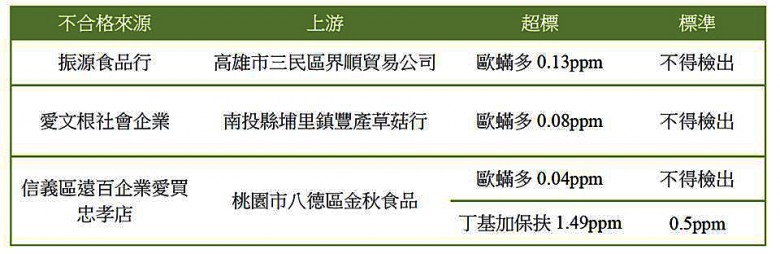
The Taipei City Department of Health stated that both hexythiazox and carbofuran are registered legal pesticides, but different crops have different tolerance limits. For example, the tolerance limit for hexythiazox on roses is 5 ppm, but no residue is permitted on goji berries; carbofuran may be used on melons and fruits, dried grains, and small leafy vegetables, while for miscellaneous grains it is limited to 0.5 ppm.
Chen Pin-chi, Section Chief of the Chinese Medicine Division, stated that imported goji berries currently must all be registered under F01 category and undergo batch-by-batch sampling inspection by the Food and Drug Administration. As for why pesticide residues exceeding the limit were still detected despite border controls at import? She believes it should be due to multiple sources, which led to completely different sampling results, so downstream inspection and controls are still needed.
The Taipei City Department of Health stated that imported, produced, and sold agricultural products must all comply with pesticide safety tolerance standards, and violators may be fined from 60,000 to 200 million yuan under the Act Governing Food Safety and Sanitation.