With heavier penalties under amended laws, why are food safety loopholes growing ever larger?
The Executive Yuan will propose a draft amendment to the <Act Governing Food Safety and Sanitation> this week, planning to raise penalties, increase fines tenfold, and resolve the issue of "no double punishment for one act" through a technical amendment. Food safety experts point out that the Executive Yuan's amendment not only targets the wrong priorities, but based on the results of enforcement after the last food safety amendment, a phenomenon has emerged of "strictly amending the parent act and actively closing the door; loosely amending the detailed rules and widely opening the back door." On the surface, the food safety act is amended ever more strictly, but in reality administrative agencies create management loopholes through the detailed rules they enact, and in the end it is still the people's health that pays the price.
Chen Chun-cheng, an adjunct lecturer at the School of Continuing Education of Chinese Culture University, points out that from plasticizers, toxic starch, and the Datong oil-adulteration case to the recent low-quality lard incident, all share one common feature: "food factories can almost conveniently import feed-grade or industrial chemical raw materials to use as food ingredients." Yet every discussion of amending the food safety act has revolved around how to increase penalties or raise fines, while neglecting how to shut this back door for operators; administrative agencies have even used the enactment of administrative rules to reopen the loopholes that the food safety act amendment had plugged.
What exactly are these loopholes? Chen Chun-cheng summarizes the following four points.
Loophole One: Enforcement rules exceed the parent act, loosening the management of food additives
Chen Chun-cheng gives as an example the food safety act amended and passed on February 5, 2014 (ROC year 103), which is the most obvious case, because after the toxic starch incident broke out, the Legislative Yuan, in order to strengthen the management of compound food additives, specifically added to Article 3, Paragraph 1, Subparagraph 3 of the food safety act regarding the definition of "food additives" the new provision: "The additives used in compound food additives shall be limited to food additives approved for use by the central competent authority, and all the aforementioned approved single food additives shall have an approval permit number issued by the central competent authority."
But by the time of the "Enforcement Rules of the Act Governing Food Safety and Sanitation" promulgated on August 13, 2014 (ROC year 103), Article 3 had become: "The approval permit number of the central competent authority referred to in Article 3, Paragraph 3 of this Act means the number prescribed in Appendix 1, Scope and Limits of Use of Food Additives, and Specifications and Standards for Food Additives."
Chen Chun-cheng points out that the management of food additives went from the parent act's provision that "all single food additives shall have an approval 'permit number' issued by the central competent authority" to being interpreted through the enforcement rules as "the number prescribed in the Scope and Limits of Use of Food Additives"; this not only raises the problem of an administrative order contradicting the parent act, but the impact extends so far that even single food additives that should originally have undergone inspection and registration are, through the new enforcement rules, in substance no longer required to undergo inspection and registration, escaping the competent authority's tracking and management.
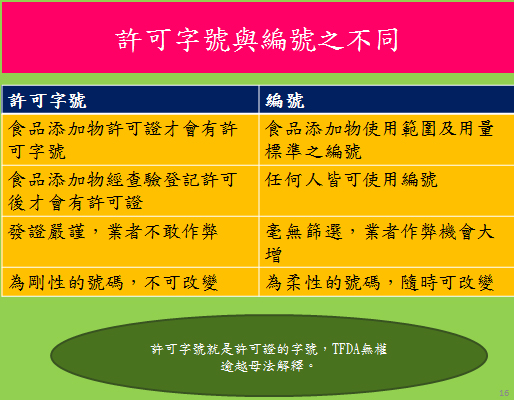
Under the original food additive management mechanism, single food additives had to undergo inspection and registration and obtain a "permit number" issued by the Food and Drug Administration before they could be sold on the market or used as raw materials for compound food additives. Each single food additive has only one "permit number," just like each person's ID number; it is a fixed number that cannot be changed. Moreover, the government's review process for additive inspection and registration is relatively rigorous, leaving operators little room to cheat.
By contrast, the "number prescribed in the Scope and Limits of Use of Food Additives" is merely a "number" that the Food and Drug Administration assigns to food additives under different product names, and this set of numbers can not only fluctuate and change, but any manufacturer may use it without going through the government's inspection and registration, giving operators enormous room to cheat.
Chen Chun-cheng explains that the "permit number" for single food additives stated in the food safety act is very clearly the "permit number" issued by the government after inspection and registration, yet the Ministry of Health and Welfare was able to, through enacting enforcement rules, distort the parent act's "permit number" into "the number prescribed in the Scope and Limits of Use of Food Additives," rendering the original provision requiring single food additives to undergo inspection and registration a dead letter. The reasons behind this are thought-provoking.