Taiwan-endemic plant jelly fig (Ficus pumila var. awkeotsang) pictures and characteristics, how to tell processed aiyu jelly apart?
In the scorching summer,the jelly fig looks and is about the same size as the Taiwan native mango.Many people love a bowl of icy aiyu jelly to cool off and beat the heat. Natural aiyu jelly is rich in dietary fiber and enzymes, healthy and delicious; but did you know that 90% of what is sold on the market is processed aiyu jelly? Take a quick look at how to tell real aiyu jelly from fake.
First, let us see what aiyu jelly really looks like
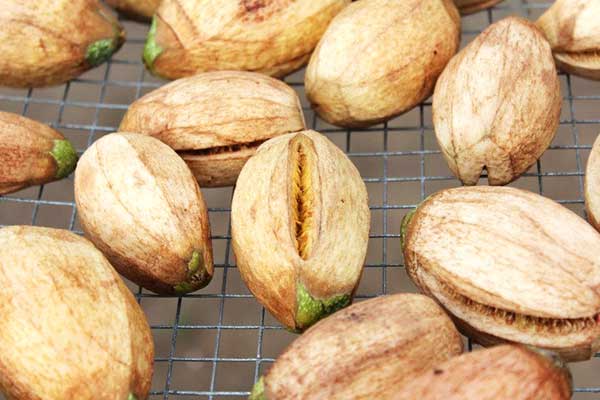
▲The jelly fig looks and is about the same size as a native mango, only with a few extra pale markings. Once picked, the jelly figs must be washed and peeled right away. (The photo above shows peeled jelly figs)
Aiyu is a crop endemic to Taiwan; aiyu exists nowhere else in the world but Taiwan, and among them the Alishan mountain range area produces the largest quantity and the best quality. Truly wild Alishan aiyu seeds actually cost a pretty penny, because wild aiyu in Alishan mostly grows on steep slopes and cliffs, on the tops of towering large trees 20 or 30 meters high, and the harvesting process is extremely hard and dangerous.
The hand-peeled jelly figs need to be sun-dried until the seed core softens, then the inside of the hand-dried jelly figs is turned out, and they are sun-dried or dried at low temperature for several days to finish, during which the control of temperature and humidity affects the quality. (The photo above shows peeled jelly figs)
Besides being hard to harvest and high in labor cost, in recent years climate variation has caused aiyu seed output to decline steadily. Although there are domesticated and improved varieties from wild stock, their pectin still cannot match the natural quality of wild aiyu, and the planted area is still not large, so at present it is still impossible to solve the shortage of aiyu seeds falling short of demand. Also, because natural aiyu is costly and output is insufficient, the great majority of aiyu drinks bought on the general market are processed aiyu jelly made from chemical additives such as agar powder, starch, flavorings and colorings, which is not only high in calories but may burden the body if eaten in quantity.
If you buy ready-made aiyu lemon, take a careful look
1. Observe the appearance
Natural aiyu jelly has a cloudy egg-yolk yellow color with reddish-brown fibers and fine bits, which are the residue of the natural aiyu seeds. Processed aiyu jelly is more transparent and lets light through better. Because of its density, natural aiyu jelly floats slightly on top of the liquid, while processed aiyu jelly sinks to the bottom of the cup.
2. Taste the texture
Natural aiyu jelly has a soft, tender and slippery texture, while processed aiyu jelly is crisp and overly bouncy.
3. The heating test
Cut a small piece of the natural aiyu jelly you bought and heat it in a pot; it still keeps a certain shape and can even be made into a hot drink. Processed aiyu jelly develops air holes and melts after heating.
4. Let it stand and release water
Natural aiyu jelly left standing for a long time will release water and eventually turn into "aiyu water", while processed aiyu jelly is made with gelling powder or gelling sheets and will not turn to water even after standing all day, just like gelatin dessert.
A table makes it easy to see at a glance
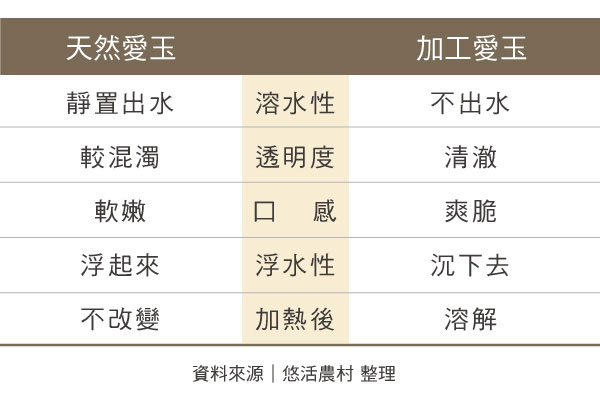
The above are simple ways to tell them apart, but as long as you use good-quality aiyu and rub and wash it with a professional technique, it can also come out crystal clear. And although some vendors sell hand-rubbed natural aiyu jelly, they also add agar powder to set the shape, so you might as well make your own natural aiyu jelly ice at home; it is not only tasty and healthy, but you can also enjoy the fun of rubbing aiyu together with your family!