Kindergarten meals may be too oily, salty and sweet, planting hidden risks of the "three highs"; the John Tung Foundation urges the government to step up oversight
Eating too much oil, too much salt and too much sugar from a young age, laying the groundwork for the future "three highs" of high blood lipids, high blood pressure and high blood sugar? The John Tung Foundation reviewed the menu contents of 120 public and private kindergartens across Taiwan, China, and found that too many foods are prepared in ways that are high in oil, sugar and salt, and that the actual severity of what is provided is far higher than parents realise.
The John Tung Foundation calls on the competent authorities to set nutritional standards for kindergarten meals, to reduce the supply of highly processed foods and to revise dishes cooked in ways high in oil, sugar and salt, and to supply more vegetables, fruit and whole-grain and root-and-tuber foods.
The John Tung Foundation conducted an in-depth analysis of kindergarten menu contents and found that the frequency of unhealthy food supply is mostly higher than the recommended number of servings. Taking high-oil, high-sugar, high-salt snacks such as cream puffs, small pastries and biscuits as an example, 4.5 servings are provided per week, almost once a day, which is higher than the recommended number (3 times); and the frequency of semi-finished fish and meat products (fish balls, shrimp rolls, sausages, ham, hot dogs, chicken nuggets, etc.) and starchy processed products (tempura, rice blood cake, etc.) is also higher than the recommended number of servings.
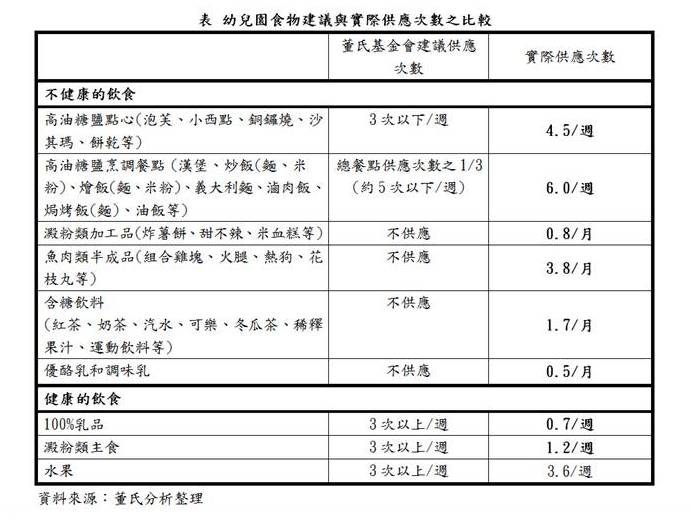
In addition, the John Tung Foundation also found that kindergartens use sugar-sweetened beverages and sweetened yogurt and flavoured milk as snacks. John Tung Foundation dietitian Lu Hui-ju said, these unhealthy foods are lower in cost and popular with children, and kindergartens, considering convenience, often make such unhealthy foods the first choice for cutting costs and saving time, but in the long run this has an adverse effect on children's health.
As for "healthy eating", the John Tung Foundation analysed that there are still many shortcomings. For example, kindergartens provide relatively sufficient vegetables and fruit, but 100% dairy products and whole-grain and root-and-tuber staple foods are clearly fewer than the recommended weekly number of servings, and nutrition is far from sufficient. Dietitian Lu Hui-ju suggests that kindergartens can increase the supply of healthy foods and reduce the supply of unhealthy foods, in order to safeguard children's dietary health.
The John Tung Foundation states that ages 2 to 5 are a critical period for establishing eating habits, and at this stage young children are mainly influenced by "family" and "kindergarten", so the meals provided by kindergartens are very important. It suggests that the competent authorities should set nutritional standards for kindergarten meals, and should revise the "Implementation Guidelines for Early Childhood Education and Care Services", so that, in line with the random inspection mechanism for primary and secondary school meals, the education bureaus (departments) of each county and city government conduct random inspections of kindergarten meals at irregular intervals.
As for the central policy part, the John Tung Foundation calls on the Ministry of Education to build a platform for high-quality food ingredient suppliers as soon as possible, for public and private kindergartens to refer to when purchasing, and, in line with the gatekeeping mechanism for primary and secondary school meals, to set out within three months the "Food Content and Nutrition Benchmarks for Kindergarten Meals", and to include it in the basic kindergarten evaluation items, to ensure that implementation can be carried out.
For kindergartens, the John Tung Foundation calls on menus to make information such as ingredients and cooking methods transparent, so that parents clearly know what their children are eating in kindergarten; before designing menus, kindergartens should first consult the professional opinion of a dietitian and implement the principle of balanced nutrition.