Changhua Xizhou Shangshui Rice is rich in ecology; on Saturday, the Footprints in the Field Market will hold a sharing session.
This Saturday (2/7), the "Footprints in the Field" market at the Taiwan Museum's Nanmen Park will host a "Shangshui Rice" sharing session for Xizhou, Changhua. Writer Wu Yin-ning founded the Xizhou Shangshui Agricultural Products Company, which contracts with local farmers and purchases at a guaranteed price, growing rice with environmentally friendly farming methods and creating a rich paddy wetland ecosystem.
The contracted area for Shangshui Rice grew from seven jia the year before last to eleven jia last year, and the increased output left Shangshui Agricultural Products unable to keep up with sales. To seek a balance between production and sales, this year's first crop season asked some farmers to fallow their fields. In addition to the Council of Agriculture's fallow subsidy of 45,000 yuan per hectare, Shangshui Agricultural Products also provides an ecological subsidy of 25,000 yuan per hectare, allowing farmers to maintain environmentally friendly field management during the fallow period. On one hand this reduces rice output, while at the same time they also try planting miscellaneous grains.
Environmentally Friendly Shangshui Rice, Purchased from Contract Farmers at a Guaranteed Price
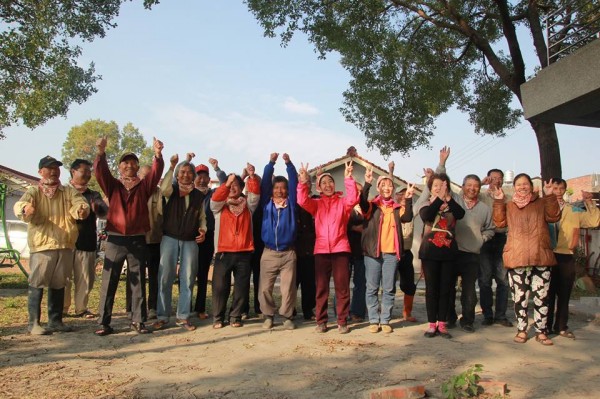
Four years ago, farmers in Xizhou, Changhua launched a water-protection action against the Central Taiwan Science Park's water grab, opposing the fourth-phase development plan of the Central Taiwan Science Park that was preparing to "reallocate" Xizhou's Cizibei Canal. Only after the long-term efforts of local residents was the irrigation water preserved. After this water-protection action, Xizhou poet Wu Sheng, writer Wu Yin-ning and local farmers formed "Xizhou Shangshui Friendly Agricultural Products," working hard to promote environmentally friendly agriculture, and together with the local Cizibei Canal Association planned the "Paddy Wetland Restoration Project."
Shangshui Agricultural Products uses a guaranteed-price purchase method for contracting with farmers, guaranteeing the same purchase price per fen regardless of output, reducing farmers' pressure over harvest yields. The harvested rice is called "Shangshui Rice." When the guaranteed-price contract system for Shangshui Rice was launched the year before last, eleven farmers joined, with a cultivated area of about seven jia. Last year the number of participating farmers increased to twenty-two, and the area of friendly-farmed paddy fields grew to eleven jia. However, because output increased substantially, Shangshui Agricultural Products' sales could not keep up for a time, creating inventory pressure.
"Too scary! Too scary!" said Chen Tzu-hui, project manager of Xizhou Shangshui Agricultural Products. With the cultivated area increasing to eleven jia, two rice crops a year equals an output of twenty-two jia, and on average 200 kilograms must be sold every day to sell it all. Production and sales could not be balanced for a time, and the huge inventory doubled the pressure on the staff. Fortunately, through purchases by enterprises and organizations at the end of last year, the inventory pressure was temporarily resolved.
Shangshui Rice emphasizes paddy wetland ecological restoration. In the field area, besides not using pesticides or chemical fertilizers, ecological ponds and bat houses have also been built. The Endemic Species Research and Conservation Center of the Council of Agriculture began conducting ecological surveys in Xizhou the year before last, and found that many organisms appear in the Shangshui Rice field area, including the protected painted snipe and crested goshawk, as well as the rare golden mouse-eared bat.
Chen Tzu-hui said that walking in the Shangshui Rice fields, he found that the number of dragonflies was much greater than before, and the golden mouse-eared bat, which previously had a better chance of being seen in low-mountain areas, unexpectedly also appeared on the Xizhou plain, possibly also related to the abundance of insects in the Shangshui Rice field area. "Our ingredients here are very rich, which makes the golden mouse-eared bat, which likes to eat insects, willing to come here."
At this Saturday's Shangshui Rice sharing session at the "Footprints in the Field" market, there will be a sharing of writer Wu Yin-ning's experience in promoting Shangshui Agricultural Products, and Chen Hung-chang, the host of the team conducting ecological surveys locally, will also present the survey results. Lin Hua-ching, deputy director of the Taiwan Museum, said he hopes that through the Shangshui Rice sharing session, more consumers will be willing to support Shangshui Rice with practical action. "I hope people will not just buy one bag, but can also subscribe long-term, making it easier for Shangshui Agricultural Products to grasp quantities, plan a more meticulous production and sales plan, and accumulate more energy for contracting with farmers."
This Saturday at 10:30 a.m. at the "Footprints in the Field" market event, details can be found on the Taiwan Museum's Facebook (https://www.facebook.com/NTMuseum) or Changhua Shangshui Friendly Agricultural Products' Facebook (https://www.facebook.com/water.hsichou?fref=ts).