Is the Council of Agriculture Ready to Face Extreme Weather?
Recently, Council of Agriculture Minister Chen Bao-ji stated that the damage to agriculture from extreme weather and ultra-low-temperature cold damage is far greater than that from trade liberalization; but trade liberalization can at least be managed through policy assessments and supporting measures to grasp international trends and impacts. Does the Council of Agriculture already have preparations for facing extreme weather? The Council of Agriculture said: "Yes, but still only in the initial stage."
Yao Ming-hui, head of the Agricultural Engineering Division at the Taiwan Agricultural Research Institute, stated that this year (2016) a 4-year NT$400 million plan will be launched. Targeting 4 crops with high sensitivity and high economic unit value, such as green onion, after conducting risk research on meteorological disasters, a set of SOPs will be formulated so that when farmers encounter different extreme weather events such as typhoons, heat waves, cold damage, and heavy rain, they will have response actions to follow. The Agriculture and Food Agency said it welcomes this.
Jia Xin-xing, director of Weather Risk Management Development Co., pointed out that agricultural meteorology emphasizes regionality. If one only looks at the weather forecasts established by the Central Weather Bureau according to administrative regions, it is "absolutely not enough"; and research results must also be integrated with farmers' actions, and cannot stop at merely issuing forecasts.
Establishing Meteorological Crop SOPs to Reduce Natural Disaster Risk
In the face of extreme weather, the Council of Agriculture's current response model is, after receiving forecast sheets from the Central Weather Bureau, to issue press releases reminding farmers to pay attention, while agricultural improvement stations in various places draft response actions, such as recommending that strawberry farmers lay plastic sheeting for warmth and cold protection, or developing net houses that green onion farmers can use to reduce the impact of cold winds; there is no main responsible unit in charge of response.
In order to strengthen the Council of Agriculture's capacity to respond to climate change, Yao Ming-hui, head of the Agricultural Engineering Division at the Taiwan Agricultural Research Institute, will carry out a research project this year titled "Establishment of Agro-Forestry Meteorological Disaster Risk Indicators and Disaster Adaptation Strategies." It is expected to take 4 crops with high economic value or high sensitivity as examples, including Sanxing green onion from Yilan, high-grafted pear from Miaoli, edamame from Kaohsiung, and sugar apple from Taitung, and combine them with regional meteorological data and prevention methods of agricultural improvement stations to establish methods that effectively reduce impacts.
The purpose of this plan is to hope that all kinds of farmers, when facing various extreme weather events such as drought, heavy rainfall, and cold damage, will have a set of standard operating procedures (SOPs), so that farmers will no longer be at a loss when confronted with massive meteorological data, and agricultural losses can thereby be reduced.
For example, every time a typhoon comes, Sanxing green onion suffers. If the probability of impact can be accurately predicted, for example only 30%, farmers would be advised to pay attention to strengthening the management of irrigation water in the fields; if the probability of impact rises to 90%, farmers would be advised to harvest early to reduce losses.
Yao Ming-hui stated that current meteorological forecasts are mainly based on large-scale administrative regions, but what farmers need is regional data on temperature and humidity changes at the production site, whether there will be heavy rainfall, and so on. Therefore, weather stations will be set up at the experimental sites of the current 4 crops to grasp regional meteorological data.
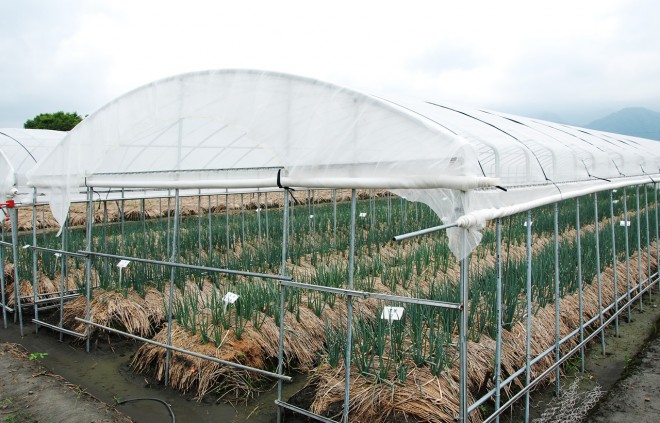
 Hualien District Agricultural Improvement Station's green onion net house plan (photo provided by Hualien District Agricultural Improvement Station)
Agricultural Meteorology Values Regionality; Looking Only at News Reports Is Not Enough
The biggest difference between agricultural meteorology and general meteorology is that regional data is very important. "Therefore, it is very important and correct for the Taiwan Agricultural Research Institute to grasp regional data," said Jia Xin-xing, director of Weather Risk Management Development Co.
"Summer afternoon thundershowers often become distinctly wet or dry once past a bridge or a field ridge," Jia Xin-xing explained, showing that regional differences are very large; and although the Central Weather Bureau has a township forecast system, most of this data comes from monitoring stations at township offices, some distance from farmers' production areas. Moreover, production areas are often open wilderness, and temperature, humidity, and soil moisture will all differ, and these data are also closely related to crop growth quality and cultivation environments.
"So agricultural meteorology must be customized. If one only looks at TV weather and information on the Central Weather Bureau website, it is definitely not enough," Jia Xin-xing said. Taking this cold damage as an example, if there were only traditional information channels and press releases from the Agriculture and Food Agency, "before the cold damage came, we only knew the temperature would drop substantially, but how low exactly? We did not know, and it would be difficult to respond."
Hoping to Strengthen Agricultural Meteorology Expertise; Agriculture and Food Agency: Hope to Reduce Risk After Natural Disasters
Regarding the grasp of extreme climate, Li Shu-mei, head of the Planning Division of the Agriculture and Food Agency, believes that the results of the Taiwan Agricultural Research Institute's plan will be a key basis for the Agriculture and Food Agency's agricultural planning. "Everyone hopes to reduce the uncertain risk of natural disasters." Otherwise, as with last year's two consecutive wind disasters, Typhoon Soudelor and Typhoon Dujuan, the billions in relief funds issued were indeed a financial burden.
Li Shu-mei stated that at the current stage, in addition to strengthening the dissemination of data from the Central Weather Bureau, the Council of Agriculture is also piloting agricultural insurance with high-grafted pears. "This is also a way to reduce production risk."
At present, the plan is also expected, after obtaining meteorological data from the Central Weather Bureau and the National Disaster Response Center, to complete subsequent early harvesting and strengthened field management actions through the systems of agricultural improvement stations, local farmers' associations, and production-marketing groups. But can the plan keep up with weather changes? Only the next natural disaster will tell.
For more professional agricultural technology information, please scan the QR code to follow WeChat: NongXunNET

Please indicate the source when reprinting.