Chinese pesticide vendors buy the herbicide glufosinate and give away electric vehicles and TVs, experts worry about overuse
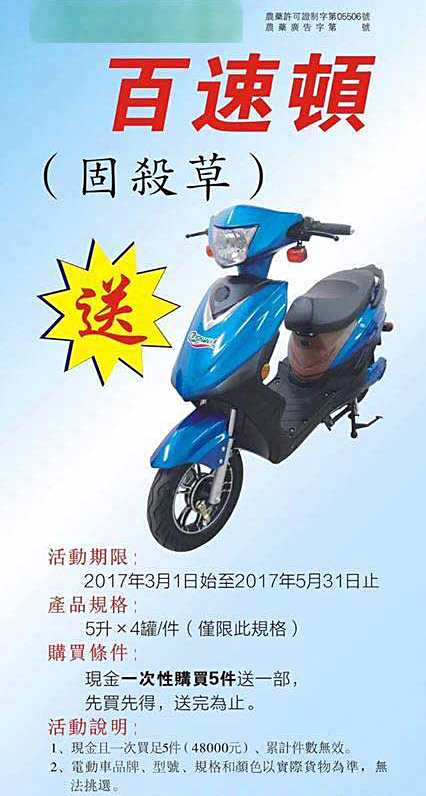
Electric scooters, LCD TVs, Korean-style grill pans, electric fans, electric heaters, reclining lounge chairs... Dazzling advertisements for free gifts began appearing in villages large and small starting last year, and many farmers rushed to grab them. How could they get them? The answer turned out to be: buy herbicides!
"Blockbuster promotion, unprecedented!" The herbicide behind this "giving away big" ad campaign is glufosinate, the overall champion of pesticide sales across Taiwan in 2016, with sales of three thousand six hundred metric tons and total revenue exceeding one billion. In 2017 it is expected to hit a new high, and within just a few short years its sales have already pulled far ahead of the other two non-selective herbicides, glyphosate and paraquat.
Patent expiry sends glufosinate into the Warring States era
"This chemical used to be very expensive, but now everyone is competing on price, and it has become a red ocean." A business manager at a pesticide company said that three years ago glufosinate was in severe shortage, expensive and hard to buy; then the patent expired and generic versions came out one after another. Add to that the fact that mainland China banned paraquat in recent years, and many factories switched to producing glufosinate, so the price has fallen year after year.
Most pesticide manufacturers in Taiwan buy the technical material from China and make generic finished products domestically. To date 82 pesticide permits have been issued, and glufosinate has entered the Warring States era. A 1.5-liter drum of glufosinate used to cost seven or eight hundred yuan on the market; now it can be bought for four or five hundred yuan.
Taiwan is also about to ban paraquat in February 2019, and glufosinate is seen as one of the replacement chemicals. On top of that, glyphosate resistance is becoming more and more serious, and many stubborn weeds cannot be killed, so glufosinate has come out ahead.
Buying madly for the free gifts; farmers stockpiling at home may increase usage
The sales tactic of giving away lavish gifts with glufosinate purchases began with one mainland Chinese manufacturer, Yongnong. Yongnong is the largest pesticide manufacturer producing glufosinate in China; it set up a branch in Taiwan in 2013, the first time a Chinese pesticide company established a branch in Taiwan and obtained a registration certificate.
The "buy five boxes, get an electric scooter" giveaway was unprecedented in Taiwan and extremely attractive to farmers, forcing other manufacturers to follow suit and start giving away all kinds of home appliances and daily necessities, with endless tricks. At Mid-Autumn Festival they gave away grill pans; when the weather turned cold they gave away electric heaters; in some rural villages you could often see electric scooters from pesticide shops coming and going, creating a different kind of "green miracle."


Cash crops increasingly use glufosinate to replace glyphosate; experts warn about resistance
Glyphosate, paraquat and glufosinate are Taiwan's three major non-selective herbicides, and among them glufosinate ranks in the middle both in toxicity and in efficacy. It is a contact herbicide, but it has slight translocation within the leaves, though it does not reach the roots.
Huang Wenda, associate professor in the Department of Agronomy at National Taiwan University, analyzed that in the past when farmers sprayed herbicides, those who wanted fast action chose paraquat, those who wanted to kill the roots chose glyphosate, and glufosinate sat in the middle, neither up nor down, and was expensive, so it did not sell well. But later farmers discovered that in orchards growing high-value crops or betel nut plantations, spraying glyphosate easily damages the tree roots; the trees would not die but would be injured, whereas glufosinate advertised "does not harm roots," and although it was more expensive, "for these orchards growing high-value crops, they can afford it." So a few years ago glufosinate sales slowly overtook glyphosate.
Glufosinate
- Main uses: Contact action, with slight translocation in the leaves. Besides weed control, it is also used as a desiccant before crop harvest.
- Half-life: DT50 is 3-10 days in laboratory soil, 7-20 days in field soil, and 2-30 days in water.
- Toxicity: LD50 1500-2000, moderate toxicity. It is neurotoxic; symptoms in tested animals include bulging eyes, convulsions, irregular breathing and diarrhea. It is toxic to early embryonic development and is irritating to the eyes and skin.
- Advantages: Moderate efficacy, breaks down quickly, and causes relatively little phytotoxicity to shallow-rooted crops.
- Disadvantages: More expensive. It has good water solubility and is easily lost from the soil; it is toxic to aquatic organisms and causes a decline in beneficial soil microorganisms such as Trichoderma populations.
Paraquat
- Main uses: Contact action, harming only the above-ground parts that are sprayed, while the roots remain. Besides weed control, it is also used as a defoliant and desiccant before harvest for many crops.
- Half-life: In the soil-adsorbed state, DT50 is 7-20 years, degrading very slowly; but once it leaves the adsorbed state it can be broken down quickly by microorganisms, with DT50 usually less than 7 days.
- Toxicity: LD50 58-113, highly toxic. It is dangerous to applicators; in the United States it is a pesticide restricted to commercial use, and a professional license is required to use it. Long-term exposure can cause pulmonary fibrosis, leading to difficulty breathing.
- Advantages: Cheap, fast-acting, breaks down quickly.
- Disadvantages: Highly toxic, dangerous to humans, and a high fatality rate if accidentally ingested.
Glyphosate
- Main uses: Systemic; after being absorbed by the leaves it can quickly translocate downward all the way to the roots, killing the whole plant, and it is highly effective on perennial deep-rooted weeds. Used for weed control and pre-harvest application on crops.
- Half-life: In field soil DT50 is 1-130 days; in water DT50 ranges from several days to 91 days. In laboratory water systems with sediment, it is 27-146 days under aerobic conditions and 14-22 days under anaerobic conditions.
- Toxicity: LD50 >5000, low toxicity. In 2015 IARC classified glyphosate as a 2A probable human carcinogen. Its main metabolite in plants, water and soil is AMPA, which is also toxic.
- Advantages: Cheap, long-lasting.
- Disadvantages: Kills even the grass roots, which is unfavorable for soil and water conservation. Many resistant weeds. It persists longer, and there is much negative controversy over its impact on the ecological environment and human health.
Lai Bohua, owner of a pesticide shop in Dacun, Changhua, said that most of the farmers nearby grow grapes and long ago stopped using glyphosate, because it damages the grapes and has already lost effectiveness against certain weed spectra. Farmers compared orchards using glufosinate and glyphosate and clearly felt the difference in how the fruit trees performed, so even though glufosinate is more expensive, they switched to it one after another. Even in rice paddies, where returns are not as high, there are cases of switching from glyphosate to glufosinate.
But the phenomenon of frantic promotions was called outrageous even by Jiang Yongzheng, a weed expert and head of the Public Nuisance Control Division at the Agricultural Chemicals and Toxic Substances Research Institute. She warned that weeds develop resistance to glyphosate, so would they not also develop resistance to glufosinate? "It's hard to say! The mechanism of action of glufosinate is a single enzyme, so developing resistance is not that difficult, and glufosinate-resistant weeds have already appeared abroad." She advised farmers never to use it excessively.
Rising raw material costs; glufosinate prices are recovering
But pesticide manufacturers also said that the price of glufosinate has gradually been recovering, and starting this year there may no longer be so many price-cutting promotions. This is because the Chinese government, in view of severe environmental pollution, has begun cracking down on factories illegally discharging wastewater and waste gas, and many pesticide factories have been ordered to shut down, so glufosinate production is again insufficient.
A business manager at one pesticide company also pointed out that there are many brands producing glufosinate, but the purity of the technical material varies; some have more impurities, which affects efficacy. In addition, the adjuvants other than the active ingredient are each pesticide company's own formulation and are trade secrets; whether the formulation is good or bad also affects efficacy, and a poor formulation may even cause phytotoxicity to crops. Farmers need to compare carefully and not be greedy for cheapness.
When spraying glufosinate, watch the residual effect and do not irrigate immediately
With paraquat on the way out and glufosinate and glyphosate running neck and neck, that is the general trend; so what should farmers pay special attention to when using glufosinate?
In her experiments, Jiang Yongzheng found that after spraying glufosinate, you cannot irrigate immediately, otherwise it may harm the crops. "Because it is highly water-soluble, sometimes even if you spray it in the furrow and do not spray the crop, the crop roots growing downward may absorb it, and the leaves that grow out will be yellowish." So after spraying glufosinate you cannot flood the field right away, and before spraying you should also check the weather; if rain is coming, avoid using it.
In addition, the residual effect of glufosinate is longer than that of paraquat. Jiang Yongzheng advised that after spraying, it is best to wait more than a month before planting crops, to avoid the residual effect affecting crop growth. That is, farmers need to control weeds earlier, and the timing cannot be too compressed.
She also explained that for perennial weeds with runners or underground bulbs, the effect of using glufosinate is limited. For goosegrass that has already developed resistance to glyphosate, glufosinate must also be sprayed while the grass is still small to have a better suppressive effect.
But Jiang Yongzheng still emphasised once again, "Do not remove all the weeds completely." No matter which herbicide it is, using it too frequently will affect soil activity and soil fertility, and harm organisms and microorganisms in the soil.
Avoid dependence on herbicides; alternatives are already being actively developed internationally
Paraquat is banned, and glyphosate is also endlessly controversial. Not long ago the EU was at daggers drawn over whether to ban glyphosate, and glufosinate seems to be the relatively safe choice. But experts warn that any single herbicide dominating is not a good thing.
Huang Wenda said that using multiple herbicides in rotation makes resistance less likely to develop, and "if there is only one alone, it is definitely bad for biodiversity as well." Some herbicides seem fine to everyone at first, but as science advances, health concerns for humans or environmental harm are gradually discovered, so it is best to avoid relying on herbicides and also avoid letting a single chemical monopolise the market.
Guo Huaren, professor emeritus in the Department of Agronomy at National Taiwan University, pointed out that France revoked the license for Bayer's herbicide BASTA F1 last October, and the EU has also enacted regulations restricting the use of glufosinate. He believes farmers should not keep relying on herbicides. Europe is now researching other labor-saving manual weeding methods, biological control and so on, or developing ecological farming methods, to replace the use of herbicides, and Taiwan should also actively research and develop these.
Huang Wenda pointed out that our country cannot just focus on banning pesticides while not developing other methods to give farmers alternatives. For example, he said, abroad they have developed a "no-till cultivation" model: first plant cover crops to suppress weed growth, then roll them down with farm machinery, which not only avoids herbicides but also improves soil fertility and stores more carbon in the soil, better fitting the premise of sustainable agriculture.