Organic Farming Doesn't Use Organic Seeds, Scholars Criticize Standards as Toothless, Urge Swift Legal Reform
At present, organic cultivation in Taiwan, China still mostly uses ordinary commercially sold seeds rather than organic seeds. In contrast to the strict international rules on the use of organic seeds in organic agriculture, Taiwan, China still has a long way to go. Chen Jianbin, Director-General of the Agriculture and Food Agency under the Council of Agriculture, said that organic seeds are one part of organic agriculture. At present the government is very accommodating toward the organic industry and can allow the use of commercially sold seeds; in the future it will strengthen guidance on organic seedlings. "After all, seeds are the mother of agriculture," he said, expressing hope that organic seed certification companies will emerge later.
What are organic seeds? Yan Yongfu, a professor in the Department of Biotechnology and Agricultural Science at National Chiayi University, explained that the definition of organic seeds includes: seeds produced from parent stock managed organically in the previous generation; for vegetatively propagated crops, at least one generation of the parent must be managed organically; and for perennial crops, the parent must be managed organically for at least two growing seasons.
Scholars: Organic Seeds Balance Human Safety with Biological and Nutritional Diversity
The Taiwan Seed Improvement and Propagation Station under the Executive Yuan's Council of Agriculture recently held a seminar on organic seed development. Guo Huaren, an honorary professor in the Department of Agronomy at National Taiwan University, said that organic farmers now almost all plant commercially sold seeds. Even if no pesticides are sprayed during the growing process, the treatment process for commercially sold seeds is not organic, so pesticide residues may still remain in the seeds. "Since we want to develop organic agriculture, we should make pesticides disappear from the world entirely," Guo Huaren stressed. Although pesticides cannot be removed 100 percent, he said, we must move in that direction, and organic seeds should also be produced by organic methods.
Chen Shixiong, Dean of the College of Science and Technology at Nanhua University, said that promoting organic seeds is also about sustaining biodiversity and nutritional diversity. Since the Green Revolution, although food production has increased greatly and many people have been saved from starvation, it has also led to monocropping and single species. "75% of our food mainly comes from 12 kinds of plants and 5 kinds of animals; nearly more than 1,000 kinds of plants have disappeared, and many species keep going extinct."
Yan Yongfu also said that organic varieties need genetic diversity in order to adapt to various environmental changes. Therefore, organic farming methods prohibit GMO genetically modified seedlings and oppose F1 varieties with uniform genetic backgrounds and pollination controlled by artificial, biological or mechanical means, while encouraging the use of OP varieties with genetic diversity that are produced through open pollination without controlled pollination.
Yan Yongfu explained that genetic diversity is equivalent to nutritional diversity. If you keep eating the same variety, the nutrition is all the same. If you switch to organic seeds with genetic diversity, nutrition will be balanced and not skewed.
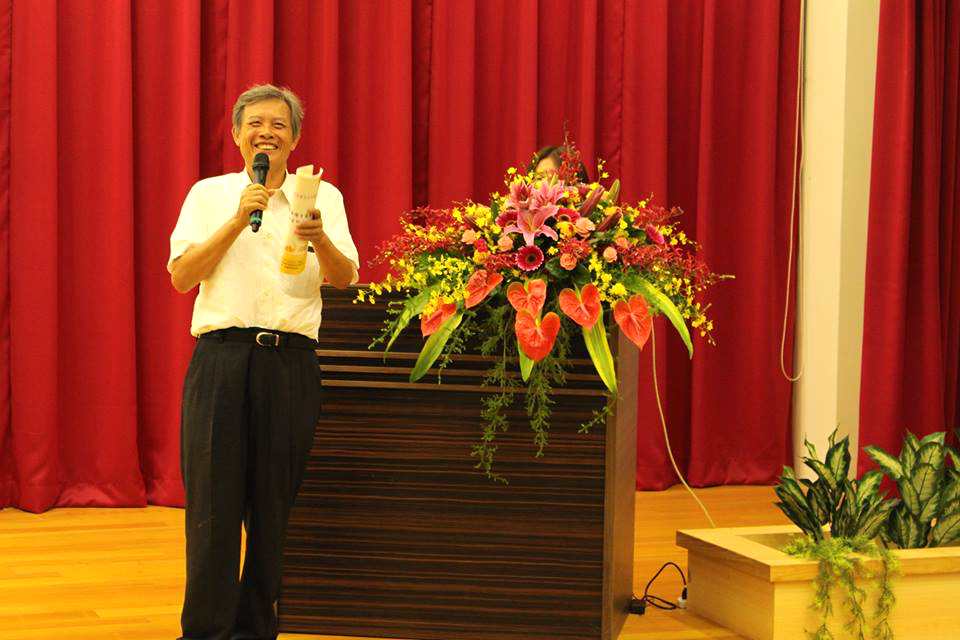


Guo Huaren: Saving Your Own Seed Requires Attention to Seed Collection Methods and Storage
As for farmers saving their own seed, only a small number of organic farmers have tried it, and the quality of organic seeds saved by farmers themselves is unstable and the quantity is small, making large-scale use difficult.
People attending the seminar also raised questions: traits of self-saved seed will drift, and the quantity gets smaller and smaller. In response, Guo Huaren explained that traits drifting may be because different varieties were nearby at the time of seed saving, so pollen from other varieties mixed in. In addition, attention must be paid to saving a large enough quantity of seed to maintain the genetic traits of the variety.
Guo Huaren also said the seed storage process is very important. The seeds must be thoroughly dried and placed in a freezer for frozen storage; stored this way, they will be fine for five years. If the seeds are to be taken out for use, they must first be left for a period of time to equilibrate with the outside temperature before opening. The remaining seeds should likewise be kept dry, sealed and placed in the freezer for storage.
Agriculture and Food Agency: Currently "Accommodating" Use of Commercially Sold Seeds, Strengthening Guidance on Organic Seedlings
Zhao Xiufang, an associate researcher at the Tainan District Agricultural Improvement Station, said that as Taiwan, China's organic market grows, demand for organic seeds will also increase, and using organic seeds is an essential part of a complete organic agriculture system. Zhao Xiufang pointed out that short-term leafy vegetables are currently the main source of organic vegetables, and demand for organic seeds is large, so research should first move in this direction.
The Tainan Agricultural Improvement Station conducted organic seed production research on 9 varieties of 3 crops: pak choi, Chinese kale and night lettuce. The results showed that the planting period and different varieties are important factors affecting seed yield, and that dense planting cultivation, although it can produce a higher seed yield, causes poor ventilation in the field and affects subsequent field management. In addition, seeds must be disinfected before sowing to kill pathogens attached to the seed surface. The results showed that during dry-heat sterilization the moisture content of the seeds needs to be reduced, and that this is also the best organic seed sterilization treatment method. However, these organic seeds are all still at the research stage.
Chen Jianbin, Director-General of the Agriculture and Food Agency under the Council of Agriculture, said that the government is vigorously promoting organic agriculture, and organic seeds are one part of organic agriculture. But at present the government is still very accommodating toward the organic industry and can allow the use of commercially sold seeds. In the future it will strengthen guidance on organic seedlings. "After all, seeds are the mother of agriculture," he said, expressing hope that organic seed certification companies will emerge later.
For more professional agricultural science and technology information, please scan the QR code to follow WeChat: NongXunNET

Please indicate the source when reprinting.