Dairy farms face a severe labor shortage across Taiwan, China, and the first wave of agricultural foreign workers has arrived.
Agricultural foreign workers have been called for for more than ten years. Because of unstable working hours and concerns about technology outflow, in the past only the fishing industry and slaughterhouses were allowed to apply. This year the Council of Agriculture and the Ministry of Labor made a strong declaration for the first time, and it is expected that foreign workers will be opened up for the dairy farming industry. Wang Zhongshu, deputy director of the Livestock Division of the Council of Agriculture, said frankly, "in principle, it will be opened," and at the end of this month the second meeting of the "Cross-National Labor Policy Advisory Group" will be held to discuss details such as working hours, wages and headcount for dairy farm foreign workers. The opening of foreign workers for dairy farming is highly symbolic. If it runs smoothly, industries such as livestock, flowers, tea and mushrooms can be expected to follow.
Why is dairy farming the first industry to be opened? What is the working style of dairy farming? Why can 30,000 to 40,000 monthly salary still not attract workers? Upper and Lower Streams visited the long-established Gaoda Dairy Farm in southern Taiwan to record the reality of frontline dairy farm work.
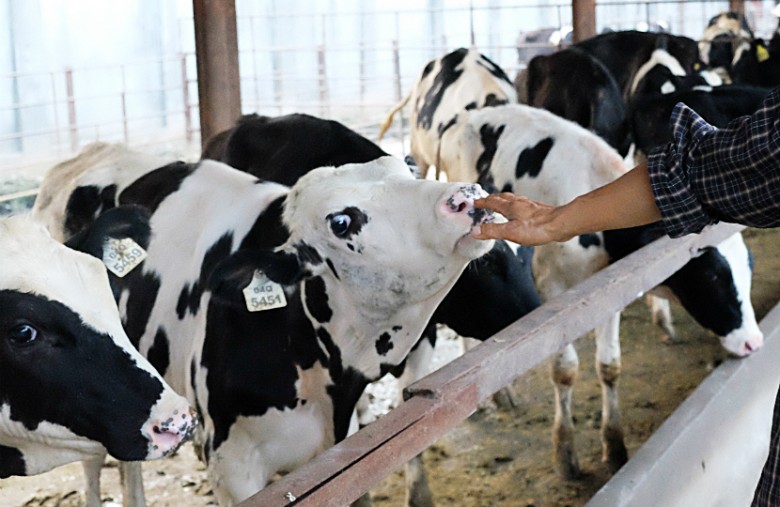


Calls to open up foreign workers continue
Besides the heavy work, many applicants back off as soon as they see the dairy farm environment. Although dairy farms divide walkways and resting areas for dairy cows, dairy cows do not care which zone you are in. As they pass through the walkway to the milking parlor, they boldly defecate and urinate while walking, and some cows, once they get stubborn, simply refuse to move, so the cow herder has to step through cow dung into the resting area and shout. "Some people come to work in the morning and are gone by the afternoon." Chen Youzhen, Chen Dongjie's eldest daughter, said with helplessness.
She returned home to help after graduating from university the year before last. Because she grew up watching cows, she had long been accustomed to such an environment, but many applicants often cannot last even a day before running away.
Hong Changjin, chairman of the Republic of China Dairy Association, raises 700 cows in Changhua and also complains endlessly about the labor shortage. He said helplessly that they are still short 3 workers, offering 30,000 to 50,000 in salary and 6 days off per month, and still cannot find anyone. "Dairy farmers only hope to bring in foreign workers because they have no other choice. In fact, once the costs of foreign workers are added up, they are not much cheaper than local workers, and there are also language problems. If we could hire local workers, we would very much like to."
Although the dairy labor shortage is a fact, outsiders also question that foreign workers are only a temporary fix, not a fundamental solution. What matters is finding out why people back off, improving the environment, and making more local workers willing to enter the industry. (Series to be continued)