Green environmental payments for farmland to launch next year, four stacked subsidies to support sustainable agriculture
Regarding the overall "Farmland Green Environmental Payment Plan," the Council of Agriculture today invited relevant experts, scholars and frontline farmers for discussion. During the meeting it was emphasized that the existing item-by-item subsidy policy will in the future be integrated into a "stacked" subsidy, which includes four fundamental items: "farmland green payments, crop incentives, cultivation system incentives and environmentally friendly subsidies." It is hoped that this can be used to adjust the production and marketing structure, first to ensure that farmland is used for farming, and second to raise the food self-sufficiency rate, thereby ensuring the sustainable operation of agriculture.
Regarding the policy that is about to be launched next year, participants raised many doubts, including whether the direction of subsidies is appropriate, whether market demand can be raised through food and agriculture education, and when the overall construction of the industrial chain will be completed, once again testing the thinking of the relevant units on the payment plan.
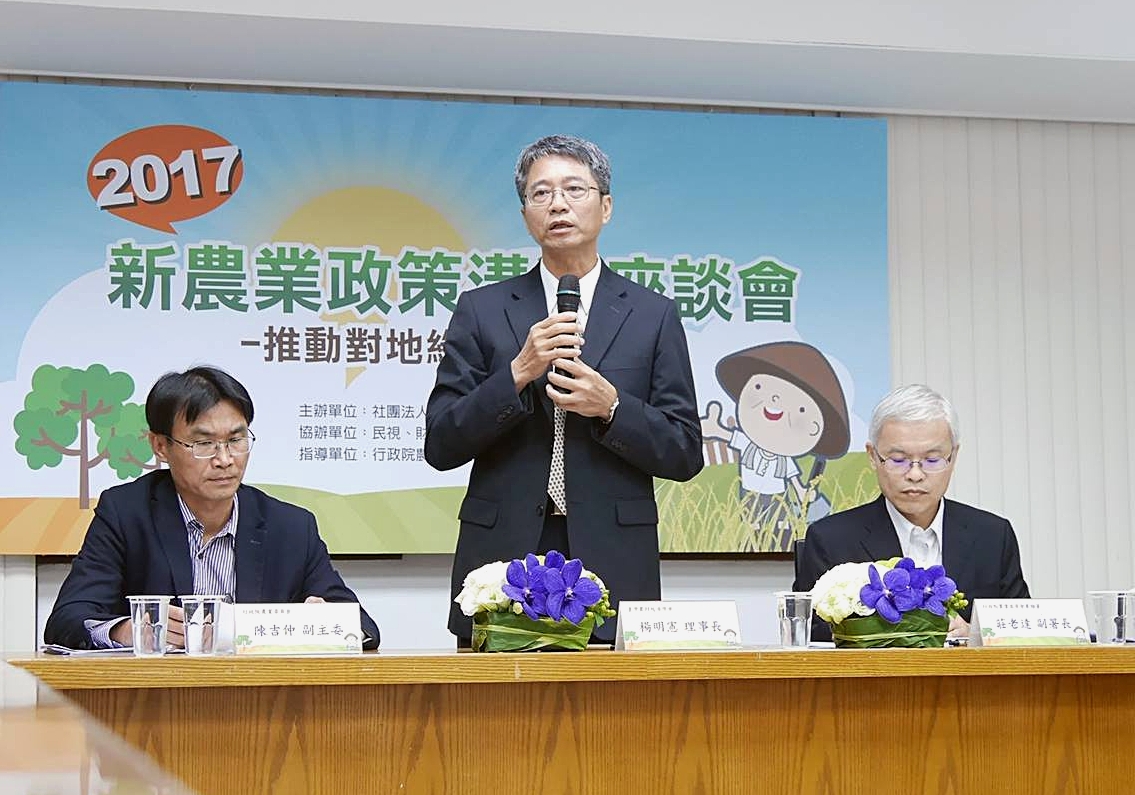 Zhang Jingzhen speaking
Ma Yu-an: Friendly and organic regulations are not yet complete. How are standards to be established? How can farmers participate?
At the same time, Ma Yu-an, chairman of the board of the Zhongdu Agricultural Production Cooperative, raised many questions about operational details, including that friendly and organic regulations are not yet complete, so how are standards to be established? How can farmers participate in defining them? There are not enough varieties of miscellaneous grains at present, so where are the concrete methods for entering friendly and organic production? Which varieties are suitable? Where are the market demand and opportunities? They all hope the government will consider these one by one and not just shout slogans.
In addition, he also pointed out that perhaps "subsidy" should not be used as the framework for thinking, and that the concept of "insurance" could be used instead, with farmers and the government each paying insurance premiums on seeds and fertilizer to face disasters, and with a smooth harvest also providing more cash to improve the equipment needed in the production process.
Soybean farmer Xie Mingquan also pointed out that the government now encourages rotation, but in actual operation, farmers in paddy fields have very little knowledge of miscellaneous grains, so naturally they will not choose to take risks, and can only rely on contract-farming entities like him to struggle alone, which of course makes it very difficult to achieve results; Hualien farmer Xia Junjie likewise used the inherent environmental and climatic limitations as an example, pointing out that the government should take regional disparities into consideration, otherwise, for the Hualien area, which is limited by insufficient sunlight, it will of course be dominated by rice, for which the technology is the most mature.
Facing questions from all sides, the Agriculture and Food Agency: implementation details will be reconsidered in policy goals
In response to questions from the public, Agriculture and Food Agency Deputy Director-General Zhuang Laoda responded that, in fact, what farmers care about most is still income. Agriculture must be sustainable, and farmers' survival must also be sustainable. Therefore, income is used as the comparison benchmark, and reasonable systems and crop choices are used in a guiding way so that farmers will accept them. Therefore, in the future the above policies will also be simplified into information that farmers can absorb, and briefing sessions will be held step by step for promotion.
In addition, regarding the public's unclear understanding of the current policy's definition of friendly agriculture, he also promised that a clear explanation would be made within one month, and that crop insurance would gradually be expanded so that both income and disasters can be covered.
Zhuang Laoda also emphasized that future policy goals will reconsider implementation details, for example thinking in terms of the characteristics of different regions. In places such as Yilan and Hualien, where the second cropping season is not suitable for cultivation, the crop items promoted there will be evaluated differently. As for the cash flow that farmers care about, although the Agricultural Bank of Taiwan currently has special project loans, given that the amounts are insufficient, in the future consideration will also be given to making adjustments based on the scale of contract farming.
As for the most critical part, food and agriculture education, Zhuang also admitted that in the past this was scattered among various ministries and councils. Therefore, the Council of Agriculture is now seeking relevant plans and ideas, moving toward a single window for implementation, hoping to solve the problem at the source.