Where is the bottom line on ractopamine-fed US pork? Council of Agriculture and Ministry of Health and Welfare state their positions at the Legislative Yuan
Today, for the first time since the new government took office on May 20, Council of Agriculture Minister Tsao Chi-hung appeared at the Legislative Yuan for interpellation. In light of the controversy sparked by a recent interview in which Tsao said, "Do we have the ability to refuse [US pork] completely?", the Legislative Yuan erupted in heated questioning. Tsao clarified that whether ractopamine-fed US pork can be imported is not something he can promise; his responsibility is to do a good job with the (pig farming) industry, and safety issues must be decided by the Ministry of Health and Welfare.
As for rumors that food from five prefectures and cities in Japan's nuclear disaster zone, including Fukushima, will be lifted from the ban, Food and Drug Administration Director-General Chiang Yu-mei of the Ministry of Health and Welfare said that since May 20 this issue has never been discussed, and that both the unilateral report on lifting the ban published by Japan's Kyodo News and the reports written by domestic media are not the current situation.
Tsao Chi-hung: No contact with the US side, focused on upgrading the industry
Can ractopamine-fed US pork actually be blocked? The Legislative Yuan's Economics Committee argued fiercely over this, and today, before Tsao Chi-hung even took the podium to answer questions, several Kuomintang legislators were already sharpening their knives. Including Chang Li-shan, Chiang Chi-chen, Lin Te-fu, Huang Chao-shun and others, they brought out relevant reports and news footage, questioning whether the Democratic Progressive Party, now fully in power, had changed its mind once it changed its seat. Huang Chao-shun put it bluntly: "Minister, are you willing to promise that US pork entering the country will absolutely not contain ractopamine?"
"I cannot make such a promise." Facing all hypothetical and commitment-seeking questions, Tsao Chi-hung stated his position clearly, repeatedly reaffirming that his stance has been consistent all along, and that what he meant in his earlier interview was that whether to import requires discussion and coordination among various ministries and agencies, not an expression of support for opening up. "My responsibility is to do a good job with the industry. As for whether (US pork) is safe, there must be a scientific basis."
At the same time, Tsao Chi-hung also responded that there has currently been no contact with any US entity, so at this stage the existing policy remains in place, namely that ractopamine is listed as a banned drug, and that neither domestic nor imported pork products may have detectable residues.
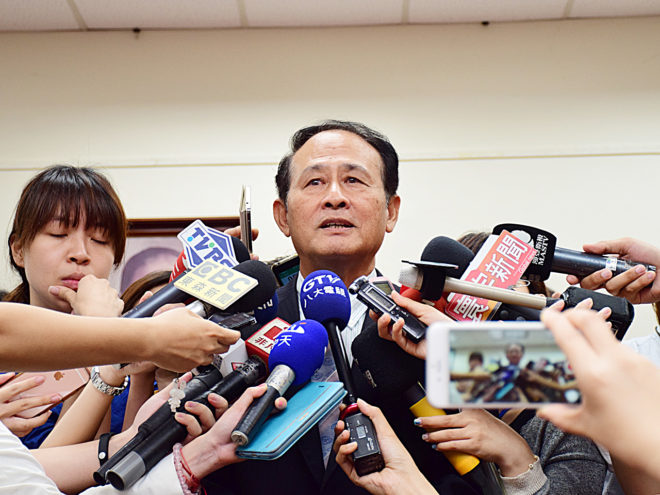
-660x495.jpg) At 9 a.m., as soon as the interpellation time arrived, the new Council of Agriculture Minister Tsao Chi-hung was questioned by the media about his stance on US pork. (Photo / Pan Tzu-chi)
If ractopamine-fed US pork cannot be blocked, the Ministry of Health and Welfare plans to restart risk assessment
Minister of Health and Welfare Lin Tzou-yien, who oversees food safety and ractopamine risk assessment, said that since taking office on May 20, the issue of opening up to US pork has not yet been discussed, and that if one day in the future the Ministry of Economic Affairs begins discussions, the Ministry of Health and Welfare will restart the risk assessment.
Lin Tzou-yien stressed that the Council of Agriculture is responsible for animals and the Ministry of Health and Welfare is responsible for people. "If we do it, I will bring in domestic and international experts to join the risk assessment work, and the report will cover aspects including pharmacokinetics, sensitive groups (the effects of eating ractopamine-fed pork), and risk communication."
Legislators: gossypol, antibiotics and red meat all carry risks and should also be assessed
Democratic Progressive Party legislator Wu Kun-yu mentioned that if US pork is intended to be imported, the Ministry of Health and Welfare cannot simply respond with the risk assessment done in 2012 in response to US beef imports; a new risk assessment must be done, and it must update the latest domestic and international scientific data from the past 4 years, produce a more rigorous assessment report, and act as a gatekeeper for the people.
Wu Kun-yu said that not only should the ractopamine risk assessment be redone, but the domestic abuse of antibiotics in animals is serious, and recently the problem of superbugs has broken out internationally, so the Ministry of Health and Welfare should also consider launching a risk assessment on the impact of antimicrobial resistance on people's health; and gossypol, which may pose reproductive harm to humans, is an ingredient many countries allow to be added to animal feed, so what exactly is gossypol's impact on people's health? The Ministry of Health and Welfare needs to carry out an assessment plan as soon as possible.
In addition, Wu Kun-yu said that red meat, which was just listed by the World Health Organization (WHO) as a Group 2A carcinogen, produces a potentially carcinogenic substance called "heterocyclic amines" when cooked at high temperatures, and the colorectal cancer rate among the people has remained high year after year. What is the connection between the two? The Ministry of Health and Welfare should also launch a risk assessment to study this.
As for rumors that food from five prefectures and cities in Japan's nuclear disaster zone, including Fukushima, will be lifted from the ban, Food and Drug Administration Director-General Chiang Yu-mei of the Ministry of Health and Welfare said that since May 20 this issue has never been discussed, and that both the unilateral report on lifting the ban published by Japan's Kyodo News and the reports written by domestic media are not the current situation.
News glossary
Pharmacokinetics: The human body has a set of mechanisms for handling foreign drugs that enter it. This field of study is used to understand the performance and characteristics of a drug in each process within an organism, including absorption, distribution, metabolism and excretion.
For more professional agricultural science and technology information, please scan the QR code to follow WeChat: NongXunNET

Please indicate the source when reprinting.