Whose happiness is it, really, in a happy city?
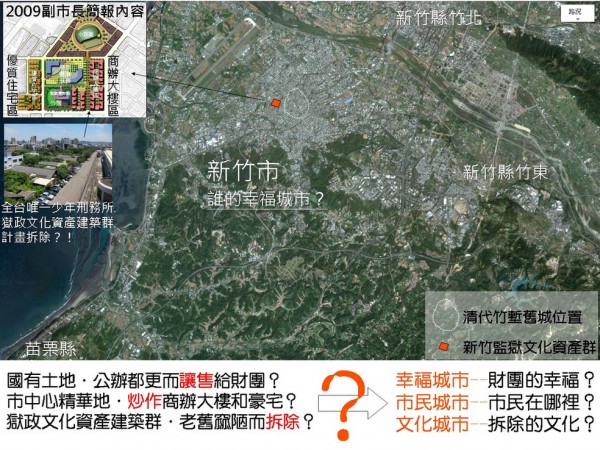
What if state-owned land in the prime downtown area of Hsinchu City were "sold off" to a consortium through urban renewal (conveniently circumventing the ban on "public sale" of state-owned land of 500 ping or more), and developed into commercial towers and premium residences for private use.
Citizens of Hsinchu, do you agree?
 Old houses and large trees may become sacrifices of urban renewal development. (Photo: Isis)
PS: Public land may be sold to an implementer through urban renewal; for the relevant regulations, see the National Property Administration of the Ministry of Finance, "Principles for Handling State-Owned Land within the Scope of Urban Renewal Projects": http://www.mofnpb.gov.tw/Edict.php?page=RuleInfo&TRE_ID=540&act=ArtAll
[Note 1]: For the details of the urban renewal case, please refer to the announcement by the competent authority. The information an ordinary citizen can obtain is limited, so the data found through online searches is used here as the basis for judgment; the source of the 2009 deputy mayor's briefing is: http://fongthinger.blogspot.de/2011/05/blog-post_24.html. I believe that if the mindset driving the publicly led urban renewal case remains unchanged, and the thinking behind disposing of national land remains unchanged, the subsequent plans will not differ much from the 2009 version.
[Note 2]: According to statistics, by the end of 2010 (year 99 of the Republic of China), the vacancy rate in Hsinchu City had reached 20.9% (source: article by Professor Chang Chin-o: http://www.moneynet.com.tw/e_news.php?id=2206); one out of every five homes stands idle, the actual number of vacant homes is about 32,000, an increase of more than 6,000 vacant homes compared with the end of 2000 (year 89 of the Republic of China). With a high vacancy rate and idle resources, the only option is to keep speculating on housing prices, making it even harder for young people to afford a home…..
Large numbers of vacant homes are simply left idle within the high housing price bubble caused by unclear information; even though "supply" has always exceeded "demand," government agencies repeatedly chime in, claiming that releasing state-owned land can control prices through volume, causing national land to be repeatedly sold off cheaply.
[Note 3]: After citizens took the initiative to report the cultural asset and pushed for a nationwide petition, the "Martial Arts Training Ground" (Yanwuchang) has now been designated as a city monument, and this year's demolition budget for the Japanese-style building cluster around Hsinchu Prison has also been suspended, but the crisis has not been lifted. See "The Japanese-style Dormitory Settlement at Hsinchu Prison, Telling the City's Story": https://www.newsmarket.com.tw/blog/14089/
For more news, please see the Facebook page [Save! The Japanese-style Building Cluster at Hsinchu Prison]: http://www.facebook.com/safeguarding.hsinchu.heritage