Avian influenza outbreaks in waterfowl slow; Council of Agriculture promotes but does not mandate indoor housing, restocking could resume as early as April
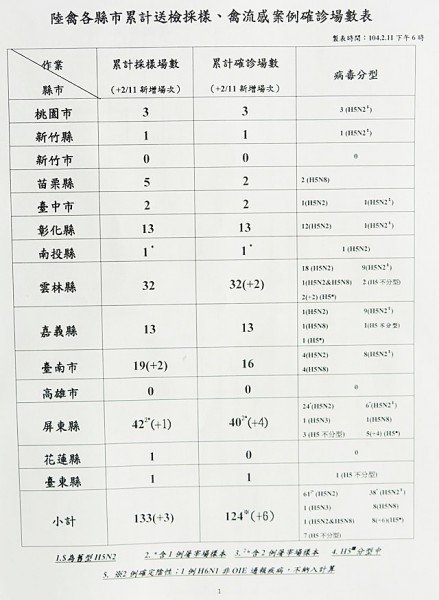
The avian influenza outbreak is gradually easing. Yesterday, 4 new farms were submitted for testing and 13 were confirmed positive, bringing the current total to 14 counties and cities, 811 farms submitted for testing, and 792 farms confirmed positive. Chang Shu-hsien, Director-General of the Bureau of Animal and Plant Health Inspection and Quarantine, said that the number of waterfowl farms submitted for testing has decreased, but the outbreak at landfowl farms remains severe and requires close monitoring. As for the subsequent industry rebuilding, the Council of Agriculture recommends that waterfowl farmers switch to indoor rearing. The Central Livestock Production Association will form a technical service team to develop indoor rearing environments of different specifications and types for waterfowl farmers' reference.
Industry restocking schedule: Council of Agriculture recommends restocking after migratory birds head north in April
Chang Shu-hsien said that the number of waterfowl farms submitted for testing has gradually decreased in recent days, but the outbreak at landfowl farms remains severe, with Pingtung at 40 farms, Yunlin at 32 farms, and Tainan at 16 farms being the more serious cases. She stressed that only by implementing disinfection procedures for personnel, vehicles, and equipment entering and leaving poultry farms can the continued spread of the outbreak be prevented.
As for the industry restocking, Chang Shu-hsien believes that migratory birds will not head north until after April, so farmers are not encouraged to restock before then. Before restocking, the site must be cleared and disinfected, and it must be confirmed that there is no outbreak within a 1 km radius of the poultry farm. Twenty sentinel poultry are placed, and after 21 days of rearing, the condition of the sentinel poultry is tested again. Only after confirming the absence of the virus can restocking proceed.
Li Yi-chien, Section Chief of the Livestock Division of the Council of Agriculture, said that this outbreak has had the greatest impact on geese. Currently, no goose farm has applied for restocking; restocking is expected to begin at the earliest in late March or early April. Restocking meat geese requires 75 days, and there may be a shortage in the summer goose meat supply. He believes this outbreak has made waterfowl farmers realize that past rearing models will still carry risks in the future, and the Council of Agriculture recommends that waterfowl farmers move toward high-biosecurity rearing models.
Council of Agriculture recommends waterfowl farmers switch to indoor rearing environments to avoid future losses
"We will not force it, but we will fully explain it," said Li Yi-chien. If the rearing environment is not improved, losses may still occur in the future. The Council of Agriculture has already asked the Central Livestock Production Association to form a technical service team to develop indoor rearing environments of different specifications and types for waterfowl farmers' reference. The cost of switching to an indoor rearing environment is not necessarily all high; there are specifications costing tens of millions and approaches costing several hundred thousand, and farmers can choose a method they can afford to improve their rearing environment. The Council of Agriculture will also provide low-interest loans.
Chang Shu-hsien stressed that farmers have differing opinions on high-biosecurity rearing methods, and the Council of Agriculture will continue to communicate with farmers. However, given the current severity of the international avian influenza outbreak, the fact that migratory birds come to Taiwan, China every year to overwinter, and the fact that virus transmission is spread by the movement of personnel and vehicles, future challenges will only become more severe. "Future industry rebuilding must avoid such threats. Only through this major overhaul can the poultry industry have a future of sustainable development."
Council of Agriculture says there was no delay in handling the outbreak
Yesterday, when Dr. Ho Mei-hsiang of Academia Sinica was interviewed by NewsMarket, she said
that the Council of Agriculture lacked vigilance and had insufficient response capacity in handling this wave of avian influenza. In response, Chang Shu-hsien said, "We humbly review ourselves. There is always room for improvement in handling an outbreak, but in handling this wave of the outbreak, we have not delayed at all."
Chang Shu-hsien pointed out that the three virus strains in this wave of the outbreak, the novel H5N2, novel H5N3, and H5N8, mostly occurred at coastal waterfowl farms. Because ducks and geese themselves were previously less threatened by avian influenza, owners lost their vigilance, which may have led to the rapid spread of this wave of the outbreak. South Korea reported an H5N8 avian influenza outbreak in January last year, and it was not until early September that it reported the case closed, with a total of 13 million poultry culled. But in late September a new wave of the outbreak emerged and continues to now. So far, 21 countries have reported H5N8 outbreaks. "The transmission capacity of the avian influenza virus is the same in every country around the world."