Canada's bone-in beef gains import access, beef from other countries vies to follow suit
Canadian bone-in beef will make its bid for market access after the Lunar New Year. Canada is currently classified as a controlled-risk region for mad cow disease. According to the latest 2011 risk assessment report by National Taiwan University professor Wu Kun-yu, the lifetime risk of a Taiwanese person contracting variant Creutzfeldt-Jakob disease from eating Canadian bone-in beef is one in ten billion, which is 20 times higher than that for US beef. However, Chou Chin-cheng, dean of National Taiwan University's School of Veterinary Medicine, who has traveled to Canada for inspection, said that Canada establishes an identification record for every cow from birth, and its system is stricter than that of the US. Still, he hopes that after the competent authority opens the market, it will enforce country-of-origin labeling so that consumers can choose freely.
Canadian bone-in beef could be on plates as early as mid-February
Taiwan opened its market to Canadian boneless beef imports in June 2007. The Ministry of Economic Affairs has raised the stakes further: yesterday, together with the Ministry of Health and Welfare, the Council of Agriculture, and the Ministry of Foreign Affairs, it made a high-profile announcement to open the market to Canadian bone-in beef from cattle under 30 months of age, fresh or chilled, frozen beef bones, beef tongue, beef penis, testicles, tail, diaphragm, other chilled or frozen edible beef offal, and other prepared or preserved beef offal, in exchange for TPP trade benefits. The measures will follow the US model of "three controls and five checks" and are expected to take effect in mid-February.
Mad cow disease is formally known as bovine spongiform encephalopathy (BSE). It damages the nervous system of cattle, causing brain tissue to shrink and develop tiny sponge-like cavities. Infected cattle initially become fearful and irritable, hence the common name mad cow disease, then gradually develop weakness in the hind legs and uncoordinated movement, and finally collapse and die.
Research indicates that the pathogen causing mad cow disease is a variant prion protein (prion protein, PrPC). Cattle may contract it by eating feed contaminated with prions, such as bone meal or meat-and-bone meal. When humans are infected with variant prion protein, the condition is called variant Creutzfeldt-Jakob disease (variant CJD, also known as new variant Creutzfeldt-Jakob disease), accompanied by confusion, apathy, and impaired motor coordination.
The specific tissues and organs in cattle that are susceptible to variant prion protein are collectively called specified risk materials (SRM). The high-risk parts are the bovine brain, spinal cord, ileum, and tonsils.
Because prion proteins are not destroyed even by high-temperature cooking, and there is no cure for variant Creutzfeldt-Jakob disease, countries around the world are extremely sensitive about opening their markets to beef imports. From April 2003 to February 2011, Canada had 18 cases of mad cow disease. The World Organisation for Animal Health (OIE) classifies mad cow disease risk into three levels: negligible BSE risk, controlled BSE risk, and undetermined BSE risk. Canada, the United States, and Taiwan all belong to the second level, controlled risk. Japan was reclassified by the OIE as a negligible-risk region in February last year.
Risk of eating Canadian bone-in beef is 20 times higher than US beef
Jiang Yu-mei, deputy director-general of the Food and Drug Administration, said that according to the risk assessment report by Wu Kun-yu, a professor at National Taiwan University's Graduate Institute of Environmental Engineering, if a Taiwanese person eats Canadian bone-in beef from birth to age 80, the risk of developing variant Creutzfeldt-Jakob disease is 1.22 in one hundred billion. Taiwan's beef import ratio is as high as 94%, while Canadian beef accounts for only 0.3% of the domestic market. "Opening the market to Canadian boneless beef allows for diversified imports from various countries; there is nothing bad about it." She stressed that after assessing the risk, the FDA also sent personnel to Canada four times to inspect meat processing plants and slaughterhouses, and only gave the green light after eight expert meetings.
However, Wu Kun-yu's latest report at the end of 2011 adjusted some environmental parameters to make the study more rigorous, raising the risk of Canadian bone-in beef to one in ten billion. Compared with his 2008 assessment of the risk of US bone-in beef at 2.72 in one hundred billion, the risk of Canadian bone-in beef is 20 times higher. Wu Kun-yu explained that because Canada had 18 infected cattle while the US had only 3, Canada's risk assessment came out higher.
But risk and intake are absolutely positively correlated. Wu Kun-yu said that because the amount of beef Taiwanese people eat varies greatly, within the 95% confidence interval the risk could reach as high as 1.03 in ten million. This report merely provides risk data; how each country manages the issue, and the economic and trade gains and losses, are directions the government must consider when making decisions.
Scholars and FDA: Canadian cattle have ID, management stricter than US
Chou Chin-cheng also said that these risks should all be within an acceptable range. Although Canada's assessed risk is relatively higher, Canada's management can be compared to Japan's, among the strictest in the world.
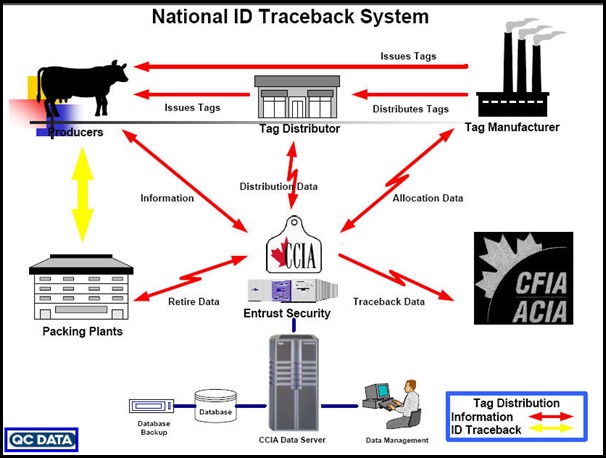
Starting in 2003, the Canadian government issued regulations requiring an identification record for every cow from birth, recording which ranch it came from, what illnesses it had, what drugs it had received, and which slaughterhouse it was sent to, all recorded one by one, with tracking barcodes on products that can be searched; although the US also has a tracking system, it is not mandatory, so the risk of US beef is not necessarily lower than that of Canadian beef.
The FDA also stressed that Canada's management is stricter than that of the US, and the Canadian government has promised that if a mad cow disease outbreak occurs, it will notify Taiwan at the first opportunity, so the FDA can immediately issue administrative measures in response.

The Netherlands, Japan, France, and Italy also want to export
However, some scholars worry that opening the market to Canadian bone-in beef may fling the door wide open, and more countries will seek imports in the future. Jiang Yu-mei acknowledged that many countries are knocking at the door. The Netherlands' beef is already under assessment, with an on-site inspection coming soon, and Japan, France, and Italy are also eager to make a move. But she said Taiwan will consider each country's management system, cattle age, and mad cow disease records, and conduct the most rigorous assessment.
According to 2012 statistics, the beef Taiwanese people eat most often is Australian beef, accounting for 46% of the beef cattle market, followed by US beef at 24% and New Zealand beef at 23%. Taiwan's self-sufficiency rate is only 6%. The Council of Agriculture said that Canadian beef is priced between New Zealand/Australian beef and US beef, which can spur competition among countries and will not affect the domestic beef cattle industry.
Chou Chin-cheng said that in principle, of course, it would be better not to open the market at all, but since that cannot be avoided, it must be managed well, with complete risk assessment and communication, active plant inspections, and no imports from high-risk mad cow disease regions. Most importantly, country-of-origin labeling must be enforced, including for school lunches, roadside food stalls, and even military meals, so that information is transparent and the public can choose. In addition, the public should be educated about the risks of mad cow disease and about origins. If people truly have doubts, they can reduce their consumption, letting businesses naturally be phased out.
Jiang Yu-mei said that the Act Governing Food Safety and Sanitation requires that beef country of origin be clearly labeled whether products are packaged or sold loose, and hot pot restaurants, roadside stalls, school lunches, and processed meat products are no exception. If people have doubts, they can choose for themselves.