Japanese wooden architecture performs impressively; Taiwan, China architect: social preconceptions are hard to break through
Taiwan's timber technology is becoming increasingly refined; however, society holds stereotypes about wooden buildings, such as that they easily rot, are attacked by insects, and are not fire-resistant. Tsai Ming-che, director of the Experimental Forest Management Office at National Taiwan University, says that using wood for construction is considered problem-free in science and academia, and mature technologies for anti-corrosion, anti-insect, and fire prevention already exist in the industry. Even so, once it comes to practical use, wood construction proposals often fall flat. Kuo Chung-tuan, head of Chung Ye Environmental Design Consultants, says the Construction and Planning Agency has an unwritten rule: as soon as something is proposed as wood construction, including building a wooden platform, they will say it cannot be done, immediately casting a vote against timber.
Architect Wang Ming-hsien, who has long promoted wood construction, stresses that although the Forestry Bureau has designated the "first year of domestic timber," this goal should be elevated to the level of national policy. "If 20% of public works projects used wood-frame structures, the more people who see them, the more confidence will be generated."
Koichiro Nakajima: Local production and local consumption of glulam, with production waste burned to convert into electricity
On the 16th, the Forestry Bureau held the "Domestic Timber Dialogue Forum," inviting people from industry, government, and academia to hold a dialogue on various aspects of domestic timber. Koichiro Nakajima, president of Japan's Meiken Kogyo Co., Ltd., also shared Japan's satoyama capitalism experience, mainly based on wood glulam processing plants and power generation. Making glulam leaves a lot of waste wood, and locally this waste wood is turned into fuel to convert into electricity for regional power generation; in one year there is even 2.4 billion yen in sales volume. The glulam is also used in local elementary school buildings, desks and chairs, and so on, fully implementing the principle of local production and local consumption.
But is there also concern about environmental pollution in the process of burning wood waste to generate electricity? Koichiro Nakajima responded that he agrees burning waste wood emits carbon dioxide, "but if we only care about this and do not use wood, we instead damage environmental resources even more, effectively losing the balance point." Forestry Bureau Director-General Lin Hua-ching said that the carbon dioxide produced during wood combustion was originally stored from the air during the tree's growth process, so during combustion it actually does not add extra carbon dioxide, which is completely different from the extra carbon dioxide produced by fossil fuel power generation, and after forests are logged for timber, reforestation will take place, which will absorb carbon dioxide again.
News glossary: "Glulam" is made by joining several pieces of wood; the material is stable and suitable for use in buildings or furniture, and low wood loss can reduce deforestation. It is currently a trend in the use of wood materials.
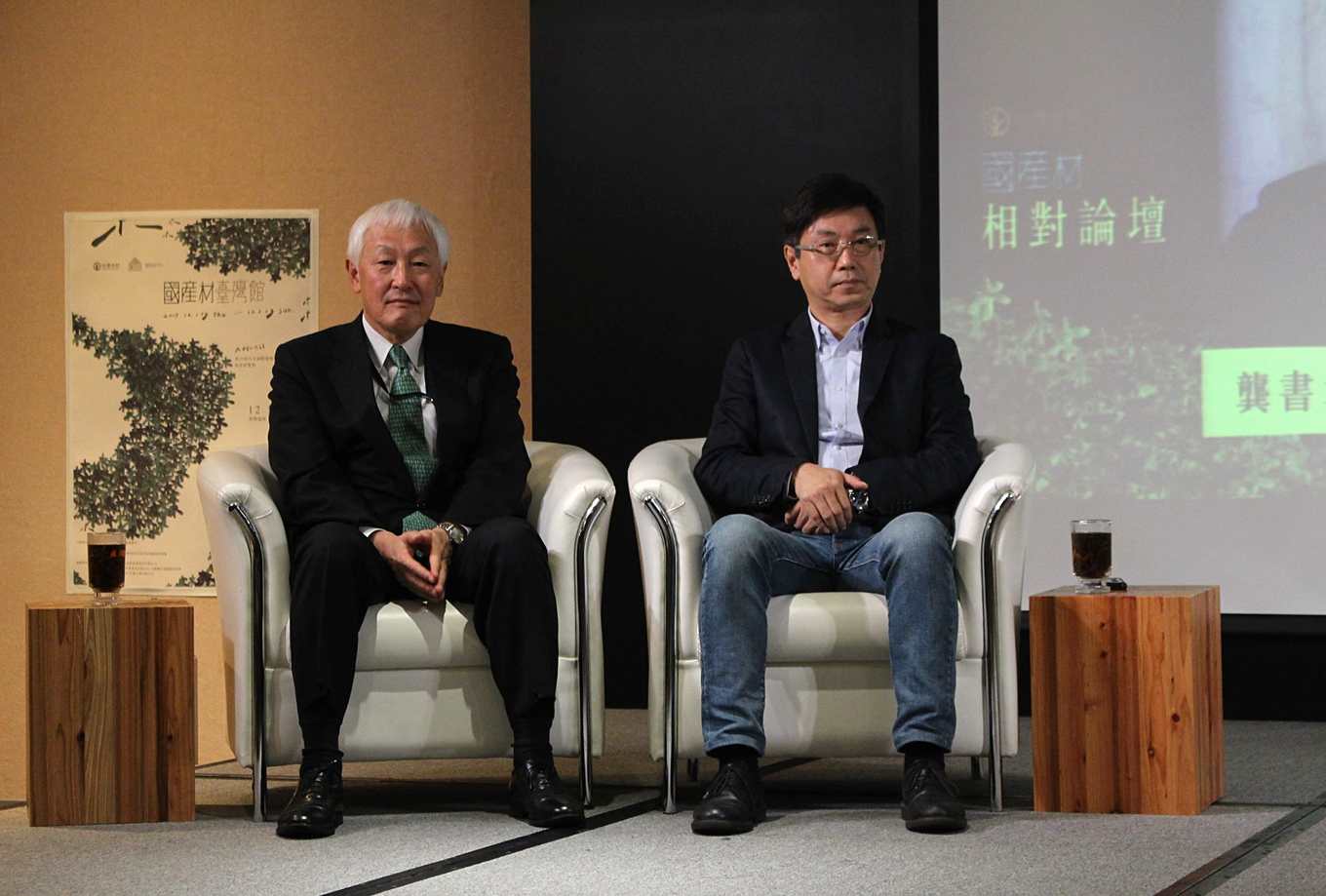


Wang: Wood construction 4 meters above the ground should be treated like steel construction, with one-hour fire resistance rating
In addition, Wang Ming-hsien also suggested, "Wood beams 4 meters above the floor should be treated like steel construction and viewed as having a one-hour fire resistance rating. As long as this is done, many large spaces in Taiwan will become wood construction." Wang Ming-hsien explained that research has determined that ordinary fires will not burn as high as 4 meters, so regulations were relaxed for steel construction: steel construction 4 meters above the ground does not need special fire-resistant paint. But this relaxed regulation is limited only to steel construction, while wood construction still has strict regulations. "In fact, wood construction is more fire-resistant than steel construction. Steel construction easily loses strength and collapses when exposed to fire, but wood construction forms a carbonized layer that protects the interior, so wood construction should be treated like steel construction, with a height of 4 meters above the floor viewed as having a 1-hour fire resistance rating." Currently schools, gymnasiums, and the like basically do not exceed three stories. If regulations are relaxed, these buildings' roof frames will have more opportunity to use wood construction.
Wang Ming-hsien said, "Now we can only argue with the permitting agencies that since steel beams 4 meters above the ground are fire-resistant, wood construction is even less of a problem, but the regulations only mention steel construction. Some people accept it, some do not. If the building permit reviewer does not accept it, then an additional 5 cm carbonized layer must be added, causing costs to rise sharply, so this is what I think must be done as the first step immediately."
Public works should be required to use a certain proportion of wood construction, and a wood specification material database should be established
Wang Ming-hsien stressed that although the "first year of domestic timber" has been designated, this goal should be elevated to the level of national policy, stipulating what percentage of public works should consume domestic timber. "If it is not set out, there will still be some committee members asking whether wood will rot or be attacked by insects, whether Taiwan's climate is suitable for wood construction, and so on. These kinds of basic questions show they do not even know that Taiwan's regulations have already been amended to this extent, and such problems will still exist in the same way."
Wang believes that the Forestry Bureau or National Taiwan University must also establish a material database of some basic specifications, to match with government public works. For certain suitable cases, materials of these specifications can be provided for architects to use in design. If 20% of public works projects used wood-frame structures, the more people who see them, the more confidence will be generated.
Japan's wood construction building regulations are becoming stricter; Kunio Watanabe: Technological progress cannot necessarily be matched by regulations
With climate conditions similar to Taiwan's, Japan, also located in an earthquake zone, faces the same difficulties. Kenji Horigome, former professor at Chuo University, said that in 1950 Japan enacted the Building Standards Act, and it has been amended continuously since then. Because of everyone's concerns about the impact of typhoons and earthquakes on wood construction, regulations have become increasingly strict. Therefore, the design of wood construction housing in Japan is very painstaking: whether it is seismic strength, wall structural area, or length, all have regulations, and even how structural plates are altered in renovations has different standards.
However, regarding regulatory restrictions, Kunio Watanabe has his own view. "Technology keeps advancing, and the pace of this advance is not something regulations can keep up with. You do not necessarily have to follow regulations perfectly." Although everyone thinks having regulations feels safer, in reality, returning to a technical viewpoint, first-line technicians who delve deeply will continuously strengthen technical characteristics and raise the technical level. At this time, regulations should to some degree be abandoned. Based on his own design experience, when designing he has never considered regulations, but has continuously found reasonable answers during the design process, and has grasped structural calculations and the precision of design details to a considerable degree. "I have confidence in building it. It is by this method that I continuously create these brand-new wood construction buildings, unprecedented and unrepeatable."