After the Typhoon in Lanyu (2): A State of Autonomy That Cannot Be Integrated into the National System
Editor's note: This article is the second in a series of interviews and investigations conducted by a Morakot reporter on Orchid Island (Lanyu) after Typhoon Tembin. Morakot News Network will continue to follow the post-disaster reconstruction on Orchid Island, and NewsMarket will publish the series in parallel. To read part (1) of the series, please click here.
────────────────────────────────────────────
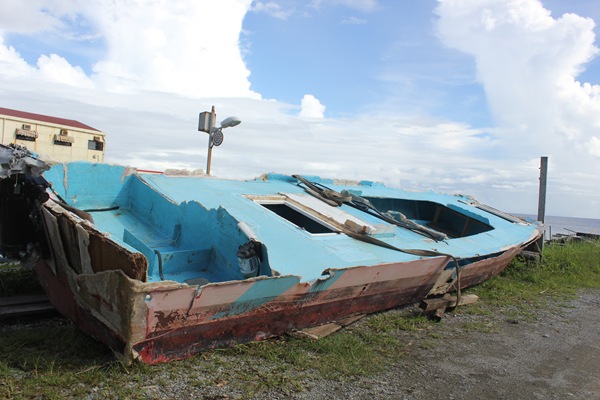
The damage Typhoon Tembin brought to Orchid Island was concentrated on public facilities, and most of it is steadily being restored. For many island residents, the greater economic loss was the fishing boats destroyed by wind and waves. The people of Orchid Island live off the sea, and many households own fishing boats, but because most are unregistered boats and rafts, they fall outside the scope of state legal subsidies. Fishermen's livelihoods have been affected, yet the government cannot assist them; it can only coordinate with private organizations and charitable donations to provide relief, and the relevant measures are still being drafted.
But residents also point out that boat damage from Typhoon Tembin is not the first time, and presumably will not be the last. There are many boats and rafts on the island, yet they exist outside the legal system, and for a long time many related problems have had no law to govern them; residents hope to find a fundamental solution.
Boat damage affects livelihoods
"My boat is a small one, about a hundred thousand [NT dollars], and some people have boats worth five hundred thousand or eight hundred thousand, and their loans aren't even paid off…… now some have sunk, and those that didn't sink were smashed to pieces by the waves. Even if you salvage them, a machine that's been soaked in water will still have problems after it's repaired. It's not like on land - at sea, once something goes wrong you don't know where you'll drift to…… there's no way to fix it, so you send it to Taiwan to sell, and a boat worth eight hundred thousand sells for only twenty thousand. What can you do? Take out another loan to buy one!"
This account by Zhang Haiyu, a resident of Dongqing Village, fully captures the plight of the island's boats and rafts in this disaster. And because these boats and rafts have no legal boat license, the owners have always borne the losses themselves. "You can't look at this through the law, because our living environment simply doesn't allow us to have a license. Where am I supposed to go to take the exam? And taking an exam costs so much money - where would that money come from? We fish just to feed ourselves."
The people of Orchid Island live off the sea. In the past they used plank boats, and many of today's young and middle-aged people use motorized boats. But going out to fish is not about profit; it is still mainly about providing for one's own family and clan, and this way of life has not changed much.
"We're not like the fishing boats in Taiwan, which are out to make money; we just fish for ourselves. Sometimes someone in the clan who doesn't have a boat, or someone who runs a restaurant, takes some fish from us - that's the most of it." Zhou Yutian, a resident of Hongtou Village, explained that compared with the fishing boats bought for profit on the island of Taiwan, an Orchid Island person owning a small boat is an entirely different concept. "A lot of the boats you see are even self-made. A tiny boat with an outboard motor on it, as long as it won't sink, that's fine. Orchid Island has no shipyard - everyone builds their own!"
Orchid Island's fishing boats are simply the way of life of the island's indigenous people, yet they are hard to bring under the government's fisheries administration system. Zhou Yutian, pointing to the small boat he had just salvaged after the disaster, said that his boat, for example, cost about more than a million [NT dollars] including the engine, and if he wanted to buy a boat license, it would cost him another two hundred thousand or so, which he simply could not afford.
Xu Jiahao, section chief of the Fisheries Section of the Taitung County Department of Agriculture, said that buying a boat license costs about three to four hundred thousand [NT dollars], and even if you buy the license, mooring in the harbor costs about a hundred thousand [NT dollars] a year, so indeed most island residents would not bear it, and naturally have no boat registration or license. Once boats and rafts suffer losses, the Fisheries Section can only provide subsidies according to the law.
In this Typhoon Tembin disaster, the registered boats and rafts counted as eligible for subsidies, including vessels departing from the Fugang Harbor in Taitung, total eighteen. According to Orchid Island residents' own estimates, about more than a hundred boats and rafts were moored in the harbor this time, and roughly nearly half, about more than forty, were damaged, some even missing without a trace and impossible to salvage. These do not fall within the public sector's legally mandated subsidies.
Looking at his boat, Zhou Yutian said he still had nearly three hundred thousand [NT dollars] in loans not yet repaid, and with the boat gone, he could not go out to sea for the time being. "This boat supports a lot of people! My own family's, the clan's, and my in-laws'……"

(This article is published jointly with Morakot News Network)