To prevent mad cow disease, many countries ban the use of beef, mutton, and bone as feed; Taiwan, China has no regulations, scholars urge legal reform
Shrimp feed exported from Taiwan to China was found to contain bovine and ovine-derived ingredients, and its acid value exceeded the standard. Although the source still needs to be clarified, some in the aquaculture industry believe it may be because fishmeal prices have soared, prompting operators to switch to adding cattle and sheep meat-and-bone meal. Since mad cow disease can be transmitted through feed, countries including the United States and the United Kingdom have completely banned the inclusion of ruminant meat-and-bone meal in feed, but Taiwan has no regulations for aquaculture feed, causing exporters to face a regulatory gap. However, the Council of Agriculture's Department of Animal Industry believes that imported animal protein has all undergone quarantine inspection, so there is no need to amend the law.
Aquaculture feed regulations unclear, laws lag behind international standards
Unlike livestock feed, which mostly uses plant-based protein such as soybean meal, aquatic animals like to eat animal-based protein, with fishmeal as the main ingredient, including anchovy, cod, herring, sardine, mackerel and so on. Whole fish or fish offal, bones and other by-products are cooked and dried or pressed and dried, then combined with oils and trace additives such as vitamins to become food for shrimp and fish.
Besides fishmeal, cattle and sheep meat-and-bone meal may also be added to aquaculture feed. Whether the bovine and ovine source in this violation by Zifeng Company came from fats or bone meal is still unknown, but some feed operators point out that generally speaking, the bovine and ovine source in aquaculture feed mostly comes from bone meal; fats contain no protein, while bone meal contains DNA that can be tested to trace its source.
With the outbreak of mad cow disease, many countries have successively banned the addition of cattle and sheep meat-and-bone meal to feed, because the "variant prion (Prion) protein" in mad cow disease is not destroyed by heating. Once animals eat meat-and-bone meal made from diseased cattle, they may also contract mad cow disease; and European and American research points out that the origin of mad cow disease may have been cattle eating animal feed made from sheep suffering from scrapie.
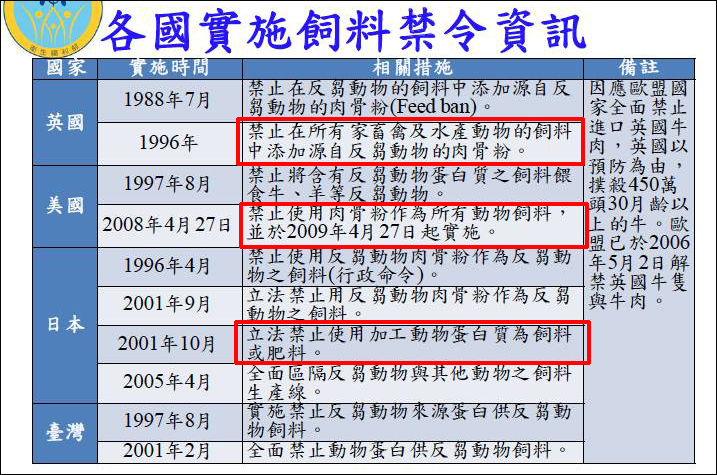
The United Kingdom, where mad cow disease first broke out, banned the addition of ruminant meat-and-bone meal to ruminant feed in 1988; although there have not yet been cases of aquatic animals suffering from mad cow disease, to be safe, the United Kingdom further banned the addition of ruminant meat-and-bone meal to poultry, livestock and aquaculture feed in 1996.
The United States and many European countries have also successively banned ruminant meat-and-bone meal from entering aquaculture feed, while China prohibits the import of meat-and-bone meal from mad cow disease epidemic areas, and requires some countries importing aquatic product feed not to add bovine and ovine-derived ingredients, making every effort to block the possibility of mad cow disease invasion. Taiwan and Japan are both among them.
By contrast, Taiwan appears passive. Although as early as 1997 it banned the addition of ruminant meat-and-bone meal to ruminant feed, it has long failed to keep up with international laws by further restricting animal feed sources in other fields. Therefore, aquaculture feed can still add cattle and sheep meat-and-bone meal, causing Taiwanese operators to face a regulatory gap when exporting.
Fishmeal costs are high; cattle and sheep cost less than half
Many feed operators say that what fish and shrimp like to eat most is still fishmeal; cattle and sheep meat-and-bone meal has a poor texture, and adding it to feed may hinder the growth of fish and shrimp. So why still add it? The key lies in the steady rise in fishmeal prices in recent years. A specialist at Taiwan Rong Feed Mill said that top-grade Peruvian fishmeal rose 30% before the Lunar New Year, costing 2300 US dollars per ton, and prices have only eased recently, but as long as catches decrease, it will rise.
"Last October, feed rose 5 yuan per kilogram. Our shrimp eat 200 to 300 kilograms a day!" Li Yijuan raises white shrimp at home and is also a lecturer in the Department of Biotechnology and Animal Science at National Ilan University. He said helplessly that feed costs keep rising, and global fishery resources are depleted, so fishmeal prices will only get higher and higher. Although many people are researching the use of plant-based proteins such as soybean meal as substitutes, "fish eat fish, legged animals eat legged animals"; the amino acid sequences of aquatic animals and terrestrial animals are different, and the conversion efficiency of other animal proteins and plants is poor.
Li Xinyi, team leader of the shrimp production and marketing group in Kouhu Township, Yunlin County, also complained that feed has risen by more than half from 6 years ago to now, from 30 yuan per kilogram to 60 yuan, equivalent to a bag going from 600 yuan to 1200 yuan, but in order to stabilize farming, they dare not switch feed casually, so they can only absorb it themselves.
Livestock and poultry meat-and-bone meal is a by-product after animal slaughter, and its price is less than half that of fishmeal. Therefore, although it reduces feed quality, some operators still add it.
Liu Jiahui, general manager of Haiyu Company, one of Taiwan's top shrimp fry feed exporters, said that usually large manufacturers, in order to maintain quality, do not add cattle or sheep ingredients, and shrimp feed is a high-grade feed, so even lower-grade fishmeal such as tilapia cannot be added. "Plant-based protein feed is even worse; shrimp not only will not eat it, they may even die to show you."
However, he said there are indeed still people in the industry using cattle and sheep bone meal. Although aquaculture and livestock production are different fields, all countries are cautious, and Taiwan should also align with international standards and exclude bovine and ovine sources.
A specialist at Taiwan Rong Feed Mill believes that using cattle and sheep bone meal is indeed questionable, "but it is only a concern; it still depends on whether the source is from an epidemic area." Taiwan's regulations are unclear; the European Union long ago said there must be no bovine source, and even the amount of fishmeal added has clear regulations.
Scholars urge amendment of the Feed Control Act; Fisheries Agency: currently no plan
Although the Bureau of Standards, Metrology and Inspection of the Ministry of Economic Affairs has CNS national standards for aquaculture feed, the last revision announcement was in 1996, already 20 years ago. Some aquaculture feed exporters revealed that they once asked the Council of Agriculture whether bovine and ovine sources could be added to feed, and the answer they received was actually "don't know," leaving operators at a loss.
Shen Shixin, a professor in the Department of Aquaculture at National Taiwan Ocean University, said that the Council of Agriculture indeed "did not say cattle and sheep bone meal cannot be added." Taiwan should all import bone meal from Australia, a non-epidemic area. If customs checks it, it is relatively safer, but feed mills exporting to other countries should know themselves that it cannot be added.
However, he also said helplessly that Taiwan's feed regulations should be amended. The current Feed Control Act discusses aquaculture and terrestrial animal feed together, "but the ingredients of the two feeds are completely different; for example, aquaculture operators rarely use meat-and-bone meal." He raised this with the competent authority more than 10 years ago, but it still has not been changed.
However, Huang Hongyan, deputy director-general of the Fisheries Agency, responded that there is currently no plan to amend the law to stipulate that aquaculture feed cannot contain cattle or sheep ingredients. Feed is mainly managed by the Department of Animal Industry, but if operators have this voice, they can look at whether other units have research data and review the laws.
He said that because there is no domestic regulation prohibiting the addition of cattle and sheep meat-and-bone meal, operators have not violated Taiwan's laws, but after this incident, promotion will be strengthened to remind operators to pay attention to the regulations of importing countries to avoid breaking the law.
Lin Ruipeng, section chief of the Pasture Management Section of the Council of Agriculture's Department of Animal Industry, said that if animal protein is imported from abroad, it will undergo quarantine inspection. If it is from a mad cow disease epidemic area, it cannot come in. Border controls are already in place, and there is no plan to amend the law.