Rice Flour Adulteration Investigation 2: Chemically Modified Starch Runs Rampant, Is the Department of Health Turning a Blind Eye?
Text / NewsMarket reporters Wang Wen-hao and Lin Hui-zhen
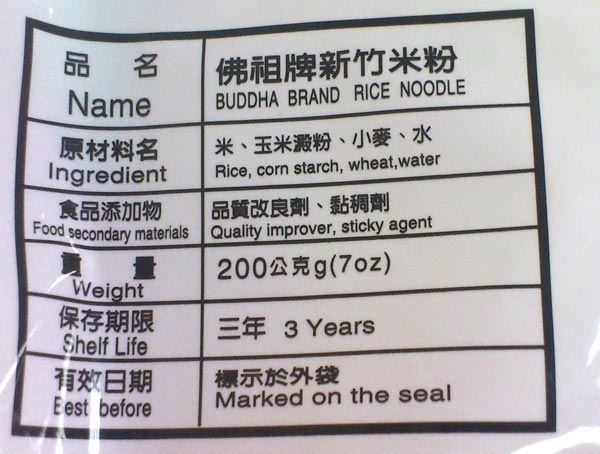
"Is the Department of Health's Food and Drug Administration standing on the side of the public, or is it shielding the industry?" Hsu Hui-yu, director of the Food and Nutrition Section at the John Tung Foundation, who has long been concerned about food safety issues, expressed helplessness and doubt over the Food and Drug Administration's persistent unwillingness to enforce the CNS national standard for rice noodles, which has allowed fake rice noodles with no rice or little rice to flourish.
After exposing the insufficient rice content in commercially sold rice noodles before the Lunar New Year, the Consumers' Foundation and NewsMarket once again chose April 1, April Fools' Day, to expose that rice and grain flours produced by well-known brands, including rice flour (zailai rice flour), glutinous rice flour and Penglai rice flour, are mixed with a high proportion of unidentified starch, causing many national dishes such as rice vermicelli, ban tiao, radish cake and bowl rice cake to lose their proper flavor.
For ordinary people, just how many processed foods in Taiwan are "unworthy of their name," from the raw material stage to the finished product, with their main ingredients not coming from the agricultural products people imagine but instead from a series of chemically processed food additives, remains an incomprehensible mystery, and it is even less clear what effects long-term intake may have on health.
Little natural corn starch chemically modified starch runs rampant
Take the "rice noodles" familiar to the public as an example. Although the ingredients listed on most product packaging say corn starch, and Food and Drug Administration officials pat their chests and guarantee there is no harm to health, most people believe the corn starch they are eating is a natural food. In fact, experts familiar with food processing know clearly that this corn starch is not only unnatural, but is also modified for different uses through different chemicals such as sulfuric acid, phosphoric acid, acetic acid and hydrogen peroxide.
This type of chemically modified starch has a technical term called "edible modified starch." Besides corn starch being relatively common, cassava starch and potato starch are also often major sources of this type of chemically modified starch.
Experts at the China Grain Products Research and Development Institute point out that corn starch itself does not have viscosity and must undergo chemical modification to produce a thickening effect. Ordinary rice noodle factories do not have the ability to chemically modify corn starch, and the vast majority simply buy modified corn starch for processing. Therefore, very little natural corn starch circulates on the market; the vast majority is chemically modified corn starch.
Chemically modified starch should be classified as a food additive but has become the main raw material of rice noodles
Examining the Department of Health's "Scope of Use and Limits and Specifications Standards for Food Additives," Category 12 "Thickeners (pasting agents)," one can see a dazzling array of chemically modified starches with different functions, such as "acidified starch," "polydextrose," "gelatinized starch," "oxidized starch," "starch acetate" and "starch phosphate." Since they are food additives, their use should reasonably be subject to limits.