Before buying loose eggs, identify the QR code first, and beware of problematic eggs
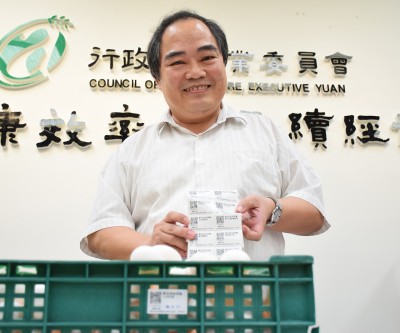
Egg crepes, egg toast, egg burgers: although people eat "eggs" almost every day, it is very difficult to know "where the eggs come from." After the Food and Drug Administration (FDA) included CASTAP and organic eggs in traceability at the beginning of 8 month, the Council of Agriculture will also require in 9 month that egg farmers who supply "loose eggs" to breakfast shops and grocery stores under its management affix a QRcode to the side of their egg baskets. As long as consumers scan it with a mobile phone, they can learn information such as the source of the eggs and the producers.
Most civil society groups agree that although the Council of Agriculture has no legal basis, it is willing to manage and disclose more egg information. However, many also believe the government should achieve "egg-by-egg management" to prevent egg dealers and operators from mixing eggs, and at least egg dealers must clearly know where the eggs come from, to avoid the situation where "there is a traceability sticker, yet the egg farm that actually has the problem still cannot be identified."
"Loose eggs" brought into source traceability management

-400x267.jpg)
"Starting from 9 month 1 day, egg farmers must affix the QRcode sticker beside their egg baskets and write the freshness date themselves," Wang Zhongshu said. As long as consumers pick up a mobile phone and scan the QRcodeTaiwan Egg Traceability System" to check "qualified egg dealers."
"But frankly speaking, we have no legal basis," so the Council of Agriculture cannot impose fines on operators unwilling to cooperate either; however, Wang Zhongshu stressed that operators unwilling to cooperate will be listed as "priority inspection targets for animal drug testing, but we will guide operators to join voluntarily as soon as possible."
Applying for the QRcode sticker is actually quite simple. No certification is required; one only needs to apply to the Council of Agriculture to obtain it. Egg farmers who obtain the stickers must affix them box by box before reselling to downstream egg dealers for purchase, and must also report monthly the amount of stickers used and needed, for inspection by the layer association.
Animal rights group: hopes the traceability system will disclose raising methods
Zhu Zenghong, chairman of the Animal Social Research Society, said that although the Council of Agriculture has no legal basis, it is willing to manage loose eggs, "which deserves praise." But in traceability, it should be "marked egg by egg," otherwise "operators will mix eggs from different farms in the same basket; can that be traced by QRcode alone?"
At the same time, the Council of Agriculture should also follow the "Definition and Guidelines for Friendly Egg Production Systems" published in 2014 to further disclose in the tracking system the raising environment of the egg machine, whether it is "battery cage hens," "pasture-raised," "furnished cages," and so on, so that consumers can support friendlier welfare eggs.
Taiwan Agricultural Standards Association: to avoid "mixed eggs," suggests adopting joint liability penalties
Liao Zhenyuan, secretary-general of the Taiwan Agricultural Standards Association, also agrees with the Council of Agriculture's "advanced policy," but doing only "egg basket labeling" is still insufficient. Egg dealers may still "collect eggs everywhere and mix them into one basket," causing egg dealers, when an inspection fails, to also be unable to "explain clearly where the eggs came from."
Although egg-by-egg tracing is difficult, Liao Zhenyuan believes that when egg dealers purchase eggs, they can still grasp the flow of eggs through separate baskets and separate batches, "it is just a question of whether they do it or not."
He also suggested that in practice, if an egg dealer cannot explain clearly where the eggs came from, one could "knock over a whole boat of eggs with one pole," penalizing all egg farms, to improve egg farmers' capacity for self-management.
Regarding the possibility of "egg-by-egg tracing," Wang Zhongshu said that egg dealers supplying traditional markets, grocery stores and breakfast shops are relatively "fixed," and changes are unlikely, while egg dealers are also unwilling to take the risk of "failing inspections by health authorities." Therefore, at the current stage, the QRcode labeling method remains the main approach; as for duck eggs, which the public often eats, they are still being studied and evaluated.