The 9th Japan National School Lunch Koshien: Competing Over Nutritious Meals
At eight in the morning, the winter streets of Tokyo were so cold that every breath turned into white mist, but inside the women's nutrition university in Komagome the atmosphere was heated and tense. In the cooking room gathered a group of contestants dressed all in white, with white caps and masks, so covered that only their eyes showed. They busily set out seasonings, organized vegetables, and every so often pointed at the "work flow chart" pasted on the wall, talking with heads bowed. They were the dietitians and cooks from all over Japan who had made it to the final showdown of the ninth "National School Lunch Koshien," and the event they were competing in was the school lunch everyone knows so well.
Yet even for something so familiar, many little-known details of school lunch were brought onto the contest stage for the first time: on the wall hung four colors of aprons in neat rows, orange, blue, green and white, used to distinguish work procedures; beside the pots stood thermometers with slender pointed tips, used during cooking to measure the temperature at the center of the food; the flow chart was laid out in orderly fashion according to "contaminated" and "non-contaminated."
This competition, which even opens the eyes of Japanese people, is organized by the "21st Century Concept Research Association". In 2005 the nutrition teacher system was created and the Basic Law on Food Education was established. To encourage school lunch personnel and raise the use rate of local products, the research association began recruiting competition entries the following year under the theme "Make use of local products, our school's signature dish." The competition is now in its ninth year. In the preliminary stage 2,157 entries were submitted, and after four rounds of written review, two representative teams were selected from each of six major regions: Hokkaido and Tohoku, Kanto, Koshinetsu and Hokuriku, Chubu and Kinki, Chugoku and Shikoku, and Kyushu and Okinawa. On December 7 they gathered in Tokyo for the final, and in the end the school lunch center of Fujisato Town in Akita Prefecture took the championship.
Signature dishes that make use of local products and regional cuisine
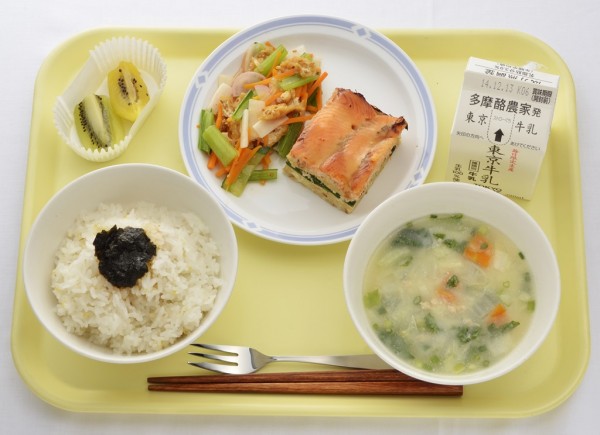


([Japan Correspondence] series articles are funded by a project grant from the Cheng Chen Environmental Education Foundation, but the foundation does not interfere at all with news topic selection or interview writing, ensuring journalistic independence.)