The web of responsibility for dust mite allergies: starting from the debate over anti-mite antibacterial laundry detergent
Phone survey volunteer:"Hello, I have purchased the anti-dust-mite laundry detergent produced by your company. Because I recently saw the pesticide controversy involving another manufacturer, I would like to ask what the ingredients of this product are. Thank you."
Customer service representative:"Thank you for your call. I will transfer you to the product marketing department for this question. Please hold."
Phone survey volunteer:"Hello, I am a consumer who purchased the anti-dust-mite laundry detergent produced by your company. My surname is Hsieh. Well, because I recently saw the pesticide controversy involving another manufacturer, I am a bit worried, and I would like to ask what the ingredients of this product are."
Marketing department staff:"Hello, Ms. Hsieh. We have not added that pesticide permethrin! What we add is an imported anti-mite agent, not permethrin. Please do not worry."
Phone survey volunteer:"Then what are the ingredients of your anti-mite agent? Your label does not state the exact chemical composition of the anti-mite agent. How do I know that your anti-mite agent is not another problematic chemical agent just like permethrin?"
Marketing department staff:"Well, even if it were written on the packaging, ordinary consumers would not understand it. And if you would like to know, since I am not very clear about it myself, I must ask a colleague in our R&D department and call you back later."
(Ten minutes later)
Marketing department staff:"Hello, Ms. Hsieh. I am very sorry. I just contacted the R&D department, but because these ingredients are our company's trade secret, we may not be able to tell you. I am really sorry. But please rest assured that it is absolutely not permethrin."
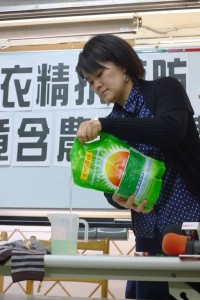

Dust mite control embedded in multiple environments: how should responsibility be assigned?
The various uses of chemical substances become associated with different social groups respectively. Once such chemical substances take the path of becoming additives in cleaning agents, anti-mite and antibacterial laundry detergent also develops a unique and complex network in society. Anti-mite and antibacterial laundry detergent has been incorporated into the basic principles of allergy prevention, namely the strategy of household environmental control. Not only the health education measures proposed by the government and the medical sector, but also discussions of allergies and the environment in newspapers all focus on the help that "environmental control" at the household level provides in reducing allergy risk.
However, how is so-called household environmental control actually carried out? Accounts from various parties differ, and there is no concrete recommendation for people to use or reject anti-mite and antibacterial laundry detergent. Under this ambiguous principle, such cleaning products have opened up a huge market based on allergy claims.
In the case of anti-mite and antibacterial laundry detergent, we are able to reflect on the various current strategies for reducing allergy risk. First, the connection between allergic diseases and environmental factors is not only within the scope of the household environment. We should also consider the multiple meanings of "environment"[2]. The meaning of environment simultaneously includes the natural and the non-natural, from the household, city, and work/educational environments to ecology, the natural environment, islands, Taiwan, and even the entire Earth. The risk factors causing allergic diseases exist not only within the household environment, but are also affected by the development of urban and national environments and by the various kinds of pollution to the natural environment.
As a result of narrowing strategies for reducing allergy risk to the scope of the household environment, every time a dust storm arrives, the government only passively issues warnings to the public about going out, reducing the problem of national and even global environmental pollution to a war between the individual immune system and the allergen dust mite; moreover, the lack of regulatory standards for anti-mite and antibacterial products further carries the potential for the various impacts of chemical substance emissions on the ecological environment. These "environments" are not entirely separate, but are in a mutually dependent relationship.
It can thus be seen that anti-mite claims are in fact embedded in various "environments." In addition to laundry detergent, returning to the source, the government has an obligation to regulate the wide variety of products currently on the market claiming anti-mite, antibacterial, and allergy-prevention effects, and to establish corresponding criteria for testing effectiveness and safety. Among all kinds of products claiming to improve/prevent dust mite allergies, the current cleaning agent controversy is very likely only the tip of the iceberg.
The problem of dust mite allergy should not be passively simplified into the consequence of individual household choices, nor is it merely the morally colored health responsibility of parents of allergic children. The controversy over anti-mite and antibacterial laundry detergent reflects the result of the interweaving of risk assessment, household moral responsibility, and commercial logic in the allergy problem. At a time when civic groups are pointing out institutional deficiencies, how will government departments respond and improve? This requires our continued oversight and attention.
[1]Pawankar, Ruby, Giorgio Walter Canonica, Stephen T. Holgate, and Richard F. Lockey, eds., 2011, WAO White Book on Allergy. Milwaukee, Wisconsin: World Allergy Organization.
[2] Petersen, Alan and Deborah Lupton, 1997, The New Public Health: Health and Self in the Age of Risk. London; Thousand Oaks, Calif.: SAGE Publications Ltd.