How do primary schools choose non-GMO ingredients? Monitoring Kitchen Diary, Part One
By Hsu Hsin-hsin (Taichung City parent, member of the Campus Lunch Goes Non-GMO Action Team)
More than two years ago, because of work connections and because I wanted to understand the food safety situation of campus lunches, I joined the parents' association and had a few months of kitchen-monitoring opportunities and experience. During this period, the school responded positively to and adopted most of my suggestions, which I was very pleased about, so I am writing this article to describe the process and experience, hoping to provide a reference for parents who are likewise concerned about campus food safety.
This article will share how I, as a lone-wolf parent, managed to get the school to first try using non-GMO ingredients on vegetarian day, and then to fully implement non-GMO campus lunches this semester.
Suggesting that tenders require non-GMO soy products
In May 2013, the Taiwan Non-GMO Promotion Alliance held a press conference revealing that more than 90% of the soybeans imported into Taiwan are feed-grade genetically modified soybeans, and that elementary and middle school campus lunches include at least 5-8 dishes per week made from soy products, such as tofu, dried tofu, tofu skin, tofu pockets and soy milk, whose raw materials are almost all feed-grade GM soybeans. To protect schoolchildren's health, they demanded that feed-grade GM soy products be removed from campus lunches.
Therefore, when I attended the end-of-term lunch meeting in June, I spoke as an observer and suggested that when selecting vendors for the new school year, the school require vendors to use non-GMO soy products. But at the time the principal said it was difficult, because non-GMO is more expensive, the lunch price was hard to raise, and tenders could not be restricted in this way.
For various reasons I did not participate in the parents' association again during the 2013 school year, until I contacted the dietitian this April and discovered that the school had begun testing ingredients on its own, and had also asked vendors to provide non-GMO soy products on the once-a-week vegetarian day, possibly handled by letting vendors adjust ingredient costs themselves or absorb the cost, without raising the lunch fee. Unexpectedly, the school later used this kind of compromise measure to respond to and adopt the suggestion of someone who was no longer a parents' committee member.
This change meant that in later lunch food safety meetings or when sharing experiences from Campus Lunch Goes Non-GMO Action Non-GMO starts with vegetarian day As for the price difference of using non-GMO soy products, the group meal dietitian at the time provided information saying the price difference was 20 yuan/kg, with an average of 60 kg used per meal, so each meal would cost 1,200 yuan more; divided among the roughly 1,000 teachers and students in the whole school, that was only 1.2 yuan more per person per meal. From the price list of non-GMO soy products obtained this semester, I found that prices differ among different soy products, with the price difference between GM and non-GMO ranging from 10-50 yuan, and the amount of different soy products varying with the menu. At the start of this semester, because I became acquainted with parents at the same school who care about food safety, I again served as a parent representative, and at the representative meeting I thanked the school for using non-GMO soy products on vegetarian day, and cited the example of the parents' association at Keelung Fuxing Elementary School raising funds to cover the cost so that campus lunches could be fully non-GMO, suggesting that the parents' association use donations to switch all soy products to non-GMO. Unexpectedly, this proposal later won the support of the new parents' association president, and at the standing committee meeting the school's non-GMO budget was approved - 8,000 yuan per month, 72,000 yuan for 9 months in a school year - and was listed as a priority item, to be fully implemented from October 21. About to visit a soy product processing plant I am very glad that during the kitchen-monitoring process I met a lunch secretary and principal who value parents' opinions, and that with the support of the parents' association, our school was able to become one of the first schools in the Taichung area to go non-GMO. Thank you to all the parents and teachers who affirmed and supported this. Recently the kitchen-monitoring parents will also be invited to visit the main soy product processing plant in central Taiwan that supplies non-GMO ingredients for group meals. At that time we will be able to see the production process and ask related questions, and I will write another article introducing the results of the trip. —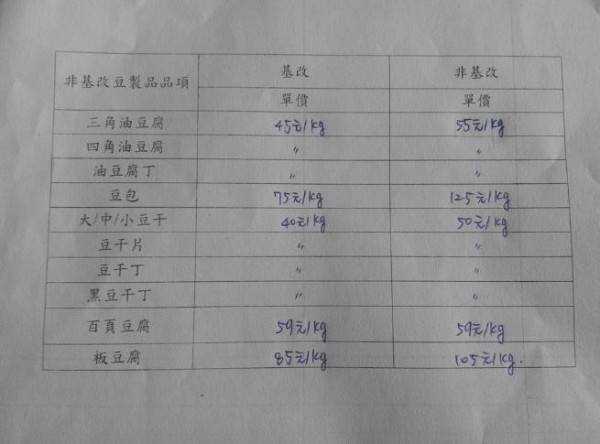

Campus Lunch Goes Non-GMO Action Team
E-mail: [email protected]
FB: www.facebook.com/nogmolunch