NTU's world-first fruit fly monitoring system wins praise from the BBC
Catching insects can also land you on the international stage! Fruit flies cause Taiwan more than 17 billion in losses every year. A team led by Professor Jiang Chao-kai of National Taiwan University developed the "Oriental Fruit Fly Ecological Monitoring and Early Warning System." Through infrared technology and network transmission, it can accurately predict fruit fly numbers within ten seconds. Last month, the BBC in the UK devoted a special article to introducing this world-first invention, and the United States, Europe and Kuwait have also come to inquire about it, adding yet another honor for Taiwan.
Infrared monitoring plus wireless transmission, warning issued in ten seconds
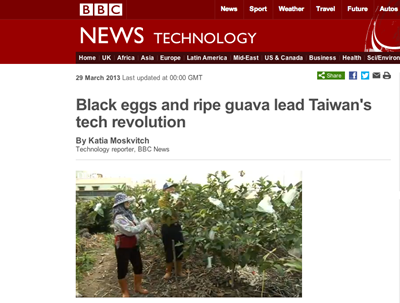
Bending over as he moves among the guava trees, farmer Jiang Zai-lang carefully inspects each guava wrapped in a transparent plastic bag and mesh foam. For the coming summer, he must strengthen his "fortifications" against fruit flies, and the yellow cylinder hanging beside the fruit trees is his secret weapon.
Opening the lid, the cylinder is filled with the corpses of dozens of fruit flies. This is the result of cooperation between Jiang Zai-lang and Professor Jiang Chao-kai of NTU's Department of Bio-Industrial Mechatronics Engineering.
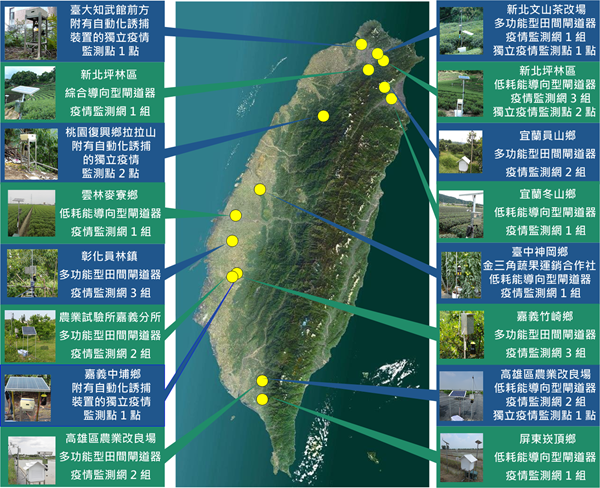
The NTU team began developing the "Oriental Fruit Fly Ecological Monitoring and Early Warning System" more than six years ago, combining wireless sensor networks (WSN), GSM wireless transmission technology and the internet. Methyl eugenol is placed in the trap to attract male fruit flies, and infrared is used to count the number of fruit flies that fly in. The data is recorded by a field gateway placed in a louvered box, and after analysis it is transmitted to a back-end platform. If more than ten fruit flies fly in every half hour, the system will also send a text message to the farmer's mobile phone at once, reminding the farmer to take action quickly. The system is also equipped with solar panels to generate its own power. The only thing farmers need to do is stick the device in the field and wait to receive text messages, simple and with no threshold. (See the image at the end of the article for the process.)
Team member Lin Zi-xiang said that in the past, government agencies sent people to the fields every ten days to count fruit fly numbers, and by the time the data was sent back for analysis and a warning was issued, it was often half a month later. If there was real harm, it would already be too late. The new early warning system can complete analysis and issue a warning in as little as ten seconds, "and what takes the most time is actually the speed at which the base station sends the text message." The system's fruit fly counting accuracy has already reached 90%, and its prediction and actual numbers can also reach 80%. Combined with information such as wind speed, wind direction and temperature from the Central Weather Bureau, it can predict fruit fly numbers for up to one week in the future, which is a great blessing for farmers.
This world-first invention even drew a BBC reporter from thousands of miles away in the UK to Taiwan to give it a like. On March 29, a lengthy report was published in the technology section, describing Taiwan's agriculture as a technological revolution. Jiang Zai-lang and his wife, who have grown guavas for 40 years, never dreamed that they would become international celebrities overnight. With simple, shy smiles, they kept saying it was all thanks to the NTU team. But when they mentioned the newspaper clippings sent by friends, proud smiles appeared on their faces again. Yet no matter how much the media praises them, what he cares about most is whether his beloved guavas can grow smoothly.
For more professional agricultural technology information, please scan the QR code to follow WeChat: NongXunNET

Please indicate the source when reprinting.