Taiwan Sugar Corporation sells land to survive, seen by the government as an ATM for industrial zones
From the Erlin Park of the Central Taiwan Science Park and the Xinyuan Farm in Kaohsiung to the Waipu Industrial Park that the Industrial Bureau plans to develop, the flat, vast Taiwan Sugar farmland, under economy-first thinking, has become an ATM for industrial zones. Hsu Shih-jung, a professor in the Department of Land Economics at National Chengchi University, criticizes that Taiwan Sugar received excellent farmland from the Japanese colonial period, yet it is "neither public nor private"; its largest shareholder is the Ministry of Economic Affairs, so when industry demands land, it naturally yields. He believes Taiwan Sugar land should be returned to state ownership, and that national land planning should be drawn up as soon as possible and idle industrial zones reviewed, so that there is a chance to save good farmland from being lost again and again.
Taiwan Sugar land sits in excellent agricultural zones, and industrial development may damage the landscape
Taiwan Sugar is the largest landowner in Taiwan. After Japan's defeat in World War II, Taiwan Sugar took over more than 110,000 hectares of land from the four major sugar companies. As public land was released to farmers and policy adjustments were made, the holdings were gradually reduced, but it still has more than 50,000 hectares today. Lin Yu-chun, a professor in the Department of Social Development at National Pingtung University of Education who studies Taiwan Sugar farmland, says the Japanese surveyed Taiwan's land in great detail, so Taiwan Sugar land is almost all excellent farmland. In recent years, plot after plot has been developed into industrial zones, which not only affects food security but also damages the rural landscape.
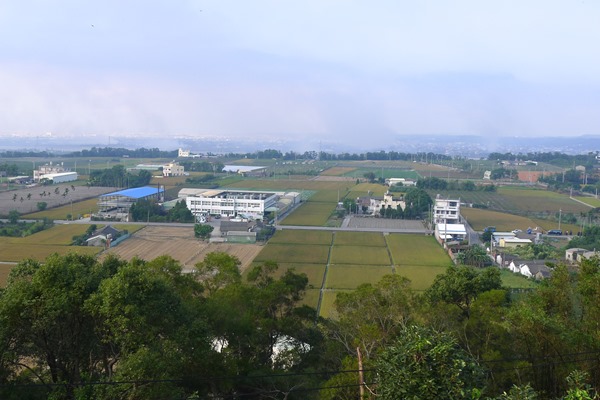
Take the industrial park the Industrial Bureau plans to develop on Taiwan Sugar land as an example. Although this Taiwan Sugar farmland is classified as general agricultural land, just a dozen minutes' drive downstream lies more than a thousand hectares of special agricultural zone. Because it is shielded by water quality and water source protection areas and slope conservation areas, there are still no high-rise buildings or factories here, making it the last pure land in Taichung. Although the industrial zone is only 100 hectares, its wastewater, waste gas, traffic routes and pollution from satellite factories could destroy in an instant the community-building efforts local people have made over many years.
Tsai Hui-hsun, a researcher at the Citizen of the Earth Foundation, believes the development of a large industrial zone will inevitably bring along neighboring satellite factories and affect the landscape quality of the entire area, so there should be comprehensive planning before development.
In its preliminary assessment for the Waipu Industrial Park, the Industrial Bureau stated: "Recently this Bureau has frequently received reports of insufficient industrial land supply due to Taiwanese businesses returning to invest or domestic manufacturers expanding plants. A survey of industrial land supply and demand in the northern, central and southern regions shows that the central region indeed has a shortage of industrial land supply. To solve the shortage of industrial land and meet manufacturers' needs for plant sites, a preliminary plan is to evaluate setting up an industrial park on Taiwan Sugar Company land in the Waipu area."
Yun Jui-lung, chief executive of the Central Region Industrial Zone Administration Office, admitted in an interview that it had not yet assessed the environment or manufacturers' willingness to move in, and was only first asking the landowner's opinion, "to see how much area can be developed." This kind of "testing the water" approach, lacking area-wide planning, is why locals describe the site selection this time as being "hit by a dart."
Further reading:
https://www.newsmarket.com.tw/blog/42427/