Council of Agriculture's Agriculture and Food Agency announces the latest spot-check results of commercially sold rice, 8 cases of violations are of major severity
The Agriculture and Food Agency of the Council of Agriculture, Executive Yuan, today released the results of random inspections of rice sold on the market in the third quarter of 2013 (ROC year 102). A total of 246 items were sampled. In the "packaging labeling" portion, 232 items passed and 14 failed (pass rate 94%). In the "quality specifications" portion, 223 items matched the grade stated on the label and 23 did not (pass rate 91%). Under Article 18 of the Food Administration Act, notices to rectify within a set deadline were issued, requiring the operators to make improvements. In this round of inspection, 8 products were found to have "relatively serious violations," and each was directly fined 40,000 yuan, with the list published as follows.
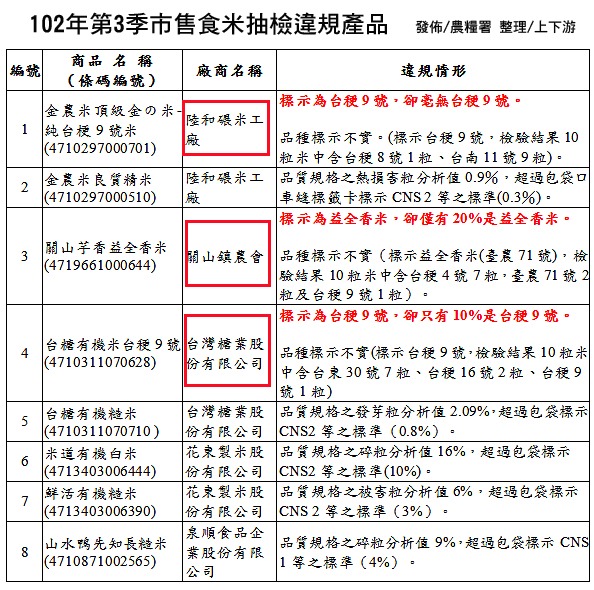
The Agriculture and Food Agency explained that under Article 14 of the Food Administration Act, packaged rice sold on the market shall clearly state the product name, quality specifications, place of origin, weight, milling date, shelf life, manufacturer name, telephone number and address, and the labeling, promotion or advertising on the bag shall not be false, exaggerated or likely to cause misunderstanding. Article 18 of the same Act provides that those who violate the regulations may be ordered to make improvements within a set deadline, and those who fail to improve by the deadline shall be fined not less than 30,000 yuan and not more than 200,000 yuan.
To strengthen the management of rice sold on the market, the Agriculture and Food Agency amended the "Directions for Discretionary Punishment in Cases Violating the Food Administration Act" on September 18, 2013 (ROC year 102). For those with relatively serious violations, the deadline for improvement is canceled and a direct fine is imposed instead, with the list published. In addition, products that fail inspection are all listed as tracking targets; if they still fail to improve after follow-up re-inspection, the penalties will be increased each time.